John Hylan, Mayor of New York

March 26, 1922
“The warning of Theodore Roosevelt has much timeliness today, for the real menace of our republic is this invisible government which like a giant octopus sprawls its slimy length over city, state and nation… It seizes in its long and powerful tentacles our executive officers, our legislative bodies, our schools, our courts, our newspapers, and every agency created for the public protection… To depart from mere generalizations, let me say that at the head of this octopus are the Rockefeller-Standard Oil interest and a small group of powerful banking houses generally referred to as the international bankers. The little coterie of powerful international bankers virtually run the United States Government for their own selfish purposes. They practically control both parties, write political platforms, make catspaws of party leaders, use the leading men of private organizations, and resort to every device to place in nomination for high public office only such candidates as will be amenable to the dictates of corrupt big business…These international bankers and Rockefeller-Standard Oil interests control the majority of newspapers and magazines in this country.”

Making COP21 Work

[google-translator]

December 15, 2015

President Obama and Secretary Kerry have made the case that developing nations account for 65% of carbon emissions, and that consequently even if industrialized countries were to stop using fossil fuels instantly, now, that would not bring global warming under control.

Statistically they are correct, but that’s not the whole story. For example, the reason that China is now the number one polluter is because the U.S. and Europe have essentially outsourced to it much of their pollution. Were they to repatriate the factories (and the well-paying middle class jobs) to their respective countries to pre-1970 levels, their pollution would likely far surpass China. Accordingly, the argument that each country must rely on its own resources to reduce emissions significantly does not recognize our complicity and responsibility, as consumers, to help those who make the products we use stop using fossil fuels.

The most effective way to reduce emissions to zero is to usher in the age of hydrogen, the only energy carrier that produces water as a byproduct. However, not all countries have the necessary natural attributes to produce a  surplus, and countries with larger populations, particularly India and China, need as much hydrogen as they can get from potential natural exporters, at least for the foreseeable future. Conversely, the U.S., Mexico, Central America, the Caribbean islands, South America, all the Mediterranean countries, New Zealand, Australia, Southeast Asia, Iceland and Hawaii, to name a few, are potential natural exporters of hydrogen as outlined in Plan A. It’s not a question of lack of technology or investment capital (there are trillions of dollars searching for worthwhile investment opportunities). The real problem is fear that the switch would kill the petrodollar, with all its consequences, and that mountains of wealth that would be redistributed. But it can be done in an orderly fashion. And there’s no choice.


Paris FCCC 2015 Final Agreement

December 12, 2015

The Paris conference is over, and member nations have unanimously adopted a resolution to keep global mean temperature within 1.5°C of that which existed before the industrial era and to help needy nations cope with the effects of global warming.

Pundits are already criticizing it due to its vague clauses and lack of legally binding mechanisms forcing nations to perform in a specific manner. The criticism is a serious analytical mistake. They should keep in mind that it is primarily a political framework among sovereign nations to cooperate against a deadly common enemy. As such, each nation must contend with internal political forces that may or may not seek to derail the agreement, with potentially catastrophic ramifications. Foremost among them is the United States, the world’s 2nd. biggest polluter, where some Republican candidates and members of Congress refuse to even accept that anthropogenic global warming is indeed real. In fact, the current Congress would likely not ratify a treaty, and it still may well become a political football in the upcoming elections. Under the circumstances, given the enormous American footprint in the world’s political stage, this agreement is pragmatic, defensible and achievable.

In economic terms, which will define each nation’s speed and methods to cope with its share of the burden, the treaty is actually an even bigger victory. As the only effective way to limit carbon emissions is to quit using fossil fuels, the treaty’s purposeful vagueness will encourage competition among the more enlightened to find a way to export renewable energy to the biggest consumers, China, the U.S. (and eventually) India. Enter hydrogen, the only energy carrier with a matchless ability to produce pure water as a byproduct. In addition to enormous energy needs, all three markets urgently need a new, permanent source of water. All it will take is any one nation to start producing as per Plan A; as the profits mount, and everyone else will want a piece of the pie.


Making Paris 2015 Successful

December 11, 2015

As at Copenhagen, the sticking point in Paris is money –who is going to pay how much so the entire world won’t look like Beijing during a red-alert smog storm. The real issue is not money per se but that the world’s powers are reluctant to simply walk away from oil and coal and the fabulous wealth and power they represent. If they truly are as committed as they say they are to do what it takes to save us humans from becoming extinct, all the U.S. and China have to do is switch to hydrogen as outlined in Plan A; at first for generating electricity and later for mobile applications. This is not complicated. Hydrogen is clean, renewable (and thus inexhaustible), and its precious byproduct, water, can transform the driest desert into a dense forest. No fuel can do that (hydrogen is an energy carrier, nature’s battery, not a fuel).

Everyone knows there is an intractable, stubborn Republican opposition to treaties or agreements that would threaten the wealth of their constituents, and that some among them are more than eager to ensure the President fails to achieve anything, particularly a legacy-defining project. But nothing prevents the government from partnering with other nations as a form of foreign aid, for example, to outsource the production of hydrogen. Competition is a basic, powerful element of free enterprise. Used correctly it should encourage others to do the same.


Source of the U.S. dollar

The U.S. has had a debt-based banking system since 1864. As a result, it is currently impossible to extinguish government debt without simultaneously extinguishing our money supply. The Federal Reserve, established in 1913, is a for-profit corporation owned by private member banks. It has no reserves to back up the Federal Reserve notes that constitute our common currency.

Here are thoughts about this subject of some of history’s most illustrious figures.

President Thomas Jefferson

“I sincerely believe that banking institutions are more dangerous than standing armies. The issuing power should be taken from the banks and restored to the people to whom it properly belongs.”

Emperor Napoleon Bonaparte
“The hand that gives is above the hand that takes. Money has no motherland; financiers are without patriotism and without decency: their sole object is gain.”

President James Madison
“History records that the money changers have used every form of abuse, intrigue, deceit, and violent means possible to maintain their control over governments by controlling money and its issuance.”

President Abraham Lincoln
“The Government should create, issue, and circulate all the currency and credit needed to satisfy the spending power of the Government and buying power of consumers. The privilege of creating and issuing money is not only the supreme prerogative of Government, but it is the Government’s greatest creative opportunity. By the adoption of these principles … the taxpayers will be saved immense sums of interest. Money will cease to be master and become the servant of humanity.”

Prince Otto von Bismarck, Minister President of Prussia, Chancellor of Germany
“The division of the United States into federations of equal force was decided long before the Civil War by the high financial powers of Europe. These bankers were afraid that the United States, if they remained as one block, and as one nation, would attain economic and financial independence, which would upset their financial domination over the world.

The death of Lincoln was a disaster for Christendom. There was no man in the United States great enough to wear his boots… I fear that foreign bankers with their craftiness and tortuous tricks will entirely control the exuberant riches of America, and use it systematically to corrupt modern civilization. They will not hesitate to plunge the whole of Christendom into wars and chaos in order that the earth should become their inheritance.”

President Andrew Jackson
“It is not our own citizens only who are to receive the bounty of our Government. More than eight millions of the stock of this bank are held by foreigners… Is there no danger to our liberty and independence in a bank that in its nature has so little to bind it to our country?… Controlling our currency, receiving our public moneys, and holding thousands of our citizens in dependence… would be more formidable and dangerous than a military power of the enemy. If government would confine itself to equal protection, and as Heaven does its rains, shower its favor alike on the high and the low, the rich and the poor, it would be an unqualified blessing. In the act before me there seems to be a wide and unnecessary departure from these just principles.”

President James Garfield
“Whosoever controls the volume of money in any country is absolute master of all industry and commerce… And when you realize that the entire system is very easily controlled, one way or another, by a few powerful men at the top, you will not have to be told how periods of inflation and depression originate.”

Thomas A. Edison
“If our nation can issue a dollar bond, it can issue a dollar bill. The element that makes the bond good, makes the bill good, also. The difference between the bond and the bill is the bond lets money brokers collect twice the amount of the bond and an additional 20%, where as the currency pays nobody but those who contribute directly in some useful way. It is absurd to say that our country can issue $30 million in bonds and not $30 million in currency. Both are promises to pay, but one promise fattens the usurers and the other helps the people.”

President William McKinley

Debt-free currency issued by the Government, not a private bank
“…There is another duty resting upon the national government – “to coin money and regulate the value thereof.” This duty requires that our government shall regulate the value of its money by the highest standards of commercial honesty and national honor. The money of the United States is and must forever be unquestioned and unassailable. If doubts remain, they must be removed. If weak places are discovered, they must be strengthened…”

President Theodore Roosevelt
“These international bankers and Rockefeller-Standard oil interests control the majority of newspapers and the columns of these papers to club into submission or drive out of public office officials who refuse to do the bidding of the powerful corrupt cliques which compose the invisible government.”

John Hylan, Mayor of New York,  March 26, 1922
“The warning of Theodore Roosevelt has much timeliness today, for the real menace of our republic is this invisible government which like a giant octopus sprawls its slimy length over city, state and nation… It seizes in its long and powerful tentacles our executive officers, our legislative bodies, our schools, our courts, our newspapers, and every agency created for the public protection… To depart from mere generalizations, let me say that at the head of this octopus are the Rockefeller-Standard Oil interest and a small group of powerful banking houses generally referred to as the international bankers. The little coterie of powerful international bankers virtually run the United States Government for their own selfish purposes. They practically control both parties, write political platforms, make catspaws of party leaders, use the leading men of private organizations, and resort to every device to place in nomination for high public office only such candidates as will be amenable to the dictates of corrupt big business…These international bankers and Rockefeller-Standard Oil interests control the majority of newspapers and magazines in this country.”

President Woodrow Wilson
“We have come to be one of the worst ruled, one of the most completely controlled governments in the civilized world –no longer a government by… a vote of the majority, but a government of the opinion and duress of a small group of dominant men. Some of the biggest men in the United States, in the field of commerce and manufacture, are afraid of something. They know that there is a power somewhere so organized, so subtle, so watchful, so interlocked, so complete, so pervasive, that they had better not speak above their breath when they speak in condemnation of it.”

President Dwight Eisenhower

…we yet realize that America’s leadership and prestige depend, not merely upon our unmatched material progress, riches and military strength, but on how we use our power in the interests of world peace and human betterment.

Throughout America’s adventure in free government, our basic purposes have been to keep the peace; to foster progress in human achievement, and to enhance liberty, dignity and integrity among people and among nations. To strive for less would be unworthy of a free and religious people. Any failure traceable to arrogance, or our lack of comprehension or readiness to sacrifice would inflict upon us grievous hurt both at home and abroad…

A vital element in keeping the peace is our military establishment. Our arms must be mighty, ready for instant action, so that no potential aggressor may be tempted to risk his own destruction.

Our military organization today bears little relation to that known by any of my predecessors in peacetime, or indeed by the fighting men of World War II or Korea.

Until the latest of our world conflicts, the United States had no armaments industry. American makers of plowshares could, with time and as required, make swords as well. But now we can no longer risk emergency improvisation of national defense; we have been compelled to create a permanent armaments industry of vast proportions. Added to this, three and a half million men and women are directly engaged in the defense establishment. We annually spend on military security more than the net income of all United States corporations.

This conjunction of an immense military establishment and a large arms industry is new in the American experience. The total influence — economic, political, even spiritual — is felt in every city, every State house, every office of the Federal government. We recognize the imperative need for this development. Yet we must not fail to comprehend its grave implications. Our toil, resources and livelihood are all involved; so is the very structure of our society.

In the councils of government, we must guard against the acquisition of unwarranted influence, whether sought or unsought, by the military-industrial complex. The potential for the disastrous rise of misplaced power exists and will persist.

We must never let the weight of this combination endanger our liberties or democratic processes. We should take nothing for granted. Only an alert and knowledgeable citizenry can compel the proper meshing of the huge industrial and military machinery of defense with our peaceful methods and goals, so that security and liberty may prosper together.

Akin to, and largely responsible for the sweeping changes in our industrial-military posture, has been the technological revolution during recent decades.

In this revolution, research has become central; it also becomes more formalized, complex, and costly. A steadily increasing share is conducted for, by, or at the direction of, the Federal government.

Today, the solitary inventor, tinkering in his shop, has been overshadowed by task forces of scientists in laboratories and testing fields. In the same fashion, the free university, historically the fountainhead of free ideas and scientific discovery, has experienced a revolution in the conduct of research. Partly because of the huge costs involved, a government contract becomes virtually a substitute for intellectual curiosity. For every old blackboard there are now hundreds of new electronic computers.

The prospect of domination of the nation’s scholars by Federal employment, project allocations, and the power of money is ever present and is gravely to be regarded.

Yet, in holding scientific research and discovery in respect, as we should, we must also be alert to the equal and opposite danger that public policy could itself become the captive of a scientific-technological elite.

It is the task of statesmanship to mold, to balance, and to integrate these and other forces, new and old, within the principles of our democratic system — ever aiming toward the supreme goals of our free society.

Another factor in maintaining balance involves the element of time. As we peer into society’s future, we — you and I, and our government — must avoid the impulse to live only for today, plundering, for our own ease and convenience, the precious resources of tomorrow. We cannot mortgage the material assets of our grandchildren without risking the loss also of their political and spiritual heritage. We want democracy to survive for all generations to come, not to become the insolvent phantom of tomorrow.

Down the long lane of the history yet to be written America knows that this world of ours, ever growing smaller, must avoid becoming a community of dreadful fear and hate, and be instead, a proud confederation of mutual trust and respect.

Such a confederation must be one of equals. The weakest must come to the conference table with the same confidence as do we, protected as we are by our moral, economic, and military strength. That table, though scarred by many past frustrations, cannot be abandoned for the certain agony of the battlefield.

Disarmament, with mutual honor and confidence, is a continuing imperative. Together we must learn how to compose differences, not with arms, but with intellect and decent purpose. Because this need is so sharp and apparent I confess that I lay down my official responsibilities in this field with a definite sense of disappointment. As one who has witnessed the horror and the lingering sadness of war — as one who knows that another war could utterly destroy this civilization which has been so slowly and painfully built over thousands of years — I wish I could say tonight that a lasting peace is in sight”…

President John F. Kennedy
“The very word ‘secrecy’ is repugnant in a free and open society; and we are as a people inherently and historically opposed to secret societies, to secret oaths and to secret proceedings. We decided long ago that the dangers of excessive and unwarranted concealment of pertinent facts far outweighed the dangers which are cited to justify it. Even today, there is little value in opposing the threat of a closed society by imitating its arbitrary restrictions. Even today, there is little value in insuring the survival of our nation if our traditions do not survive with it. And there is very grave danger that an announced need for increased security will be seized upon by those anxious to expand its meaning to the very limits of official censorship and concealment…”

The South China Sea & Climate Change

11/24/2015

Background
So what does the South China Sea have to do with climate change, the yawning gap in the distribution of wealth and income and the approaching water crisis? In a word, everything.

In “Asia’s Cauldron: The South China Sea And The End Of A Stable Pacific,” Robert D. Kaplan, chief geopolitical analyst for Stratfor and former member of the Pentagon’s Defense Policy Board, masterfully examined some of the reasons why the South China Sea is so crucial. But other powerful esoteric forces are at play –fear of economic collapse and loss of oil supplies being two of them- and they are steering the U.S. and China, the world’s two largest economies and the biggest emitters of greenhouse gasses, toward a terminal collision course.

The American Perspective
The United States emerged from World War II with nearly half the world’s GDP. With victorious Britain nearly bankrupt and Europe, Japan and the Soviet Union in ruins, American industry had no competition. But that situation changed. Overspending in the Korean and Vietnam wars, a defense budget larger than the next 10 nations combined, the space program, and growing domestic entitlements led to a massive devaluation of the dollar. The day of reckoning came in 1971 when President Richard Nixon cancelled the dollar’s direct convertibility to gold. However, in an effort to prop up the value of the dollar, Nixon negotiated a quasi-mercenary deal that in exchange for arms and protection Saudi Arabia would denominate all future oil sales in U.S. dollars. Subsequently the other OPEC countries agreed to similar deals thus ensuring a global demand for U.S. dollars and allowing the U.S. to export some of its inflation. Since these dollars did not circulate within the country and were therefore not part of the domestic money supply, economists felt another term was necessary to describe the dollars received by petroleum exporting countries (OPEC) in exchange for oil. Accordingly, Georgetown University economics professor Ibrahim Oweiss came up with the term “petrodollar,” and it stuck. The rest of the world soon followed, and today all currencies are “fiat.” The difference is that they’re all compelled to earn dollars to pay for the oil they buy. Only the United States Federal Reserve, a privately owned non-governmental entity, is authorized to create dollars at will. This enormous power creates an illusion of safety that investors worldwide have historically flocked to and (still) allows the government to perpetually borrow however much it wants at bargain rates. Its only “restraint” is the debt ceiling, set by Congress, which is routinely raised as needed to accommodate the perennial budget deficits.

Overspending, like gambling, is an addiction, and it has consequences that can be postponed but not avoided. Nixon’s shock happened at a time when America’s industrial base was still relatively intact. Over the last 45 years the manufacturing sector was essentially outsourced to nations with lower labor costs and the American middle class collapsed.

https://www.aei.org/wp-content/uploads/2015/10/mfg1.jpg

To illustrate, 50 years ago America’s largest private sector employer was General Motors. Its full-time employees made an average $50/hour in today’s dollars, including benefits. Now GM manufactures and sells far more cars in China than in the U.S. Today’s largest private sector employer is Walmart, with 1.3 million employees. Beginning in February 2016 its employees will earn roughly between $9.90 and $24.70 an hour, many without benefits. Think about it. Today’s highest-paid employees make half what the average employee made 50 years ago, and most of the outsourced manufacturing jobs were traditionally filled by men. This devastated non-rich American families, roughly 90% of the population.

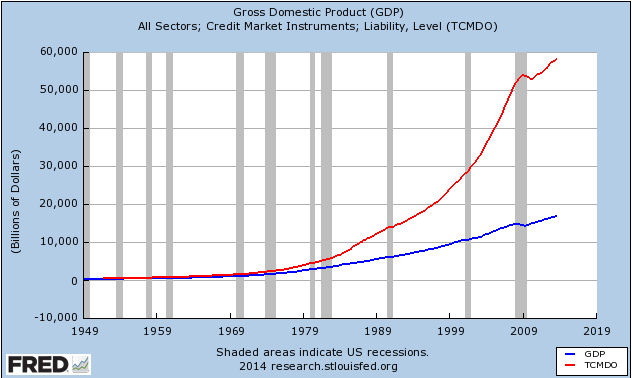
The collapse of employment in American manufacturing coincided with the rise of the financial sector.

http://3.bp.blogspot.com/-3CN47ACRfUg/Ut20ujWEX2I/AAAAAAAAOk0/1tCqS371Skk/s1600/debt+to+GDP.PNG

The new game in town became figuring out new ways make money from money -as fast as possible. The trouble of course was that only those with money could play it.

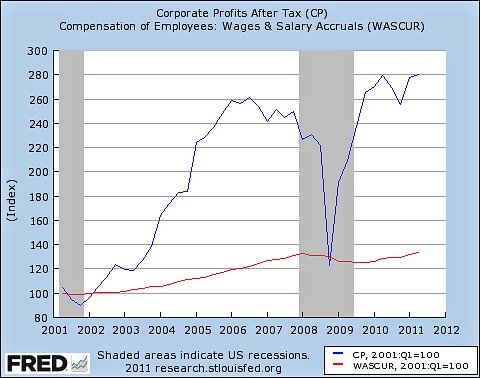
http://static1.1.sqspcdn.com/static/f/303385/14597088/1318432977713/chart-corporate-profits-employee-wages.jpg?token=DxJvRa3cnKupzF83yOMBpUX9x64%3D

As a result, median income remained flat or declined while corporate profits skyrocketed. This disparity allowed the latter to influence the electoral process, the government and even the courts to pass laws, adopt policies and legal decisions such as Citizen’s United that favored them at the expense of the mass of the population. Today a symbiotic relationship exists between the government and a tiny number of plutocrats who collectively account for roughly 50% of political contributions that has all but eviscerated what remained of our democracy. Their priority is to protect the all-important financial sector, controlled by a minuscule minority, by attempting to perpetuate the military status quo.

China
China’s spectacular growth over the last 30 years relied on its (then) low-cost labor pool to out-compete foreign manufacturers of consumer goods and entice them to build factories in China, not on attempting to control the world’s oil resources and financial system. This resulted in the world’s largest reserves of hard currency and a vast trade surplus with the United States. But its success, though on an exponentially larger scale than Japan and South Korea, cannot compensate for two strategic weaknesses.

Currently China is not self-sufficient in oil and, despite its peerless South-North Project, its water resources are insufficient to irrigate its arid western half, a necessity to provide living room for its dense eastern half and potentially at least double its economy. Like its industrialized Asian peers, this oil shortage currently compels it to rely on the good will of the U.S., which currently controls the oil routes between the Strait of Hormuz, the Strait of Malacca and on to Japan, and Russia. As a result, China is vulnerable to currently not imminent -but neither unforeseen- events that might conceivably result in either partial or complete disappearance of one or both of these vital oil sources. Given the magnitude of the risk, it is not difficult to understand why China insists on claiming almost all the South China Sea. If not there, then where, and if not now, when?

Ominous Fears
What we have then, is a clash of vital interests. The U.S. cannot afford to lose the only real collateral supporting the value of the dollar –its perceived ability to control and protect the western shore of the Persian Gulf and keep the oil lanes open. Similarly, China cannot afford to pass by a real opportunity to achieve oil independence. For both then, oil is the bedrock of their economies. Not only that, in the U.S. at least, most of the oil stocks are controlled or owned –directly or by proxy- by the same small percentage of the population that controls the financial sector.

The nature of the approaching collision between their vital needs is such that it is difficult to see how they might reconcile them. Indeed, President Obama’s “pivot” to the area and China’s effort’s in the military arena clearly indicate that neither is particularly optimistic about reaching a compromise. Accordingly, there is no evidence they support an all-out push to introduce a low-tech scheme to replace fossil fuels and nuclear fission with hydrogen to generate electricity, at least not in the near term. This despite the fact that hydrogen is the only energy carrier with zero emissions which is what’s truly needed to halt or even reduce them. Our fate is literally in their hands.

Financing Climate Change

October 30, 2015

Background
At the 2009 Copenhagen Climate Convention an impasse emerged. Nonetheless, wealthy nations finally committed to provide poor nations with $100 billion by 2020. So far, little or no cash has actually been disbursed, and as it now stands the world’s temperature is on track to increase by 4 degrees Celsius, not 2. Last week, at preparatory talks in Germany for the upcoming all-important Paris meeting in December 2015, it became painfully apparent that money threatens to collapse the Paris talks even before they begin. This time inaction is not an option.

Paying For Climate Change
The issue of who should pay how much for the cost of containing Climate Change and its consequences should be linked to the principle of proportional responsibility that all nations –producers and users- bear for not having factored into the price of manufactured goods the damage to the environment since the beginning of the Industrial Revolution. Accordingly, the cost of mitigating and adapting –insofar as is humanly possible- to the consequences of Climate Change should be viewed as a tax with penalties and interest levied by mother Earth on humans for disrespecting the environment, and even if we all pay our share the damage already done is so egregious our survival is not guaranteed. Furthermore, no one is blameless. Manufacturers profited financially, it’s true, but users greatly benefited from and enjoyed the many products and gadgets that improved productivity, created jobs, provided unprecedented comfort, safety and speed, and relieved billions from tedious, backbreaking labor. Thus, the tax should be allocated based on historic and current emissions. For example, there is no comparison between Malawi’s per capita carbon emissions, 18 Kg/year, and the United States, 17.5 metric tons/year.

The Political Landscape
It should be noted that the $100 billion agreed to in Copenhagen is public money, not private. That means all taxpayers within the contributing nations are being called upon, once again, to subsidize the shareholders and executives of the industries that profited the most from the Industrial Revolution. Even so, no one is presently floating the idea of levying a retroactive tax on accumulated capital to redress that slight. Public funds in today’s United States are almost always the product of bitter tugs of war between two parties that have not balanced a budget since 2001 and who routinely add to a perpetual debt –now exceeding $18 trillion- despite President Jefferson’s warning. As a result, unheralded items like Climate Change must compete with armies of lobbyists and well-funded political donors who believe themselves immune to its ravages. That explains why, despite its undisputed lethality, Congress has not seen fit to appropriate however much is realistically necessary to combat it.

Plans
That Climate Change is a clear and present danger, not just to the Unite States but to the entire planet, is not in dispute. What is not known is how severe the consequences are going to be, partly because a lot still depends on what we do, or perhaps more accurately, on what we fail to do. In 2013 and 2015 President Obama announced concrete actions to combat Climate Change. In March this year, Secretary Kerry stated, among other things, that the solution to the problem is “energy policy.” Regrettably, that will not resolve the chronic shortage of surface water in the Great Plains, the Colorado River basin and California and the apparently irreversible depletion of our largest aquifers. Unless this budding calamity is promptly addressed, inevitably it is going to lead to a massive decline in food production, forced mass migration from the southwest to the east, and a host of demographic, social and economic consequences. Barring unforeseen events such as a permanent El Niño that might transform southern California, Nevada and Arizona into a tropical rain forest, Climate Change is going to aggravate these water shortages, and no one anywhere has announced specific plans to address that. Therefore, if we really are serious about these issues, we’ll have to make some profound, unprecedented changes commensurate in scope and magnitude with the problem at hand. Firstly we’ll need adopt and implement a specific, feasible plan to replace fossil fuels and nuclear fission with hydrogen, even if it hastens the end of the petrodollar –which is in any event inevitable- regardless of the consequences. Secondly, we’ll have to muster the political willpower –which implies broad financial support- to fund that transition. Thirdly, we’ll need to create a new economic order based on the estimated $17 trillion budding renewable energy market, not oil, to combat the gaping abyss in the distribution of wealth and income that President Obama so eloquently described.

Financing Climate Change
Proportional responsibility requires a formula that calculates historical and current emissions by each country. The biggest polluters would be responsible for their portion of the accumulated CO2 but they would be relieved of the obligation to assist poor low polluters. Instead, private capital would be recruited and encouraged to invest there to help them transition to solar to produce and export hydrogen from electrolysis of seawater. That way wealthy countries with weak or intermittent direct sunlight or inadequate shorelines would have a stake in the $17 trillion renewable energy market, and low emitters would have a new infrastructure to help lift them out of poverty.

President Obama on Inequality

October 23, 2015

Excerpt of President Obama’s full remarks on mobility and inequality on December 4, 2013.

…I believe this is the defining challenge of our time: Making sure our economy works for every working American. It’s why I ran for President. It was at the center of last year’s campaign. It drives everything I do in this office.

The top 10 percent no longer takes in one-third of our income — it now takes half. Whereas in the past, the average CEO made about 20 to 30 times the income of the average worker, today’s CEO now makes 273 times more. And meanwhile, a family in the top 1 percent has a net worth 288 times higher than the typical family, which is a record for this country.

But this increasing inequality is most pronounced in our country, and it challenges the very essence of who we are as a people. Understand we’ve never begrudged success in America. We aspire to it.

The problem is that alongside increased inequality, we’ve seen diminished levels of upward mobility in recent years. A child born in the top 20 percent has about a 2-in-3 chance of staying at or near the top. A child born into the bottom 20 percent has a less than 1-in-20 shot at making it to the top. He’s 10 times likelier to stay where he is. In fact, statistics show not only that our levels of income inequality rank near countries like Jamaica and Argentina, but that it is harder today for a child born here in America to improve her station in life than it is for children in most of our wealthy allies — countries like Canada or Germany or France. They have greater mobility than we do, not less.

The idea that so many children are born into poverty in the wealthiest nation on Earth is heartbreaking enough. But the idea that a child may never be able to escape that poverty because she lacks a decent education or health care, or a community that views her future as their own, that should offend all of us and it should compel us to action. We are a better country than this.

So let me repeat: The combined trends of increased inequality and decreasing mobility pose a fundamental threat to the American Dream, our way of life, and what we stand for around the globe. And it is not simply a moral claim that I’m making here. There are practical consequences to rising inequality and reduced mobility.

For one thing, these trends are bad for our economy. One study finds that growth is more fragile and recessions are more frequent in countries with greater inequality. And that makes sense. When families have less to spend, that means businesses have fewer customers, and households rack up greater mortgage and credit card debt; meanwhile, concentrated wealth at the top is less likely to result in the kind of broadly based consumer spending that drives our economy, and together with lax regulation, may contribute to risky speculative bubbles.

And rising inequality and declining mobility are also bad for our families and social cohesion — not just because we tend to trust our institutions less, but studies show we actually tend to trust each other less when there’s greater inequality. And greater inequality is associated with less mobility between generations. That means it’s not just temporary; the effects last. It creates a vicious cycle. For example, by the time she turns three years old, a child born into a low-income home hears 30 million fewer words than a child from a well-off family, which means by the time she starts school she’s already behind, and that deficit can compound itself over time.

And finally, rising inequality and declining mobility are bad for our democracy. Ordinary folks can’t write massive campaign checks or hire high-priced lobbyists and lawyers to secure policies that tilt the playing field in their favor at everyone else’s expense. And so people get the bad taste that the system is rigged, and that increases cynicism and polarization, and it decreases the political participation that is a requisite part of our system of self-government.

So this is an issue that we have to tackle head on.


Last Chance in Paris

An Impending Crisis

A tsunami of methane –a greenhouse gas 27 times more potent than carbon dioxide (CO2)- of El Niño proportions may soon be released into the atmosphere, and no one can prevent that. If and when it happens, the concentration of greenhouse gases will exceed current projections by several orders of magnitude. Fortunately there’s hope. Once airborne, the methane will slowly combine with oxygen and transform into CO2. In other words, the initial spike in potency will be relatively temporary; however the concentration of CO2 will climb nonetheless, and so will the world’s temperature. As things now stand, by some estimates 25 to 50% of all species of flora and fauna on our planet are going to become extinct. That is certain to create a crisis for organisms at the top of the food chain, including us.

Tactical or tangential actions like carbon trading and caps on emissions from power plants –both fertile ground for corruption and fraud- are not going to stop, let alone reverse, Climate Change. The simple reality is that unless humanity stops using fossil fuels, higher demand due to growing population and affluence will inevitably send emissions soaring again. Already the damage done is out of control. Any effective antidote is going to require no less than uncommon political will, heroic courage, and an almost obsessive desire to cooperate among a tiny group of nations that can save –or destroy- the world. So far they have not initiated a public conversation, much less come up with a specific plan, to address core issues such as:

• How to reduce the acid in the ocean;
• Recycle current and future excess carbon dioxide in the atmosphere;
• Address the chronic global shortage of fresh water and the rapid depletion of the world’s aquifers;
• Commit to specific quotas to accept the millions of refugees that will have to be evacuated from sinking nations due to rising seas.

Plan A is a scheme designed to use solar energy, seawater and gravity to produce hydrogen, pure water and a net surplus of electricity, and may well be the answer to the core issues outlined above. It envisions using existing technology and solar energy exclusively to produce hydrogen by electrolysis of seawater. The hydrogen is then compressed and piped to power plants built anywhere atop suitable mountains. There it is burned in special but already existing turbines to generate electricity; its byproduct –steam- is collected, condensed and piped by gravity at optimal pressure to a series of staggered hydroelectric turbines below the hydrogen plants; naturally, the higher the mountains, the more turbines that could be installed. The same water is used consecutively by all the turbines, therefore the electricity they generate in the aggregate, including the original hydrogen plant at the top, exceeds that which was consumed earlier in the production of the hydrogen. When the water reaches the bottom of the mountain it is collected and used as desired.

The plan compares favorably with desalination –a voracious consumer of energy that requires close proximity to a shore- and with fossil and nuclear-fired power plants, which do not yield commercially useful amounts of water. The hydrogen plants could be built anywhere, even in remote inland deserts, and the drought-proof pure water they would produce would be completely independent of the natural water cycle.

Carbon emissions are rapidly changing the chemical composition of the atmosphere and making the ocean increasingly acidic. This threatens the entire food chain in both habitats, including species we depend on for our food. The plan helps in two ways: it ends all emissions from the generation of electricity and simultaneously creates a new source of pure fresh water that could be used to make the deserts green. The new vegetation would help convert the CO2 into oxygen and sequester the carbon into the soil, the inverse of the process now causing Climate Change. The deserts would of course become darker and reflect less solar heat into space, however that would be offset by the lack of new emissions and the additional oxygen. That would benefit both the atmosphere and the ocean.

The new source of drought-proof water derived from Plan A could also be the answer to the worldwide shortage of water in cities on the west coast of South America that rely on rapidly disappearing tropical glaciers. This issue may not command the same sense of urgency in well-watered capitals such as Washington, Moscow, Paris, London, Rome or Berlin as it no doubt does in Beijing, but the former will also be severely impacted by the impending consequences –wars, famine, refugees- if the issue is not fully addressed on a planetary scale. Unfortunately, currently there are no other publicly disclosed plans or even suggestions to do so.

Rising Seas
Plan A envisions flooding natural below-sea-level depressions with seawater. In the United States it would require a canal from the Pacific to Death Valley; the system would be expanded to include many other dry lake beds in the vicinity covering many thousands of square kilometers. The same could possibly be done in Argentina, the Sahara Desert, the Dead Sea and other similar locations throughout the world which may or may not be enough to prevent densely populated areas like Bangladesh, Miami, New Orleans, New York and island nations in the Pacific, from ending up underwater.

Creating A Market

If there’s a buyer, there’s a seller. China has powerful reasons –insufficient water and energy resources to develop its arid western half- and the economic power to create a market for hydrogen, and it can do so virtually overnight. All it has to do is announce that at as of a specific date it will gradually commence buying it to fuel its power plants, and the world will respond.

Finally, if there are any better ideas, certainly now is the time to share them!


Secretary Kerry on the Road to Paris Dec. 2015

[google-translator]

Remarks at the Atlantic Council
John Kerry
Secretary of State
Washington, DC
March 12, 2015

SECRETARY KERRY: Well, good morning, everybody. Fred, thank you very, very much for a very generous introduction. I’m delighted to be here with everybody. Distinguished ambassadors who are here this morning, thank you for taking time to represent your countries and come here and share your concern about this critical issue.

And I’m delighted to be accompanied by our envoy on climate, who’s been toiling away in the fields for a long time now in helping to shape President Obama’s and the State Department’s policy on this, Todd Stern. Todd, thanks for your many efforts on it.

Fred, thank you for leadership here at the Atlantic Council. I think Fred has demonstrated that he seems to always have the ability to have his finger on the most critical issues of the day, not just today actually, but of tomorrow. And as a result, we can always count on the Atlantic Council to be ahead of the curve and to be challenging all of us to think. So we appreciate very much what you do. And thank you, all of you, who are on the board and/or a part of and committed to the efforts of the council.

I have to add you also have an impeccable eye for talent. I was not surprised to hear that you had the good sense to hire Ambassador Richard Morningstar. He’s one of the most experienced global energy experts and a good friend of mine and Massachusetts – a son of Massachusetts. And now that he’s the director of the new Global Energy Center, you couldn’t be in better hands. And secondly, my former legislative assistant on energy and climate and then went to the White House, Heather Zichal, is part of this great family of effort on climate. So I think we’re kind of a family here this morning, in fact.

It’s clear that from Venezuela to Iraq to Ukraine, there is no shortage of energy challenges in the world today. And we’ve had many conversations recently. I was in Brussels. We had an U.S.-EU energy summit, where we laid out an agenda for how we can liberate some of these countries from their one-country dependency in the case of Russia and others. It has huge strategic importance. But I have to tell you, at the top of the list of energy challenges is climate change. And that is why the Road to Paris series, the very first hosted by the center, is so very important, and I am really delighted to be here and be a part of it.

As Fred mentioned, climate change is an issue that is personal to me, and it has been since the 1980s, when we were organizing the very first climate hearings in the Senate. In fact, it really predates that, going back to Earth Day when I’d come back from Vietnam. It was the first political thing I began to organize in Massachusetts, when citizens started to make a solid statement in this country. And I might add that’s before we even had an Environmental Protection Agency or a Clean Water Act or Safe Drinking Water Act or a Marine Mammal Protection Act or a Coastal Zone Management Act. It all came out of that kind of citizen movement. And that’s what we have to be involved in now. And the reason for that is simple: For decades now, the science has been screaming at us, warning us, trying to compel us to act.

And I just want to underscore that for a moment. It may seem obvious to you, but it isn’t to some. Science is and has long been crystal clear when it comes to climate change. Al Gore, Tim Worth, and a group of us organized the first hearings in the Senate on this, 1988. We heard Jim Hansen stand in – sit in front of us and tell us it’s happening now, 1988. So we’re not talking about news reports or blog posts or even speeches that some cabinet secretary might give at a think tank. We’re talking about a fact-based, evidence-supported, peer-reviewed science. And yet, if you listen to some people in Washington or elsewhere, you’d think there’s a question about whether climate change really is a problem or whether we really need to respond to it.

So stop for a minute and just think about the basics. When an apple falls from a tree, it will drop toward the ground. We know that because of the basic laws of physics. Science tells us that gravity exists, and no one disputes that. Science also tells us that when the water temperature drops below 32 degrees Fahrenheit, it turns to ice. No one disputes that.

So when science tells us that our climate is changing and humans beings are largely causing that change, by what right do people stand up and just say, “Well, I dispute that” or “I deny that elementary truth?” And yet, there are those who do so. Literally a couple of days ago, I read about some state officials who are actually trying to ban the use of the term “climate change” in public documents because they’re not willing to face the facts.

Now folks, we literally do not have the time to waste debating whether we can say “climate change.” We have to talk about how we solve climate change. Because no matter how much people want to bury their heads in the sand, it will not alter the fact that 97 percent of peer-reviewed climate studies confirm that climate change is happening and that human activity is largely responsible. I have been involved in public policy debates now for 40-plus years, whatever, since the 1960s. It is rare, rare, rare – I can tell you after 28 years-plus in the Senate – to get a super majority of studies to agree on anything. But 97 percent, over 20-plus years – that’s a dramatic statement of fact that no one of good conscience has a right to ignore.

But what’s really troubling is that those same scientists are telling us what’s going to happen, not just the fact of it being there, but they’re telling us what’s coming at us. These scientists also agree that if we continue to march like robots down the path that we’re on, the world as we know it will be transformed dramatically for the worse. And we can expect that sea levels will continue rising to dangerous levels. We will see nations moved as a consequence in the Pacific and elsewhere – Bangladesh, countries that are low.

We will see large swaths of cities and even some countries under water. We can expect more intense and frequent extreme weather events like hurricanes and typhoons. We can expect disruptions to the global agricultural sector that will threaten job security for millions of farmers and undermine food security for millions of families. We can expect prolonged droughts and resource shortages, which have the potential to fan the flames of conflict in areas that are already troubled by longstanding political, economic, religious, ideological, sectarian disputes. Imagine when they’re complicated by the absence of water and food.

These are the consequences of climate change, and this is the magnitude of what we are up against. And measured against the array of global threats we face today – and there are many. Terrorism, extremism, epidemics, poverty, nuclear proliferation, all challenges that respect no borders – climate change belongs on that very same list. It is, indeed, one of the biggest threats facing our planet today. And even top military personnel have designated it as a security threat to not just the United States but the world. And no one who has truly considered the science, no one who has truly listened objectively to our national security experts, could reach a different conclusion.

So yes, this is personal to me. But you know what? The bottom line is it ought to be personal to everybody, every man, woman, child, businessperson, student, grandparent, wherever we live, whatever our calling, whatever our personal background might be. This issue affects everyone on the planet. And if any challenge requires global cooperation and urgent action, this is it.

Make no mistake, this is a critical year. And that is why this Road to Paris series is so important. The science tells us we still have a window of time to prevent the worst impacts of climate change, but that window is closing quickly. We’re already in a mode where we’re looking at mitigation, not just prevention. In December, the world will come together at the UN Climate Conference in Paris, and we will see whether or not we can muster the collective political will to reach an ambitious, comprehensive agreement.

Now even those of us who are most involved in the negotiations – and Todd and I have talked to this, and talked about it with the President – we all understand. We know that even the agreement we’re trying to reach in Paris will not completely and totally be able to eliminate the threat. It’s not going to. But it is an absolutely vital first step, and it would be a breakthrough demonstration that countries across the globe now recognize the problem and the need for each and every one of us to contribute to a solution. And it will set the market moving; it will change attitudes; it will change governments. And then progressively, no one can quite measure what the exponential productivity of all of that effort will produce. So we have nine short months to come together around the kind of agreement that will put us on the right path.

Now rest assured – not a threat, but a statement of fact – if we fail, future generations will not and should not forgive those who ignore this moment, no matter their reasoning. Future generations will judge our effort not just as a policy failure but as a collective moral failure of historic consequence. And they will want to know how world leaders could possibly have been so blind or so ignorant or so ideological or so dysfunctional and, frankly, so stubborn that we failed to act on knowledge that was confirmed by so many scientists, in so many studies, over such a long period of time, and documented by so much evidence.

The truth is we will have no excuse. You don’t need to be a scientist to see that the world is already changing and feeling the impacts of global climate change and significantly. Many of the things I mentioned a moment ago are already beginning to unfold before our eyes. Just look around you. Fourteen of the fifteen warmest years on record in all of history have occurred since 2000, in all of recorded history. Last year was the warmest of all. And I think if you stop and think about it, it seems that almost every next year becomes one of the hottest on record.

And with added heat comes an altered environment. It’s not particularly complicated. I don’t mean to sound haughty, but think about it for a minute. Life on Earth would not exist without a greenhouse effect. That is what has kept the average temperature up, until recently, at 57 degrees Fahrenheit, because there is this greenhouse effect. And it was called the greenhouse effect because it does exactly what a greenhouse does. When the sun pours in and bounces off at a different angle, it goes back up at a different angle. That can’t escape, and that warms things – a very simple proposition.

Now it’s difficult to tell whether one specific storm or one specific drought is solely caused by climate change, or a specific moment, but the growing number of extreme events scientists tell us is a clear signal to all of us. Recently Southeastern Brazil has been experiencing a crippling drought, the worst the region has seen in 80 years. The situation is so dire that families in Sao Paulo have been drilling through their basement floors in search of groundwater.

And the historic droughts in some parts of the world are matched only by historic floods in others. Malawi is currently in the midst of a disaster in which more than 150 people have died. Tens of thousands of people have been stranded by the rushing waters, cut off from food, clean water, healthcare, and thousands more have been forced from their homes.

This is happening now. It’s not a future event. And you can find countries, places – in fact, California, where they’ve had 100-year, 500-year droughts and massive fires and so forth as a consequence of the changes. Ask any scientist who studies the movement of species, and they’ll tell you how species are moving steadily north, fish moving. Everything is changing. It’s happening before our eyes, and that’s the first reason there is no excuse for ignoring this problem.

The second reason is that, unlike some of challenges that we face – I can readily attest to this – this one has a ready-made solution. The solution is not a mystery. It’s staring us in the face. It’s called energy policy. Energy policy. That’s the solution to climate change. And with the right choices, at the right speed, you can actually prevent the worst effects of climate change from crippling us forever. If we make the switch to a global, clean-energy economy a priority, if we think more creatively about how we power our cars, heat our homes, operate our businesses, then we still have time to prevent the worst consequences of climate change. It really is as simple as that. But getting there is proving not to be as simple.

So what, more specifically, do we need to do? I’m not going to come here and just describe the problem. What do we need to do?

To begin with, we need leaders with the political courage to make the tough, but necessary, policy choices that will help us all find the right path. And I am pleased to say and proud to serve with a President who has accepted that challenge, who has taken this head on. Today, thanks to President Obama’s Climate Action Plan, the United States is well on its way to meeting our international commitments to seriously cut greenhouse gas emissions by 2020. And that’s because we’re going straight to the largest sources of pollution. We’re targeting emissions from transportation and power sources, which account for about 60 percent of the dangerous greenhouse gases that we release. And we’re also tackling smaller opportunities in every sector of the economy in order to be able to address every greenhouse gas.

The President has put in place standards to double the fuel efficiency of cars and trucks on American roads. We’ve also proposed regulations that will curb carbon pollution from new and existing power plants.

But it’s not enough just to address the pollution generated by dirty sources of energy; we also have to invest in cleaner alternatives. Since President Obama took office, the United States has upped its wind energy production more than threefold and increased our solar energy generation more than tenfold. We’ve also become smarter about the way we use energy in our homes and businesses.

And this is by far the most ambitious set of climate actions that the United States of America has ever undertaken. And it’s a large part of why today we’re emitting less than we have in two decades. It’s also the reason that we were able to recently announce the goal of reducing emissions by 26 to 28 percent, from 2005 levels, and accomplish that by year 2025. And that will put us squarely on the road to a more sustainable and prosperous economy. Now, this upper end target would also enable us to be able to cut our emissions by 83 percent by mid-century, which is what scientists say we need to do in order to prevent warming from exceeding the threshold level of 2 degrees centigrade, Celsius.

But I can’t emphasize this enough, no single country, not even the United States, can solve this problem or foot this bill alone. And that isn’t just rhetoric. It’s physically impossible. Think of it this way: Even if every single American bikes to work or carpooled to school, or used only solar panels to power their homes; if we each planted a dozen trees, every American; if we somehow eliminated all of our domestic greenhouse gas emissions – guess what? That still wouldn’t be enough to offset the carbon pollution coming from the rest of the world. The same would be true if China went to zero emissions but others continued with business as usual. It’s not enough for one country or even a few countries to reduce emissions if their neighbors are unwilling to do their share. So when I say we need a global solution, I mean it. Anything less won’t work.

Now of course, industrialized countries, obviously, play a major role in bringing about a clean-energy future. And the days of the Industrial Revolution all the way through the last century – obviously the industrial countries benefited by developing and growing, but they also created the basic template for this problem. But even if all the industrial countries stopped today, it doesn’t solve the problem. And it certainly is a signal that other countries shouldn’t go off and repeat the mistakes of the past. We have to remember that, today, almost two-thirds of global emissions come from developing nations. So it is imperative that developing nations be part of the solution also.

Now I want to make this very, very clear. In economic terms, this is not a choice between bad and worse. Some people like to demagogue this issue. They want to tell you, “Oh, we can’t afford to do this.” Nothing could be further from the truth. We can’t afford not to do it. And in fact, the economics will show you that it is better in the long run to do it and cheaper in the long run. So this is not a choice between bad and worse, not at all. Ultimately, this is a choice between growing or shrinking an economy. Pursuing cleaner, more efficient energy is actually the only way that nations around the world can build the kind of economies that are going to thrive for decades to come.

And here’s why. Coal and oil are only cheap ways to power a nation in the very near term. But if you look a little further down you road, you begin to see an entirely different story. When you think about the real numbers over time, the costs of those outdated energy sources actually pile up very quickly.

Start with the economic impacts related to agriculture and food security and how scientists estimate that the changing climate is going to cause yields of crops like rice and maize and wheat to fall by 2 percent every decade. Consider what that means for millions of farmers around the world and the inflationary impact that will have on food prices. Now factor in how that would also exacerbate global challenges like hunger and malnutrition that we already face. Add to that the other long-term health-related problems caused by dirty air – asthma is an example, which predominantly affects children and already costs Americans an estimated $50 billion annually. The greatest single cause of young American children being hospitalized in the course of a summer in the United States is environmentally-induced asthma, and that costs billions.

The reality is that carbon-based air pollution contributes to the deaths of at least 4.5 million people every year. No part of that is inexpensive. And any nation that argues that it simply can’t afford to invest in the alternative and renewable energy needs to take a second look at what they’re paying for, consider the sizable costs that are associated with rebuilding in the wake of devastating weather events. In 2012 alone, extreme weather cost the United States nearly $120 billion in damages. When Typhoon Haiyan hit the Philippines a little over a year ago, the cost of responding exceeded $10 billion. And that’s just the bill for the storm damage. Think of the added health care costs, the expenses that result from agricultural and environmental degradation. It is time, my friends, for people to do real cost accounting.

The bottom line is that we can’t only factor in the price of immediate energy needs. We have to include the long-term cost of carbon pollution. We have to factor in the cost of survival. And if we do, we will find that pursuing clean energy now is far more affordable than paying for the consequences of climate change later.

But there’s another piece of reality to take into account. And as you can see, these arguments begin to compound and grow, become irrefutable, frankly. Clean energy is not only the solution to climate change – guess what? It’s also one of the greatest economic opportunities of all time. Want to put people to work? This is the way you put people to work. The global energy market of the future is poised to be the largest market the world has ever known. We’re talking about a $6 trillion market today, with four to five billion users today. That will grow to nine billion users over the next few decades. By comparison, the great driver of wealth creation in this country in the 1990s, when super-billionaires and millionaires were created and every income level of America went up, that was a technology market. And it was a $1 trillion market with only a billion users – just to get a sense of the possibilities here.

Between now and 2035, investment in the energy sector is expected to reach nearly $17 trillion. That’s more than the entire GDP of China and you just have to imagine the opportunities for clean energy. Imagine the businesses that could be launched, the jobs that will be created in every corner of the globe. And by the way, the United States of America, in the year 2015, doesn’t even have a national grid. We have a great big gaping hole in the middle of our country. You can’t sell energy from the wind farm in Massachusetts or in Minnesota to another part of the country, because we can’t transmit it. Think of the jobs in creating that grid. Actually, you don’t have to imagine it. All you have to do is look at the results that we are already seeing in places like my home state of Massachusetts.

In 2007, we set a couple of goals. We pledged to build 2,000 megawatts of wind power capacity by 2020, and more than 250 megawatts of solar power by 2017. It was pretty ambitious. It was unprecedented. But we knew that the potential benefits to the state were enormous.

Fast forward to today, and Massachusetts has increased renewable energy by 400 percent in the last four years alone. We used a bulk purchasing program for residential solar to help keep prices low for residents and businesses across the state. And because of that, today there are residential solar installations in 350 of Massachusetts’s 351 cities and towns. Today, the commonwealth’s clean energy economy is a $10 billion industry that has grown by 10.5 percent over the past year and 47 percent since 2010. It employs nearly 100,000 people at 6,000 firms, and it’s the perfect example of how quickly this transformation could happen and how far its benefits reach.

If we put our minds to it, folks, if we make the right decisions and forge the right partnerships, we can bring these kinds of benefits to communities across the United States and around the globe. To get there, all nations have to be smarter about how we use energy, invest in energy, and encourage businesses to make smart energy choices as well.

Now, we’ll have to invest in new technology, and that will help us bring renewable energy sources like solar, wind, and hydro not only to the communities where those resources are abundant, but to every community in every country on every continent. We’ll have to stop government money from going towards nonrenewable energy sources, like coal and oil. It makes no sense to be subsidizing that. Which is why the United States has been helping to drive efforts in the G-20 and APEC to phase out wasteful fossil fuel subsidies.

And we’ve actually taken steps to prevent now global financial institutions from funding dirty power plants and putting public money into those things that we know are going to go in the wrong direction. We’ll have to strengthen legal and regulatory frameworks in countries overseas to help spur investment in places where it’s insufficient. It’s much easier for businesses to deploy capital when they have confidence in the local legal and regulatory policy. And to attract money, we need to control risk. The more you can minimize the risk, the greater confidence people, investors will have to bring their capital to the table.

We also have to continue to push for the world’s highest standards in the environmental chapters of the trade agreements that we’re pursuing, just like we are doing in the Transatlantic Trade and Investment Partnership and the Trans-Pacific Partnership. And just like labor standards in other agreements, these environmental agreements have to be really fully enforceable.

Finally, we have to find more ways for the private and the public sector to work together to make the most of the innovative technology that entrepreneurs are developing here in the United States and around the world. And this is the idea that is behind the White House announcement that they made last month, the Clean Energy Investment Initiative. Its starting goal is to attract $2 billion in private sector investment to be put toward clean energy climate change solutions.

Now, the good news is much of the technology that we need is already out there. And it’s becoming faster and faster, easier to access and cheaper to access. A report that the Department of Energy released this morning actually projects that in the United States, wind power is going to be directly competitive with conventional energy technologies within the next 10 years. None of this, therefore, none of what I have said, is beyond our capacity. It’s not a pipe dream; it’s a reality. It’s right there. And it’s up to us to grab it. The question is whether or not it is beyond our collective resolve.

Now, we have seen some encouraging progress, frankly, over the past few months. During President Obama’s trip to New Delhi early this year, and Fred referred to it in his introduction, India – well, both China and India – the President – affirmed its far-reaching solar energy target, and our two nations agreed on a number of climate and clean energy initiatives. We also committed to working closely together to achieve a successful global agreement in Paris. So India is joined in that challenge.

And that came on the heels of the historic announcement in China that the United States and China, the world’s two largest emitters of carbon pollution – two countries, by the way, long regarded as the leaders of opposing camps in the climate negotiations – have now found common ground on this issue. And I joined President Obama as he stood next to President Xi, and Todd was there when we unveiled our respective ambitious post-2020 mitigation commitments. That is an enormous achievement.

And it had an impact. It was felt in Lima at the COP meeting in Lima recently, and had an impact on the ability to move towards Paris with greater momentum. Around the same time, the EU announced its target as well, which means we now have strong commitments from the three largest emitters in the world.

Now we need more and more nations to follow suit and announce their ambitious mitigation targets as well. And because this has to be a truly all-hands-on-deck effort, I invite all of our partners – businesses and industry groups, mayors, governors throughout the country and around the world to announce their own targets, their commitments leading up to Paris, so we can set an example and create a grassroots movement towards success. This will help us come forward with plans that will help every country be able to reach their goals.

Now I am keenly aware that we can do a better job of engaging the private sector and our partners at the sub-national level of government in this effort. And I can tell you today that I plan to make certain in the next months that that happens. I know many of you have already made impressive announcements, those of you engaged in business or on the boards of an enterprise or eleemosynary or educational institutions. And you’ve helped to lay out how we can combat climate change, and I thank you for doing that. But now it’s time to build on those pledges. Let us know how you are doing. I say let us know through the State Department, through state.gov, and how we can help you make progress. And this is the kind of shared resolve that will help ensure that we are successful in Paris and beyond.

In closing, I ask you to consider one basic question. Suppose stretching your imaginations, as it will have to be, that somehow those 97 percent of studies that I just talked about – suppose that somehow they were wrong about climate change in the end. Hard to understand after 20 years of 97 percent, but imagine it. I just want you to imagine it. What are the consequences we would face for taking the actions that we’re talking about, and based on the notion that those might be correct? I’ll tell you what the consequences are. You’ll create an extraordinary number of jobs, you’ll kick our economies into gear all around the world, because we’ll be taking advantage of one of the biggest business opportunities the world has ever known.

We’ll have healthier people. Those billions of dollars of costs in the summer and at hospitals and for emphysema, lung disease, particulate cancer, will be reduced because we’ll be eliminating a lot of the toxic pollution coming from smoke stacks and tall pipes. Air will be cleaner. You can actually see your city. We’ll have a more secure world because it’ll be far easier for countries to attain the long-lasting energy independence and security they thrive – they need to thrive and not be blackmailed by another nation, cut off, their economy turned into turmoil because they can’t have the independence they need and the guarantees of energy supply.

We will live up in the course of all of that to our moral responsibility to leave the planet Earth in better condition than we were handed it, to live up to even scripture which calls on us to protect planet Earth. These – all of these things are the so-called consequences of global action to address climate change. What’s the other side of that question? What will happen if we do nothing and the climate skeptics are wrong and the delayers are wrong and the people who calculate cost without taking everything into account are wrong? The answer to that is pretty straightforward: utter catastrophe, life as we know it on Earth.

So I through my life have believed that you can take certain kinds of risks in the course of public affairs and life. My heroes are people who dared to take on great challenges without knowing for certain what the outcome would be. Lincoln took risks, Gandhi took risks, Churchill took risks, Dr. King took risks, Mandela took risks, but that doesn’t mean that every risk-taker is a role model. It’s one thing to risk a career or a life on behalf of a principle or to save or liberate a population. It’s quite another to wager the well-being of generations and life itself simply to continue satisfying the appetites of the present or to insist on a course of inaction long after all the available evidence has pointed to the folly of that path. Gambling with the future of Earth itself when we know full well what the outcome would be is beyond reckless. It is just plain immoral. And it is a risk that no one should take. We need to face reality. There is no planet B.

So I’m not suggesting it’s going to be easy in these next months or even these next few years. If it were, we would have solved this decades ago when the science first revealed the facts of what we were facing. But it is crunch time now. We’ve used up our hall passes, our excuses. We’ve used up too much valuable time. We know what we have to do. And I am confident that we can find a way to summon the resolve that we need to tackle this shared threat. And we can reach an agreement in Paris, we can carve out a path toward a clean energy future, we can meet this challenge. That is our charge for ourselves and for our children and grandchildren, and it is a charge we must keep. Thank you all. (Applause.)

MR. KEMPE: I wanted to thank Secretary Kerry for his significant, passionate, focused remarks, important remarks that I think will really set up the road to Paris, but really way beyond that. We understand that you have to rush out to a very important meeting at the White House. I do want to ask just one question to close this off, and if you can broaden this to the energy world at large. We’re seeing falling prices, we’ve got the U.S. energy boom. How are you looking at the impact of both of those things in context of this? What is the geopolitics of these falling prices and the rise of America as really the leading, if not a leading energy producer in the world?

SECRETARY KERRY: Well, the impact is very significant, obviously. It’s certainly affected Russia’s income and the current situation in Russia. It’s affected the situation in Iran. It’s affected the budgets of those producing states. It has potential on some sides to strategically be helpful and the potential on other sides to be strategically damaging. For instance, if Petrocaribe were to fall because of events in Venezuela or because of price and so forth, we could wind up with a serious humanitarian challenge on our – in our near neighborhood.

And so there are a lot of pluses and minuses of it, but you have to remember the primary reason for America’s good fortune in this turnaround right now is LNG. It’s the production of gas and fracking and what’s happened in terms of our independence, at least – and we’re also producing more oil, by the way, at the same time. And we’ve become one of the world’s largest, if not the largest energy producer. That’s positive as long as we’re on a road to deal with the problem I just laid out here today.

But remember, while LNG is 50 percent less carbon-intensive than oil, it’s nevertheless carbon, and it has its impact. So it’s a movement in the right direction, but in the end, we’re going to have to do all the things I just talked about, which is move to sustainable, renewable, alternative other kinds of energy that don’t have that problem. And the way the world is going right now because of the dependency – another negative impact of that is that it has greatly reduced the price of coal, and therefore in certain countries, people are just going on a price basis and racing to coal. And that means we have a number of coal-fired power plants coming online in various countries at a rate that is simply destructive. And they’re not coming on with the latest technology in all cases.

There is no such thing in the end as absolutely clean coal. And so we have a challenge with respect to what we’re going to do. There are technologies that significantly clean coal, and when put in place, that’s very helpful. And if you can do carbon sequestration and storage, which isn’t happening enough – there’s a way to use it – but it’s, in the marketplace, I think, going to be far more expensive in the end than these other technologies which are coming online to produce other things at a far better cost. As I mentioned to you, wind is about to be in the next 10 years competitive with other energy. So that’s going to be an enormous transformation.

But what really has to happen here is the setting of a goal through the Paris agreement so that people suddenly see that countries everywhere are moving in this direction, and then the marketplace begins to move. That’s when innovators and entrepreneurs and investors start to say this is the future and it takes hold, and that accelerates the process itself. And when that begins to happen, that’s when this $6 trillion market and the ultimately 9 billion users component of this really kicks in and takes over.

So it’s a mixed bag for the moment, but I think we certainly see the roadmap to move in the right direction. Thank you.

MR. KEMPE: So in closing, let me just say three or four years ago, the Atlantic Council gave you its Global Citizen Award in conjunction with the UN General Assembly, not knowing how much you would now be further earning it with your miles on the ground. We want to thank you not just for your work on climate change, which is absolutely historic and groundbreaking, but really your visionary, principled, and tireless leadership at a time we know is historically challenging. Thank you. (Applause.)
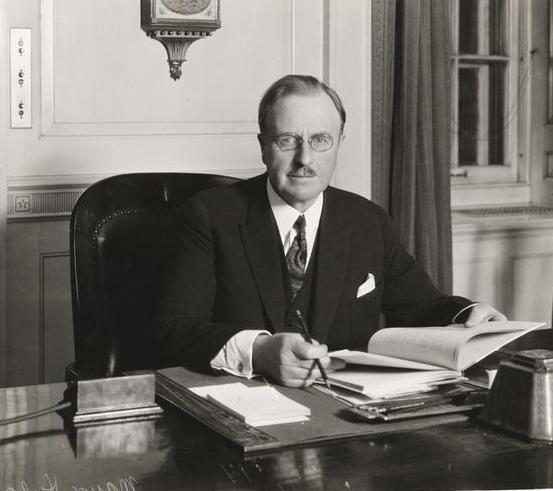
WordPress theme: Kippis 1.15