The enhanced subsidies, enacted during the COVID-19 pandemic and extended via the Inflation Reduction Act, ended on December 25, 2025. This negatively impacted the entire American healthcare system.
Total marketplace enrollment declined by 2.6 million people (12%) between February 2025 and February 2026, the steepest decline since the exchanges opened in 2014.
The average out-of-pocket premium for a subsidized household more than doubled, from $888 in 2025 to $1,904 in 2026.
Middle-income earners making just over 400% of the Federal Poverty Level (~$63,000 for a single individual) saw their financial assistance vanish entirely overnight. For example, a 60-year-old earning $65,000 can face annual premiums as high as $26,000.
Older adults in their 50s and 60s face the steepest premium hikes due to age-rating rules built into standard insurance pricing.
Healthier and younger individuals are the first to drop coverage when prices spike. This leaves a sicker, older pool of enrollees.
To cover the added risk of a sicker pool, insurers are projected to lift baseline unsubsidized premium rates by up to 26%.
Fearing financial losses from poor risk pools, some insurers are expected to exit state marketplaces altogether, leaving consumers with fewer plan options.
Hospitals, clinics, and safety-net providers are facing an estimated $7.7 billion surge in uncompensated care in 2026 alone. Individuals who dropped insurance still seek emergency care but cannot pay their bills.
Medical groups, hospitals, and pharmacies are dealing with a projected $32.1 billion drop in revenue as individuals cut back on elective procedures, doctor visits, and filled prescriptions.
On the conservative ledger, letting the subsidies expire saves the federal government roughly $30 billion to $35 billion per year in tax credit payouts.
Conversely, economic models show that the loss of healthcare consumerism is shrinking overall state GDPs by $34.1 billion and threatening over 286,000 jobs nationwide.
Some states like Mississippi and Texas face the worst uninsured spikes; a few others have attempted to launch temporary, state-funded stopgap subsidies to blunt the impact.
In the United States, virtually no segment of the population is completely, 100% insulated from the out-of-pocket costs of healthcare. Even among those with comprehensive health insurance, premiums, deductibles, copays, and coverage denials leave the vast majority exposed to financial risk.
Insulation by Insurance Type
True insulation from costs—having medical expenses fully paid for when someone gets sick—depends heavily on the type of insurance coverage.
Public Insurance Only (Medicaid): This group is the most insulated. Approximately 47.8% of people under age 65 covered solely by public insurance have $0 in annual out-of-pocket expenses.
Private / Employer Insurance: This group has very little insulation. Only 9.1% of privately insured individuals manage to navigate the year with zero out-of-pocket medical expenses.
The “Cost Secure” Population
Instead of being entirely insulated, a better metric is whether people feel financially safe from healthcare costs. According to the West Health-Gallup Healthcare Affordability Index only 49% of U.S. adults are classified as “Cost Secure”—meaning they can reliably afford the medical care and prescriptions they need.
The remaining 51% of the population is considered under financial stress regarding medical care. This lack of security impacts even affluent households; roughly 20% of households making over $180,000 a year report that they are not cost-secure.
Why is healthcare in America so expensive?
Healthcare in America is expensive primarily because providers, hospitals, and pharmaceutical companies charge significantly higher prices for services, drugs, and medical devices than anywhere else in the world.
According to analyses by organizations like the Peterson-KFF Health System Tracker, the crisis is driven by several major structural factors:
High Prices, Not More Care
Americans do not necessarily consume more healthcare than people in other wealthy nations; they simply pay much higher prices for the exact same doctor visits, hospital stays, and procedures.
The U.S. lacks broad government price controls on pharmaceuticals, allowing drug manufacturers to charge the highest prices globally.
Lack of Competition and Market Consolidation
Hospital Monopolies: Large hospital systems routinely buy up smaller local clinics and independent practices, creating local monopolies or “take-it-or-leave-it” markets where they can dictate high prices.
Strict licensing requirements, medical school limits, and barriers for international doctors restrict the overall supply of medical professionals, driving up labor costs.
Administrative Waste and Complexity
The U.S. system relies on a fragmented network of hundreds of private and public insurance plans, each with unique billing codes, rules, and portals.
Overhead
Hospitals, doctors, and insurers must employ massive administrative staffs just to handle complex billing and paperwork, which adds billions in waste that does not improve patient care.
Misaligned Incentives
Reactive Care: The American system rewards reactive treatment and specialized procedures rather than long-term primary care, wellness, and disease prevention.
A vast majority of healthcare spending goes toward treating severe, advanced-stage chronic conditions (like heart disease and diabetes) that could have been managed or prevented much more cheaply through early primary care.
Impact of the Cost of Education
The average total sticker price for education from a bachelor’s degree through a Ph.D. ranges from $130,000 to over $300,000 in tuition and fees, though out-of-pocket costs for a Ph.D. are often heavily discounted or free.
Breakdown by Degree Level
- Bachelor’s Degree (Undergraduate)
• Average Cost: $40,000 to $120,000+ total (for 4 years).
• Details: In-state public universities average around $10,000–$11,000 per year in tuition ($40,000–$44,000 total). Private nonprofit universities often average $40,000+ per year ($160,000+ total) before financial aid. - Master’s Degree (Optional/Interim)
• Average Total Cost: Around $62,000 to $73,000 (for a 2-year program).
• Details: Costs vary by field (e.g., arts vs. education) and whether the school is public or private. Many students go straight from a bachelor’s to a Ph.D. and skip a standalone master’s program. - Ph.D. / Doctoral Degree
• Sticker Price Cost: $48,000 to $145,000+ total (for 4 to 6 years).
• Actual Cost: Often $0 in tuition. Most research Ph.D. programs in the U.S. provide tuition waivers and pay students a modest living stipend ($20,000 to $36,000 per year) in exchange for teaching or research assistantships.
Important Financial Factors
• The biggest expense of a Ph.D. is not tuition, but the salary you give up while spending 5 to 6 years in school instead of working full-time.
• Professional doctorates (like an Ed.D. or DBA) rarely offer full funding, whereas traditional research Ph.D.s frequently do.
Earning a Full Professional Salary (Ages 28–35+)
The median age for completing a PhD in the U.S. is about 31.5 years old, varying by field (STEM fields often finish around 29–32; humanities often finish around 36).
Impact of Malpractice Insurance Premiums
Malpractice insurance premiums increase the cost of healthcare by raising the operating expenses for doctors and hospitals, which leads to higher prices for medical services.
Direct Costs for Providers
• Higher Overhead: Doctors and clinics pay thousands to hundreds of thousands of dollars each year for malpractice coverage.
• Specialty Differences: High-risk specialties like neurosurgery or obstetrics face massive premiums, forcing providers to charge more to stay in business.
Indirect Costs and Defensive Medicine
• Defensive Medicine: Doctors order extra tests and procedures just to protect themselves from lawsuits.
• Wasted Spending: This extra care adds billions of dollars to the healthcare system every year without improving patient health.
• Access Issues: High costs drive doctors away from certain high-risk areas or cause them to retire early, which reduces the supply of care and raises prices.
Impact of High Healthcare Costs on Labor Competitiveness
Higher Business Costs
• Employers pay a large share of health insurance for their workers.
• This high overhead leaves companies with less money to hire new staff.
• Businesses have less cash to invest in new equipment or training.
Slower Wage Growth
• Money spent on health insurance cannot go into paychecks.
• Workers see flat or very slow wage increases.
• Rising insurance premiums swallow up gains in worker productivity.
Lower Job Mobility (“Job Lock”)
• Workers fear losing their health insurance if they change jobs.
• People stay in jobs that do not match their true skill level.
• This dynamic stops workers from moving to more productive roles.
• It also discourages people from starting new businesses.
Impact of Healthcare Lobbying
Healthcare lobbying shapes federal legislation by driving up medical costs, blocking reforms like single-payer or surprise billing protections, and protecting industry revenues. Healthcare lobbying is governed generally by the Lobbying Disclosure Act and monitored via public disclosures.
Key Impacts of Healthcare Lobbying
Higher Costs: The pharmaceutical, insurance, and hospital sectors spend billions to influence Congress, which helps maintain complex administrative systems that drive up prices for patients.
Blocked Reforms: Well-funded industry groups frequently stall or weaken cost-containment measures, prevent public option plans, and fight against price caps on prescription drugs.
Unequal Representation: Because healthcare policy is highly complex, lawmakers often rely on industry lobbyists for information, giving heavily resourced corporate groups far more influence than patient advocates.
Concentrated Power: A small number of large, for-profit health systems and corporate associations account for the vast majority of lobbying expenditures, skewing federal policy in their favor.
Impact of Citizens United v. Federal Election Commission
In 2010 the Supreme Court lifted restrictions on independent political spending by corporations, labor unions, and wealthy donors, declaring that limiting this independent spending violates the First Amendment’s protection of free speech. The primary impacts of this landmark decision on modern election cycles include:
The Rise of Super PACs
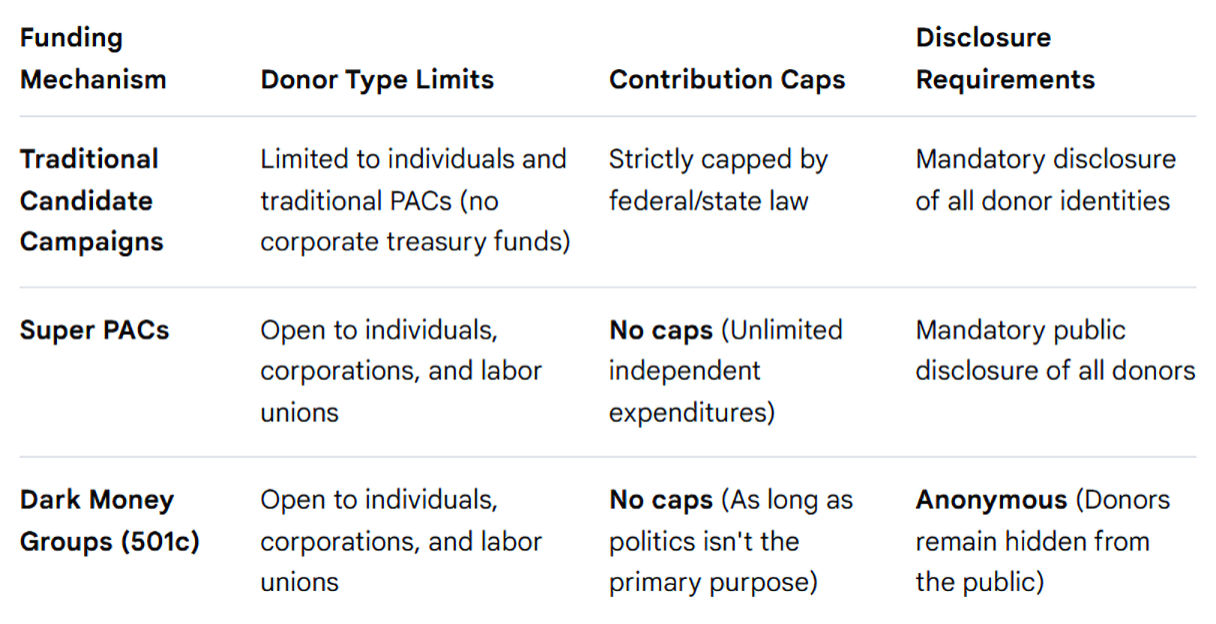
While direct contributions from corporations and unions to a candidate’s official campaign remain illegal, the ruling paved the way for a subsequent lower court case (SpeechNow.org v. FEC) that established Super Political Action Committees (Super PACs). These entities can accept completely unlimited financial contributions from individuals, corporations, and unions to openly advocate for or against candidates.
Proliferation of “Dark Money”
The decision greatly expanded the use of dark money. This occurs when political spending flows through politically active 501(c)(4) social welfare organizations and non-profits. Because these groups are not legally required to disclose their donor lists, hundreds of millions of dollars pour into elections annually from completely untraceable sources.
Escalation in Election Spending
Total federal election spending has reached unprecedented heights. Ultra-wealthy mega-donors exert a highly concentrated influence. For example, the Brennan Center for Justice found that during the 2024 presidential race, donors giving $5 million or more to Super PACs spent more than double what they had in the 2020 election. Ultra-wealthy donors contributed over $2.6 billion during that single federal election cycle.
Partisan and State-Level Shifts
Research indicates the lifting of spending limits has influenced political map outcomes unevenly. A multi-year study comparing state legislative patterns published by Columbia University found that in the 23 states that previously maintained strict corporate and union spending bans, the Republican Party captured a 3-to-4 percent greater share of the vote and an average 5 percent increase in legislative seats after the 2010 ruling.
Campaign Finance System Comparison Post-Citizens United
Ineffective Government
The Federal Government as a whole is heavily influenced -some say fully controlled- by big money in terms of the legislation it enacts. This has created entrenched conditions that saddle ordinary Americans with much higher education, healthcare and insurance costs, among many others, that heavily reduce the nation’s competitiveness in the global market. While not the only cause, it is directly related to the chronic trade deficit.
Tariffs
The ramifications are so deep and widespread that it is futile to attempt to redress them with tariffs. This approach has been tried before, specifically the Smoot-Hawley Tariff Act of 1930 that raised import duties on over 20,000 goods and deepened the global economic downturn of the Great Depression.
Retaliation and Wars
• Foreign retaliation: Overseas nations like Canada, France, and Britain quickly imposed their own punitive tariffs against American-made goods.
• Collapsing commerce: Global trade plummeted sharply, with international trade values dropping by roughly 65% between 1929 and 1934.
• Shrinking exports: U.S. exports fell drastically as foreign markets became closed or too expensive to access.
• Served as a catalyst to the rise of Adolf Hitler
Economic Strain at Home
• Higher consumer prices: Tariffs forced everyday items like food and clothing to become more expensive for struggling American families.
• Worsened depression: While the 1929 stock market crash started the downturn, the tariff walls choked off recovery channels and worsened unemployment.
• Agricultural distress: Farmers who originally pushed for protection found themselves hurt worse by lost export markets and retaliatory measures.
The subsequent Reciprocal Trade Agreements Act of 1934 reversed these policies.
Conclusion
The painful trail of calamities that befell humanity beginning with the Great Depression are but a dress rehearsal of what might follow should we fail to address them. Not only are today’s weapons orders of magnitude more powerful than ever, for the first time the United States is attempting to dominate a far more populous country (China) and a much larger industrial capacity, all in the context of incipient technologies (AI and robotics) the likes of which we’ve never seen. This begs the question, is it still easier, less costly and deadly, to attempt to force others to do our bidding, or is the time ripe to enact peaceful, lifesaving, imperceptible internal changes for the benefit of all? If the latter is in the running, the book above may have the answer.