Coal is extracted from the ground by coal mining, either underground by shaft mining, or at ground level by open pit mining, and its extraction and use are directly related to a number of adverse health and environmental consequences, including:
• 2,800 deaths from lung cancer and black lung disease in the United States alone;
• Millions of tons of waste products such as dust, fly ash, bottom ash, and flue-gas desulfurization sludge that contain mercury, uranium, thorium, arsenic, and other heavy metals;
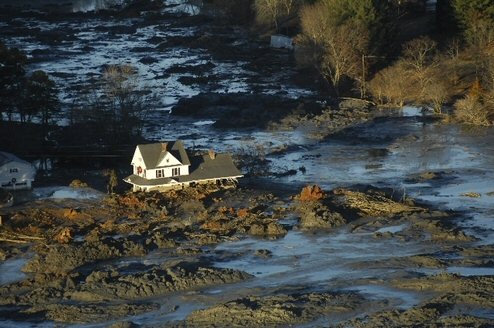
• Contamination of land, groundwater and waterways due to mining and spills such as the Kingston Fossil Plant coal fly ash slurry spill;
• Subsidence above tunnels;
• Uncontrollable coal seam fires which may burn for decades, centuries or millennia, as in Australia;
• Coal-fired power plants without effective fly ash capture systems are one of the largest sources of anthropogenic background radiation exposure.
Coal is the largest anthropogenic emitter of carbon dioxide in the atmosphere, a greenhouse gas that causes global warming and climate change. A coal-fired power plant emits around 2,000 pounds of carbon dioxide for every megawatt-hour generated, almost double the carbon dioxide released by a natural gas-fired electric plant.
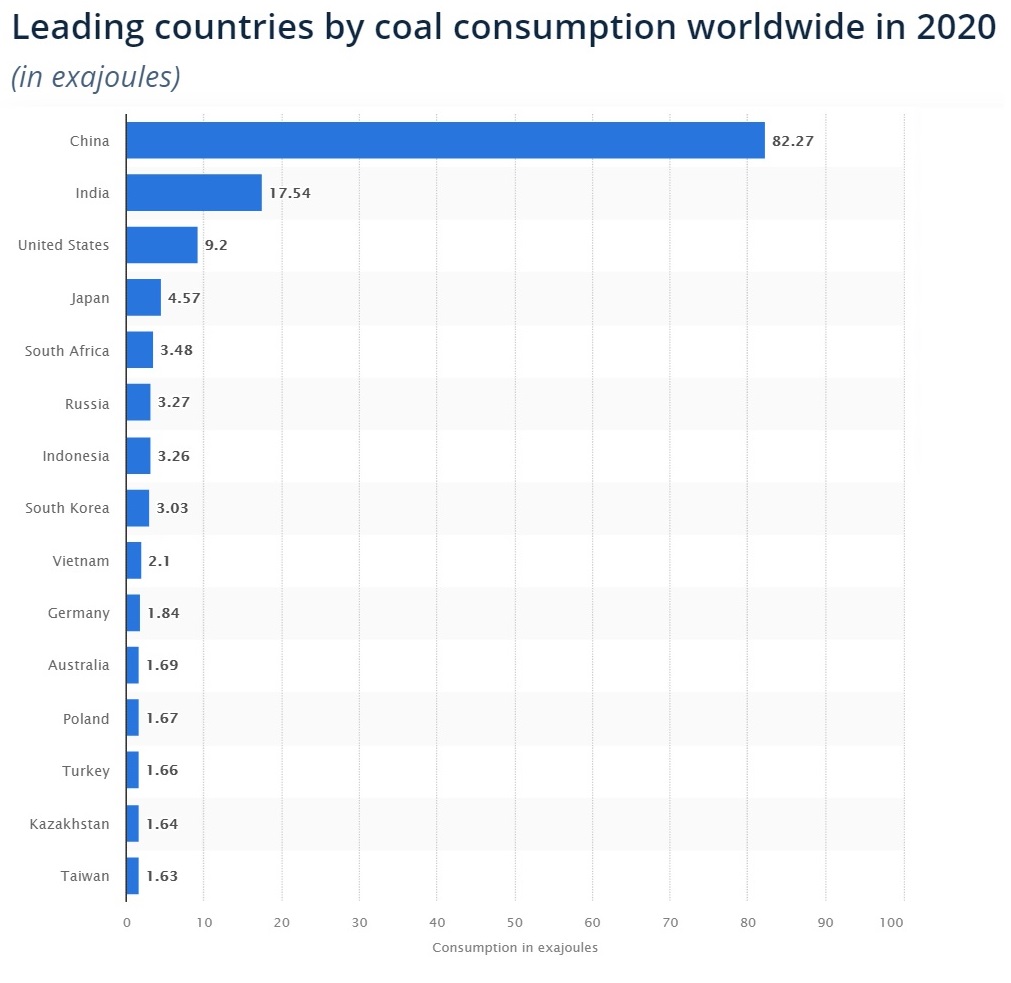
Today China is the world’s largest producer and consumer of coal in the world, and accounts for almost half of the world’s coal consumption. Coal supplied 70 percent of China’s total energy consumption of 90 quadrillion British Thermal Units (BTUs), but the International Energy Agency (IEA) projects coal’s share of the total energy mix to fall to 59 percent by 2035 due to anticipated higher energy efficiencies and China’s stated goal to reduce its carbon intensity (carbon emissions per unit of GDP). Even so, absolute coal consumption is expected to double over this period, reflecting the large growth in total energy consumption. But coal-producing nations are equally responsible because they supply China with much of the coal it uses.
In 2011 a study determined that world proved reserves of coal would last 112 years at that year’s rate of production. However, according to the World Resources Institute, nearly 1,200 new coal-fired power plants are planned across the globe with a total proposed capacity of 1.4 million megawatts. China and India account for 76% of the proposed plants, but as pressure mounts to phase out nuclear power after the 2011 Fukushima Daiichi disaster, Japanese coal imports are likely to continue to grow as well.
In sum, despite great technological advances, mankind continues to depend on fossil fuels for most of its energy needs, unchanged from thousands of years ago. No nation has yet announced, much less committed, to a realistic, feasible plan to phase out their use. On the contrary, the world’s population will to grow to 9 billion by 2050; inevitably, that will cause an increase in the respective rates of contamination of the environment and depletion of fossil fuel reserves.
Our planet has a fever. It’s getting worse, and the trend will continue unless we do whatever it takes to redress it. Thomas Jefferson once wrote that “by usufruct, the earth belongs to the living.” There is no one but us to collectively implement the drastic but feasible steps that will be required to do so.
This is a concrete, cost-effective proposal to substitute hydrogen for coal to simultaneously generate electricity, create an otherwise unobtainable new source of pure water, regardless of location and impervious to drought and climate change, and eliminate the number one source of air pollution in China. The United States would produce the hydrogen exclusively and profitably by electrolysis of seawater using solar power only, with zero carbon dioxide emissions.
On February 17, 2012, an article in the Shanghai Daily reported that 40 percent of China’s rivers are seriously polluted, two thirds of Chinese cities are “water needy,” 300 million people in rural areas lack access to drinking water, and 20 percent of rivers are too toxic to even touch. In response, it continued, the State Council unveiled a guideline to cap the maximum volume of water use at 700 billion cubic meters by the end of 2030 and tighten its supervision over exploitation of underground water and other sources of drinking water.
Rationale
As the consequences to the environment of anthropomorphic climate change continue to worsen, it behooves us all to do what we can to mitigate their effect. The solution is well known: cease and desist using nuclear fission and fossil fuels to generate electricity and run motor vehicles. One obvious way to do so is to replace them with hydrogen from the ocean. At issue is whether existing electrolysis technology can use seawater directly without first desalinizing it to produce hydrogen profitably. Here’s an analysis written in 2010 describing the electrochemical intricacies of three types of water used in electrolysis, including seawater. At least one water splitter able to produce hydrogen up to 99% pure from seawater exists (details here). The latter of course is of paramount importance since three fourths of our planet’s surface is covered with it. The analysis shows that chlorine, not oxygen, is the default byproduct of electrolysis of seawater. As it happens, this is fortuitous because that same chlorine could be used to treat the freshwater produced when the hydrogen is recombined with oxygen to generate electricity.
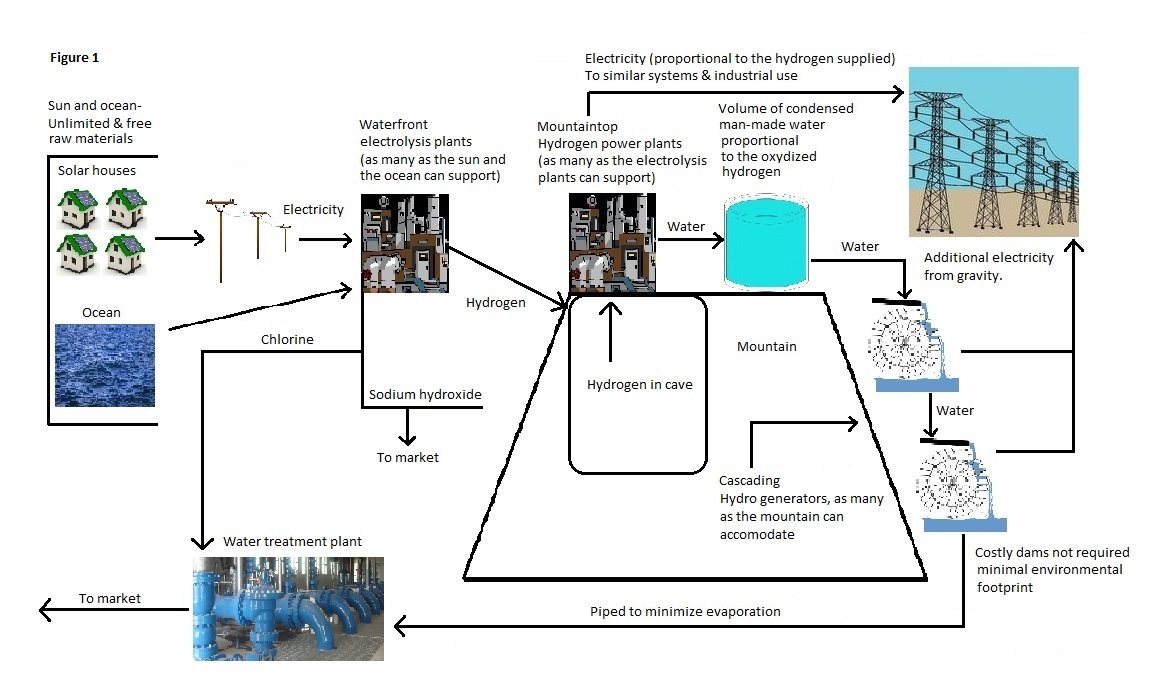
Figure 1 shows that freshwater created as a byproduct of the oxidation of hydrogen can be used and reused over and over to generate additional electricity as it flows down the mountain by gravity and turns as many turbines as the mountain can accommodate. Their combined output should recover and exceed the energy used to produce the hydrogen. Thus, not only is the system (several systems could be connected in series) self-sustaining in terms of energy, it actually should generate a surplus of it. No other method of generating electricity has the ability to create water –not even hydro, which uses existing freshwater to turn its turbines and requires costly dams that disrupt the local ecosystem.
The system’s components need not be contiguous. For example, the electrolysis could take place anywhere –at cities on sun-drenched islands such as Honolulu, San Juan, Havana or Las Palmas- in which case the hydrogen and chlorine would be exported by ship, or in (currently idle) inland potential powerhouses like Death Valley. At any port elsewhere both would be unloaded and distributed by pipeline (in the case of hydrogen, the cost would be minimal because it is the lightest element in the periodic table) to remote, suitable mountains towering over bone-dry valleys and plateaus such as the vast arid and semi-arid regions in central Asia north of the Himalayas, north-central Mexico, the Sahara Desert, the west coast of South America, the Kalahari Desert, the Middle East, and the American Southwest. That way the hydrogen systems and their associated mountaintop hydro plants could irrigate the valleys below to grow food (and other vegetation, to help recycle the carbon dioxide already in the air and reverse desertification) and support a local population where it was previously impossible to do so. Some of the electricity could be used locally; the rest could be transmitted, over long distances if necessary, to distant thirsty mega-cities like Beijing, New Delhi, Amman, Teheran, Lima, Madrid, and Phoenix.
Of particular interest is that –in effect- these systems would redistribute “frozen” (in the hydrogen) sunlight and water from sun-drenched tropical and sub-tropical shores to areas with minimal precipitation or with cold winters (mostly in the northern hemisphere) that use vast amounts of fossil fuels to power their heating systems.
Conclusion
The mass production of hydrogen in the Southwest of the United States and elsewhere with abundant sun and seawater would eventually eliminate the need for nuclear fission and fossil fuels to generate electricity. As a result, the diminished need for oil and gas in particular would greatly reduce the probability of terminal wars over them among the great powers. The manufacture of water in areas where there isn’t any would support irrigation to grow food and other plant life with the capacity to recycle excess carbon dioxide in the atmosphere. Finally, additional food and water would be most welcome in a world expected to hit 9 billion by 2050, and the gradual reduction in the distribution of wealth without resorting to new taxes, confiscations or other drastic measures would reduce the likelihood of civil strife.
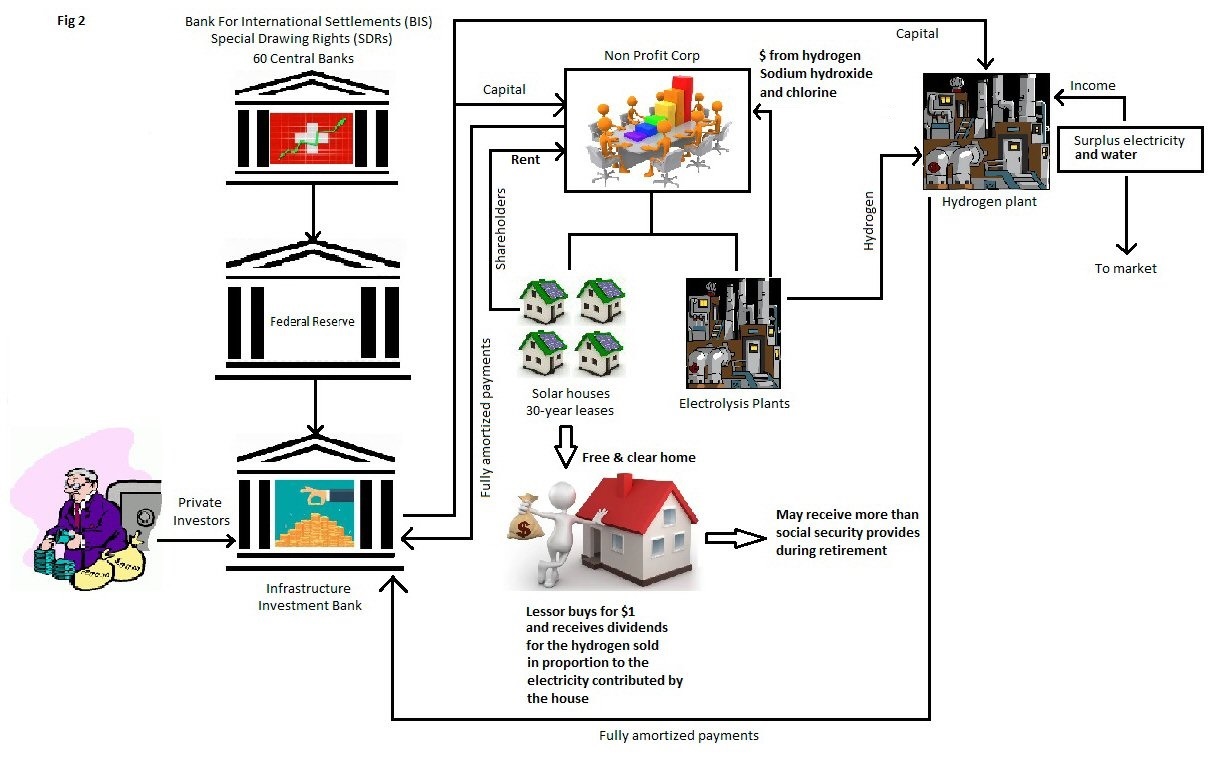
By special law, an Infrastructure Investment Bank, designated as a charity, could be federally chartered and insured by the Federal Reserve System (not the Federal Government). Neither the Fed nor the Government, nor any of their current or future potential departments, affiliates, agencies or designees, would have access to the Bank’s funds for any reason. The purpose of the Bank would be to fund a full transition to a green and white Hydrogen Economy.
The goal of this transition would be to:
Fully replace fossil fuels and nuclear fission to generate electricity.
Wean the U.S. from the need to rely on foreign oil reserves to support the dollar and to control the ocean’s choke points.
Significantly reduce the probability of a terminal war.
Tap a widely availalable and inexhaustible fuel for mobile applications.
Literally manufacture virtually unlimited pure water where desalination is impractical or impossible, including inland arid areas such as west of the 98th Meridian in the United States, and the Sahara Desert. The need to address water scarcity is well known; existing infrastructures such as China’s South-North Water Transfer Project, California’s State Water Project, and proposed but now defunct analogues such as the North American Water and Power Alliance (NAWAPA), while forward-looking, will not meet the world’s future needs. The proposed Death Valley Canal System would, – without costly dams.
Use hydrogen to fully meet the United States’ current and future energy demand.
Export hydrogen in vast amounts to countries that need both energy and water.
Mitigate the very real consequences to the advent of robots run by artificial intelligence, mechanical slaves that threaten to replace human workers on an unprecedented scale.
Relieve federal, state and local governments from the responsibility and burden of providing ever-growing safety net benefits.
Create a template for other countries to help prevent famine, mass-migrations and wars.
Peg the value of all currencies to each country’s per capita production and use of green and/or white hydrogen. This would replace the International Monterary Fund’s (IMF) basket of privileged currencies, enforce universal fiscal discipline, preclude deficit spending to fund wars of aggression, rein in inflation, and protect wealth everywhere.
As of 2024, the top 10% of the population owned fully 60% of the nation’s wealth, or $101.3 trillion. New legislation would require them to gradually deposit not less than 50% of their wealth in the proposed Investment Bank. As a result, the Bank’s capital could approach approximately $50 trillion. This would be neither tax nor confiscation; instead, depositors would create individual Charitable Remainder Unitrusts (CRUTs). Depositors would get prorated income tax charitable deductions in amounts equal to their individual contributions. The CRUTs’ assets would grow tax-free and additional contributions would be allowed after the initial funding. The Bank (the trustee) would distribute a predetermined prorated percentage of its assets each year. Its income would be derived from the sale of electricity, hydrogen, water and other ancillary products as outlined here. To protect the interests of the depositors’ heirs, the former would use a portion of the income they receive to purchase life insurance in an amount equal to their contributions. Thus, the depositors would get a tax deduction and income for life, and upon their passing, their heirs would receive the insurance benefit.
Pundits have been comparing the “fall” of Kabul to Saigon. The pandemonium is certainly similar. But today the Vietnamese work very hard for their living, just as they did during the war. About three-quarters of them live in country areas and villages growing rice and fruit trees or raising livestock. More importantly –as far as is publicly known- there are no mass executions. Perhaps 50 years from now –if humanity is still around- the current animosity in Afghanistan will have subsided and people will be living their lives out more or less normally.
The Vietnam fiasco did not have consequences in terms of the propagation of communism; in fact, the Soviet Union disintegrated in 1989, and China subsequently adopted many capitalist reforms that propelled it to the growing powerhouse it is today. These events were unthinkable as American helicopters lifted desperate people out of Saigon’s embassy rooftop in 1975.
The similarities between Saigon and Kabul are misleading, coincidental and superficial. Nixon ended the Vietnam war primarily because the American people did not support it and Congress refused to continue paying for it. Today the geopolitical reality stemming from the unprecedented, meteoric rise of China’s economic and military might is an entirely different matter. The quality, quantity, efficiency, and technological sophistication of its navy and air force continue to grow in leaps and bounds, and so is their nuclear arsenal.
Viewed in that context America’s departure from Afghanistan is reminiscent of Rome’s futile withdrawal from Britannia around 410, to help fend off the barbarians who had crossed the Rhine in the winter of 406-407. It still didn’t prevent the Empire’s demise 66 years later, in 476. From a military perspective Afghanistan, a landlocked country, is a dead-end mousetrap consuming lives and vast economic resources that could be advantageously redeployed elsewhere. It is surrounded by nations hostile to the U.S. –Iran to the west, Turkmenistan, Uzbekistan and Tajikistan (former Soviet Republics) to the north, China to the east, and Pakistan (a dubious American ally) to the south and southwest.
In short, the preemptive but ominous withdrawal from Afghanistan, a course of action on which former President Trump and President Biden agree, makes sense. The U.S. and China are squaring off, among other things, over the South China Sea and Taiwan, and no one knows how that’s going to play out.
Background A long-awaited, unclassified Preliminary Assessment of Unidentified Aerial Phenomena issued by the Office of the Director of National Intelligence is an unexpected silver lining to the Covid-19 pandemic: The $2.3 trillion relief bill signed by then-President Donald Trump actually required the Pentagon to continue investigating UAPs and release its findings to the public. Worldwide sightings by reputable and plentiful eyewitnesses abound. The good news is that now there’s a required-by-law disclosure mechanism in place akin to the White House Press Secretary’s regular briefings. The bad news is that this first report admits that a significant portion of these sightings do not conform to current U.S. technology. The objects are able to accelerate instantly at speeds in excess of anything we’re capable of, change directions suddenly, impervious to g-forces that should rip them apart, and dive into the ocean and emerge flying at such speeds. Among other things, these observations suggest an intelligence able to make gravity at will, and by extension, gravitational shields that make them invulnerable to anything we have. To put that in perspective, we are of course aware of gravity, but we don’t even know what it is. The report leaves open the possibility that some of the events may be attributable to “technologies deployed by China, Russia, another nation, or a non-governmental entity.” That begs the question, if that is so, why are they investing so heavily on comparatively primitive systems like hypersonic missiles?
The Problem The intelligence community’s thunderous silence on the subject is not reassuring. If anything, it tacitly admits that we are at the mercy of a superior intelligence. That of course opens the door to security concerns that transcend anything humanity has ever experienced, at least not in recorded history: the possibility of extraterrestrial invasion, enslavement, or even outright extermination. Long ago Carl Sagan said that “extraordinary claims require for validation extraordinary evidence.” This UAP report is that evidence.
Despite unparalleled ongoing and worsening tensions and disputes, emergency links exist between Russia and the U.S., and presumably with China, to avoid thermonuclear war. The possibility of extraterrestrial invasion by beings with vastly superior technological knowhow should not be ignored. Accordingly, if an agreement, even in principle, does not exist to instantly activate a (currently dormant) planetary command, then the great powers should give it the priority it deserves. No one knows if other less-benign extraterrestrials are on the way.
Historical Background
When they “opened” China in 1972 President Richard Nixon and Secretary of State Henry Kissinger did not anticipate the consequences that would follow. Nixon’s primary motive was to take advantage of the then adversarial Sino-Soviet relationship to open another front in the Cold War with the Soviet Union. Declassified documents published by the National Security Archive and the George Washington University’s Cold War Group of the Elliott School of International Affairs reveal that agreement on Taiwan was absolutely necessary for diplomatic normalization. Indeed, nearly 9 pages of the 46-page record of the First Zhou-Kissinger meeting on July 9, 1971 show that Kissinger disavowed Taiwanese independence and committed to withdraw two-thirds of U.S. military forces from the island once the Vietnam War ended. However, Nixon’s resignation and Ford’s political weakness precluded conclusion of the normalization process. Chairman Mao also was interested in a rapprochement with the U.S. for the very same reason Nixon was –a counter to China’s dangerous confrontation with the Soviets. Near the end of Nixon’s trip to China February 21-28, 1972, the two governments issued what is known as the Shanghai Communiqué. In it the United States declared that it “acknowledges that all Chinese on either side of the Taiwan Strait maintain that there is but one China and that Taiwan is a part of China.” Furthermore, Nixon stated that the United States did not support Taiwanese independence.
Trade between the two countries started to grow in earnest after 2000, when Congress voted to grant China “permanent normal trade relations,” which paved the way for China’s accession to the World Trade Organization in 2001. Since then the Chinese economy has grown exponentially. Now it’s the world’s second largest economy, by some estimates on track to overtake the U.S. by 2030 or earlier.
A Questionable Strategy The Trump Administration’s strategy was geared to create conditions to slow down, halt, and (hopefully) reverse China’s economic growth. It erected tariffs, ousted prominent Chinese high-tech firms from the American market, and delivered de facto ultimatums to other countries telling them, in no uncertain terms, to do the same. Now the Biden Administration seems to be following the script. So far these efforts have been unsuccessful. The International Monetary Fund (IMF) estimates China’s economy will grow by 8.2% in 2021 and the U.S. by 3.1%, and in 2020 our trade deficit actually rose 17.7 % to $679 billion, highest since 2008. As for America’s efforts to persuade other countries to –in effect- boycott China, there are at least three fundamental reasons why this too is likely to be, to say the least, difficult. Firstly, China is already the number one or number two trading partner with most of the world, including NATO members (it recently became France’s largest customer of cosmetics, surpassing Germany and the U.S.). Secondly, embargoes and tariffs are only going to encourage China even more to redouble its efforts to become self-sufficient in high tech and other critical fields, increase domestic consumption to reduce the role of exports as its primary engine of growth, and open its economy further to attract even more foreign investors eager to sell to its vast pool of increasingly wealthy consumers. Thirdly, and more ominously, President Xi made it clear that while he hopes to reunify Taiwan with China peacefully and even outlined a five-point proposal to do so, he also stated that “we make no promise to renounce the use of force and reserve the option of taking all necessary means.” Accordingly, they have engaged us in an arms race that, given the size of our existing debt and the uncontestable need for long-term massive investment here at home, is simply unsustainable. This begs the question, if this strategy of confrontation fails to deliver, is there a peaceful Plan B waiting to replace it?
Sobering Facts Higher Education
The United States is trying to preserve the dwindling technological advantage it enjoyed since the end of World War II, but it doesn’t bode well. There’s a high-tech STEM (science, technology, engineering and mathematics) crisis: foreign-born non-citizens currently account for 81% of electrical engineering majors and graduate students in the U.S.; and in computer science –critical for innovation and research in fields such as cyber and artificial intelligence, American-born students make up just 21% of the student body. Furthermore, this is not an aberration. According to the World Economic Forum, in 2016 China had at least 4.7 million native-born recent STEM graduates, followed by India with 2.6 million. In contrast, the U.S. only had 568,000, and of those, half were foreign-born. In addition, although China’s total population is four times larger than the U.S., it has eight times as many native-born STEM graduates. Other estimates see Chinese graduates aged 25 to 34 rising 300 percent by 2030 compared to just 30 percent in the U.S. and Europe. The numbers speak for themselves.
Student Debt
According to the College Board, over the past 30 years the average cost to attend a public four-year institution has more than tripled, and at private four-year schools it more than doubled. This documented trend far outpaced the incomes of the lower and middle-classes. As a result –according to the Federal Reserve Bank of New York- about 54% of all American students take out loans to pay for college. Their average debt topped $37,500 in 2020, and collectively they now owe $1.6 trillion. Based on the current rate of growth, by some estimates student loan debt will reach $2 trillion by 2024. For students, paying off student loans as soon as possible after graduation is a fundamental priority. Unlike mortgages, which can be extinguished in foreclosure, and credit card loans, which are dischargeable in bankruptcy, student loans are not. Students that are unable to pay the loans back for any reason are haunted by collectors for life and their credit scores depressed. This state of affairs strongly encourages youngsters to choose careers with the highest possible rates of compensation, and STEM-related are not at the top of the list. Employment in them is limited and neither guaranteed nor widespread, and more lucrative options are widely available. That is detrimental to the national interest. It all but ensures that in just a few years we’ll find ourselves lagging further and further behind China and India, a prescription for irrelevance.
Military Aspects
According to the U.S. Department of Defense’s 2020 Annual Report to Congress about military and security developments in China, the latter is for practical purposes mobilizing “all relevant aspects of its society and economy for use in competition and war.” The report further warns that “China has already achieved parity with –or even exceeded- the United States in several military modernization areas, including (a) shipbuilding (it already has the largest navy in the world, currently with 350 ships and submarines including over 130 major surface combatants; in comparison, the U.S. Navy’s total battle force is approximately 293 ships as of early 2020. In addition, China is the top ship-building nation in the world by tonnage and is increasing both its production capacity and capability for all naval classes); (b) land-based conventional ballistic and cruise missiles, and (c) integrated air defense systems. On June 2, 2012, at the Shangri-La Dialogue in Singapore, then Secretary of Defense Leon Panetta disclosed that “by 2020 the Navy will redeploy its forces from today’s roughly 50/50 percent split between the Pacific and the Atlantic to about a 60/40 split between those oceans.” If Secretary Panetta’s ratio still applies as of this writing, the U.S. has approximately 176 ships in the Pacific. That amounts to just 50% of China’s current (and growing) fleet, deployed mostly near its protective home-based missile umbrella. In view of these facts and given the rate of Chinese shipbuilding is it reasonable to expect that the U.S. Navy will be able to overpower its Chinese counterpart 10,000 miles away just a few years from now?
Innovative Thinking is in Order Presidents Eisenhower, Kennedy and Reagan as well as the Bulletin of Concerned Scientists have repeatedly warned us about the consequences of nuclear war. It’s not that nuclear-armed powers are unable to abolish nuclear weapons, just that they’re unwilling to do so.
When Winston Churchill replaced coal with oil for the Royal Navy he also transformed it into a strategic commodity. Ever since then direct or indirect control of the world’s deposits has been a bone of contention among the industrialized powers. When the U.S. embargoed Japan’s oil supplies, the latter, in desperation, attacked Pearl Harbor to destroy the American Fleet which they perceived as a threat, and invaded the (then) Dutch East Indies to get the oil it needed to run its economy. Similarly, Hitler, blockaded by the Royal Navy (with U.S. help), and afraid of a possible future Soviet embargo of indispensable raw materials, including oil, attacked the latter. We all know the result, no point in counting the dead. There are two things we as a species must learn from this –if we want to survive. The first is that the devastation of World War II would be nothing more than a dress rehearsal if it were to be repeated with today’s (and future) weapons. The second is that the bone of contention must be replaced with a non-polluting, universally and easily available energy carrier that cannot be controlled or hoarded by any one nation or group of nations: hydrogen. More explicitly, we must trade all fossil fuels, including oil and the wealth derived from them, for survival. It’s as simple as that. The technology to do so exists, and climate change is firmly and relentlessly nudging us in that direction. We just need to heed.
A Strategic Commodity
Winston Churchill’s decision to replace coal by oil for the primary source of power of the Royal Navy forced Britain, which at the time had no known domestic oil fields, to seek, acquire and maintain control of oil deposits in distant lands. On May 21, 1901 the Shah of Persia signed the first oil concession agreement of the 20th Century bestowing upon an Englishman called William Knox D’Arcy a special and exclusive privilege to search for, obtain, exploit, carry away and sell natural gas, petroleum, asphalt and ozerite throughout the whole extent of the Persian Empire for a period of sixty years. In 1908 oil was discovered at Masjid I-Suleiman in southern Persia, and within a year the Anglo-Persian Oil Company (APOC) was formed. Six years later, on June 14, 1914, at Churchill’s behest -and coincidentally just fourteen days before the assassination of Archduke Franz Ferdinand of Austria that sparked World War I- Parliament passed a bill to fund the British Government’s acquisition of a 51% interest in APOC. Thereafter Churchill promptly placed two directors on its board and negotiated a secret contract to provide Britain with a 20-year supply of oil under favorable terms. Thus, with one stroke, Churchill promoted oil to a strategic commodity and an instrument of national policy. While this British monopoly (and later, American and Russian) of the world’s oil fields amassed immense wealth for them, it also created a suffocating dependence for the (then) up and coming German and Japanese Empires that led to World War II.
Worth noting is that China, then hibernating, did not compete in the struggle for control of foreign oil deposits. Now the Asian giant –with a population four times larger than the United States- has awakened, become wealthy and powerful, and ominously served notice that it is intent on reclaiming Taiwan, which it sees as Chinese territory, and on monopolizing whatever fossil fuels may be found in the South China Sea –in its eyes a non-negotiable imperative to ensure oil self-sufficiency for its navy. In other words, the dynamics that existed in 1914 and 1941 never subsided; this time around they’re enhanced by weapons capable of ending life as we know it in a matter of minutes. There is however a sliver of hope: the universal understanding that fossil fuels, including oil, are the cause of climate change. Either we abolish their use or they will abolish us.
Clarification
As to the purpose and intent of this website, both are disclosed in the “About Us” page. Equally important, this is not a “for profit” enterprise catering to special interests; rather, we simply seek to leave a better world for our children and grandchildren.
Though not one of our collaborators is a polymath, we all face impending anthropomorphic catastrophes encompassing nearly every known discipline. Our technology, which continues to evolve at a breathtaking speed, has far outpaced our level of spiritual maturity. Artificial intelligence, quantum computing, and robotics –to name three- now threaten to wrest any vestigial control we may still have over terminal weaponry, and primitive traits like dominance, greed and lust for power still call the shots.
Anthropomorphic climate change is impervious to our needs and wants; its ramifications reach into every aspect of human endeavor –economic, psychological, military, social, and directly impacts the availability of water, energy and food, and population growth. In response, we have attempted to amass a kernel of pertinent, cutting-edge knowledge as reported by renowned specialists, and used it to suggest an original, non-permanent structural blueprint to restrain our aforementioned traits from destroying us all.
We believe hydrogen is the answer. If mass produced by electrolysis of seawater using solar energy primarily, it could be burned to create a new source of pure water to conquer drought, compensate for the depletion of aquifers and melting glaciers, ensure the production of food, and make it possible to plant trees anywhere, even in the driest deserts, to help recycle the carbon dioxide already in the atmosphere. Crucially, unlike desalination, which is impractical or impossible in inland areas and a heavy consumer of energy, our suggested system would also generate electricity, not just by burning the hydrogen itself but by using gravity as shown on the front page diagram. Fusion, on the other hand, transforms hydrogen into helium. Inevitably, in time, with future and cumulative demand stemming from technologies and schemes not yet invented, our supply of water would permanently and irretrievably decline.
New Technologies and Discoveries
Great progress has been, and continues to be made, at every critical technological junction to make this feasible and economical. The price of solar panels declined about 80% from 2000 to 2020 (there’s no reason why residential consumers must be compelled to remain attached to the grid other than to continue to subsidize public utilities, which burn fossil fuels), a catalyst was discovered that minimizes the production of chlorine gas while producing hydrogen by electrolysis of salt water, numerous corrosion resistant materials for bipolar plates are being tested, and, crucially, a turbine capable of burning hydrogen directly and uninterruptedly, without fuel cells, already exists.
What’s Missing
While undoubtedly brilliant, these projects exist in a vacuum, isolated from each other: they’re not part of an all-encompassing team dedicated to replace fossil fuels with hydrogen. One way to compensate for that shortfall would be to amalgam a group of grassroots volunteer experts in the many disciplines involved to develop and publicize a comprehensive, technically-detailed blueprint that our political leaders would be hard-pressed to ignore.