Plan A: The U.S.

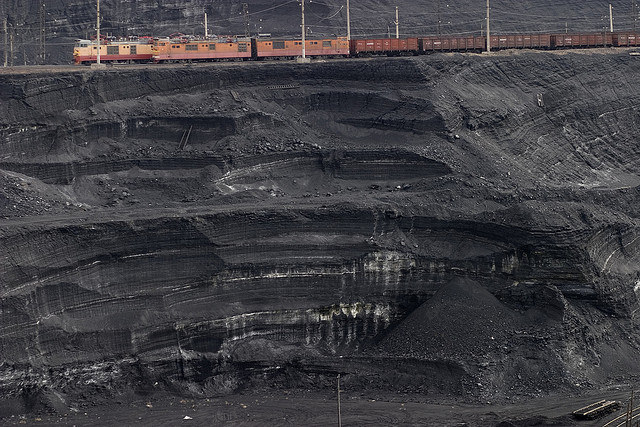
Open Pit Coal Mine 3
The goal: eliminate the coal mine

Coal is extracted from the ground either at ground level by open pit mining, or by shaft mining. The world’s top producer and user of coal (and energy in general) is China, accounting for about half of global coal consumption.

Coal-fired electric power generation emits approximately 2,000 pounds of carbon dioxide (CO2) per megawatt-hour generated, almost double the CO2 released by natural gas-fired plants per megawatt-hour generated. Coal supplies about 70% of China’s total energy consumption, however the International Energy Agency (IEA) projects that it will fall to 59% by 2035 due to higher energy efficiencies and China’s goal to reduce carbon emissions per unit of GDP. However, absolute coal consumption is expected to double over this period due to the large growth in total energy consumption.
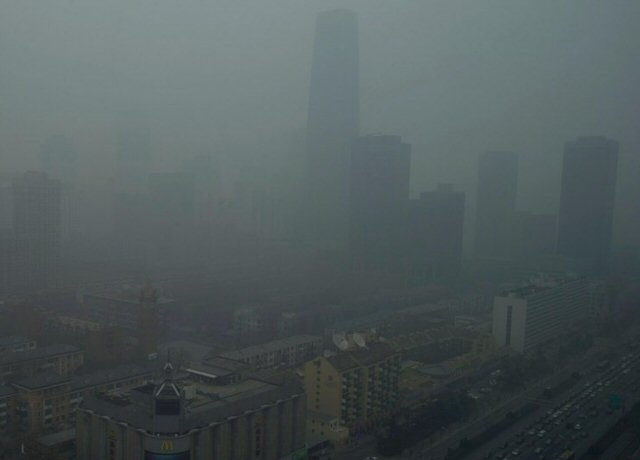
killer smog, and global warming.

Thick, off-the-scale smog routinely shrouds eastern China in winter, forcing airlines to cancel flights because of poor visibility and prompting the government to temporarily shut down factories and curtail fleets of government cars; streetlights and buildings all but disappear into the haze and pedestrians don face masks. But the problem is global: as of May 2013 worldwide levels of the chief greenhouse gas that causes global warming, carbon dioxide, reached 400 parts per million, an amount never before encountered by humans. The last time this happened was at least 2 million years (could be as much as 10 million years) ago, during the Pleistocene Era. When measurements of this gas were first taken in 1958, it was 315 ppm; currently, the concentration of CO2 is growing at about 2 parts per million per year, 100 times faster than at the end of the Ice Age. At that time it took 7,000 years for CO2 levels to rise by 80 parts per million. Now, because of burning fossil fuels, particularly coal and oil, levels have risen by the same amount in just 55 years. Natural gas, which is 75% methane, a far more potent greenhouse gas than carbon dioxide, also pollutes the air, albeit at a lower rate. Today the concentration of carbon dioxide is rising at 2 ppm per year. If the entire world were to switch to gas, the concentration of CO2 would still rise at approximately 1 ppm per year, and methane would increase as well.
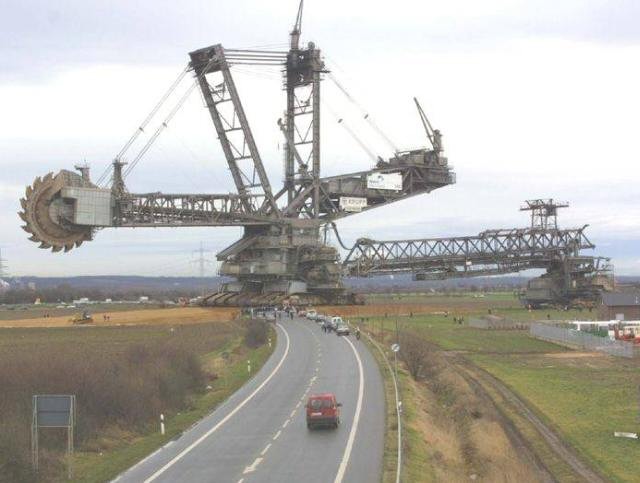
The method: using modern technology and equipment,
Earth moving equipment

Today’s giant earth-moving machines would fit right into science fiction movies, a far cry from the equipment used when the Panama Canal was built. Almost any excavation project is possible if the required technological, political, human and financial resources are brought to bear.
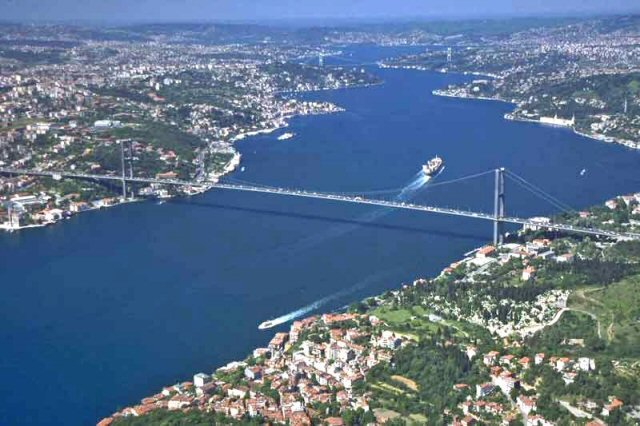
A possible sea-level canal from the Pacific Ocean…

There’s no question that this project would dwarf practically any engineering endeavor ever attempted: a trench at least 200 miles long, 3,400 feet deep, depending on the route, and 500 feet wide. The cost could well be in the hundreds of billions of dollars; the exact amount would have to be determined by a feasibility study. But it would have to be done only once, and it would pay for itself over time. In any event, not seeing this through is not an option given the gravity of our economic (few well-paying jobs for the working class) and environmental condition. Instead, it should be pursued with the same urgency and intensity as if our lives depend on it, because they do.
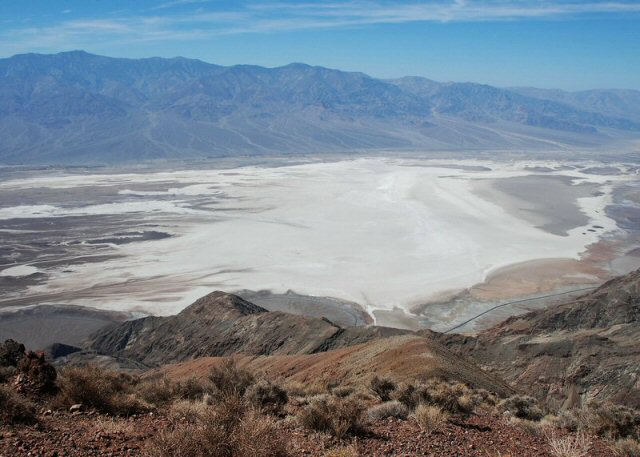
to fill Death Valley.
to Death Valley.

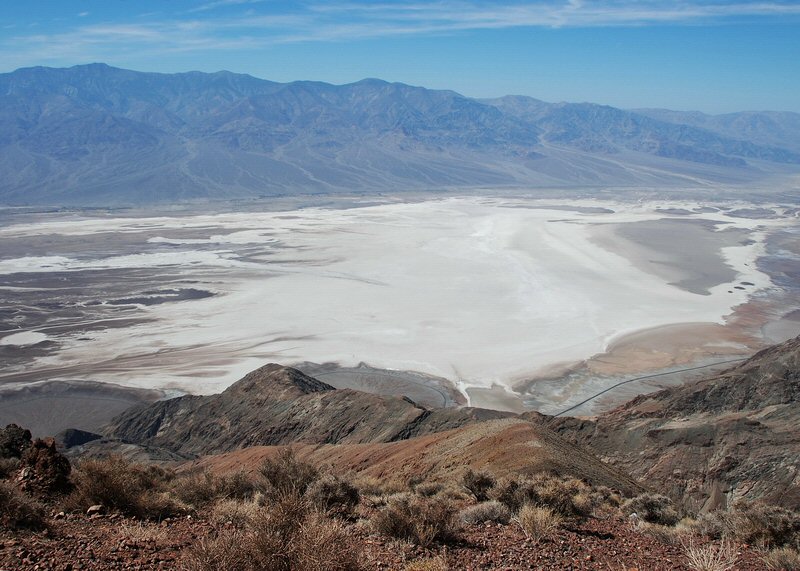
At 282 feet below sea level, the floor of Death Valley is the lowest, driest, and hottest location in North America, about 3,000 sq mi (7,800 sq kilometers). During the middle of the Pleistocene Era it was part of a succession of inland seas, collectively referred to as Lake Manly. There are four major mountain ranges between the Valley and the ocean, each one adding to an increasing rain shadow effect. As a result, the average annual precipitation is 1.58 inches (40 mm) and the typical summer daily evaporation rate 0.75 inches/day (1.9 cm/day. It is due to these characteristics that only a sea-level canal would constantly replenish the water that would be lost to evaporation and electrolysis without incurring constant pumping costs.

The idea of consuming large tracts of flat real estate with solar panels to generate electricity makes sense only if we persist in clinging to the outdated concept that buildings must be supplied with electricity generated somewhere else. Why not install efficient solar cells on each and every new building in the desert, including homes, and distribute the profits go to homeowners instead of utility shareholders? That would create an incentive to generate as much power as possible. The resulting income stream would help pay their mortgages, reduce the risk of default and lower interest rates. Of course, utilities could still compete with other licensed contractors to monitor, maintain and repair the distribution grid, necessary for industrial-scale electrolysis and aquafacture.
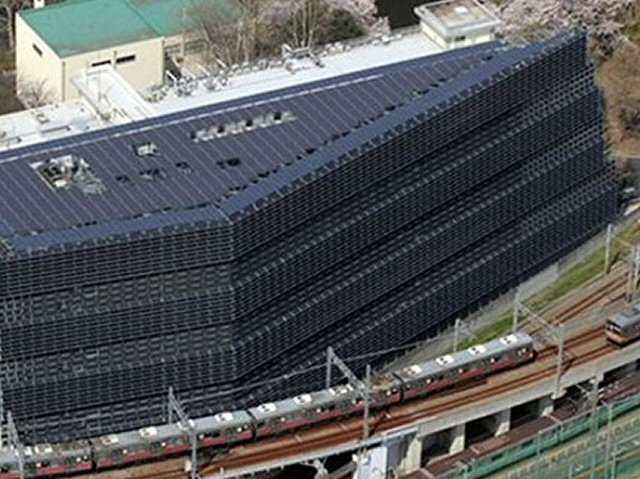
solar buildings,
Building with solar panels

Multi-story buildings have a larger theoretical capacity to generate more electricity for the same area of real estate than single family homes. The drawback is that they need additional space from other buildings of equal or greater height in order to avoid each other’s shadows. Thus, a dense forest of skyscrapers would not be ideal.
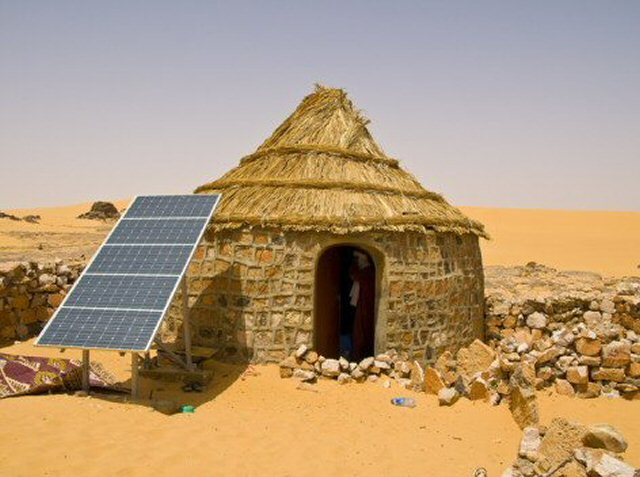
and solar homes, no matter how modest,
Add solar panels to any and all homes, no matter how modest,

If every home in every desert city were equipped with enough panels to produce a surplus of electricity during the day to charge batteries to be used at night, when the demand is lower, and export whatever is left to big users, the cities themselves would become the generating power plants. This disperses the generating sources, an advantage in case of war or terrorist acts.
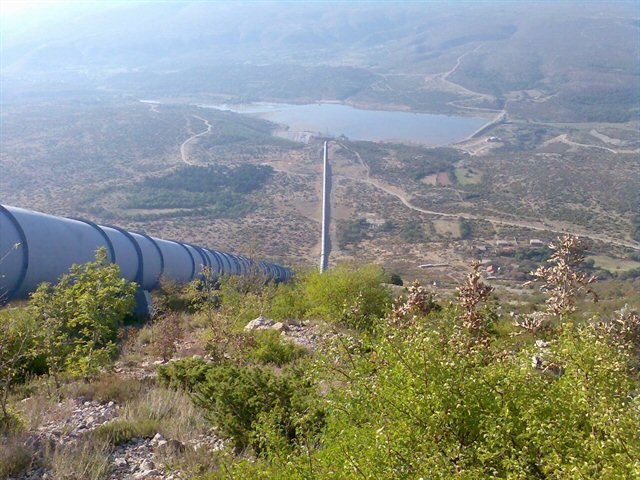
to produce hydrogen and chlorine by electrolysis at Death Valley. Save and store the chlorine; compress and pipe the hydrogen up to…
To produce hydrogen and chlorine by electrolysis at Death Valley. Save and store the chlorine; compress and pipe the hydrogen up to…

Compressed hydrogen -not water- would be pumped uphill. The advantage is that hydrogen weighs much less than water, therefore it requires less energy to pump. Because hydrogen is lighter than air, it tends to rise. This would simply accelerate the process.
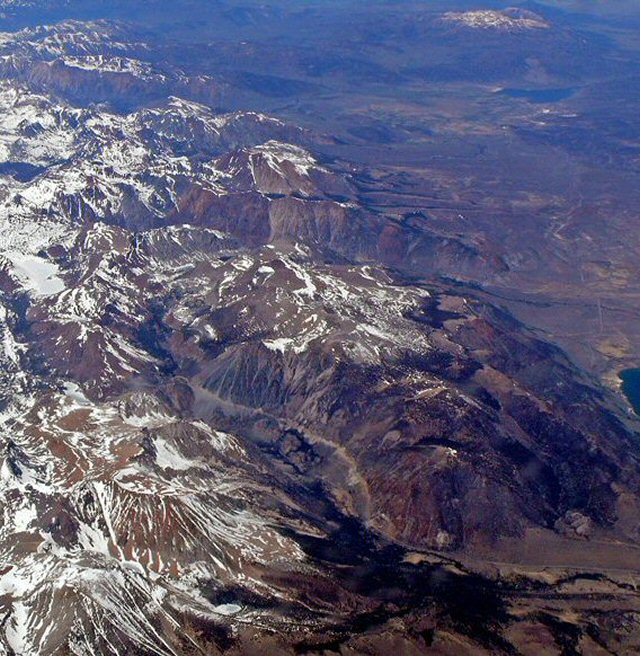
suitable mountaintops in the desert…
suitable mountaintops in the desert.

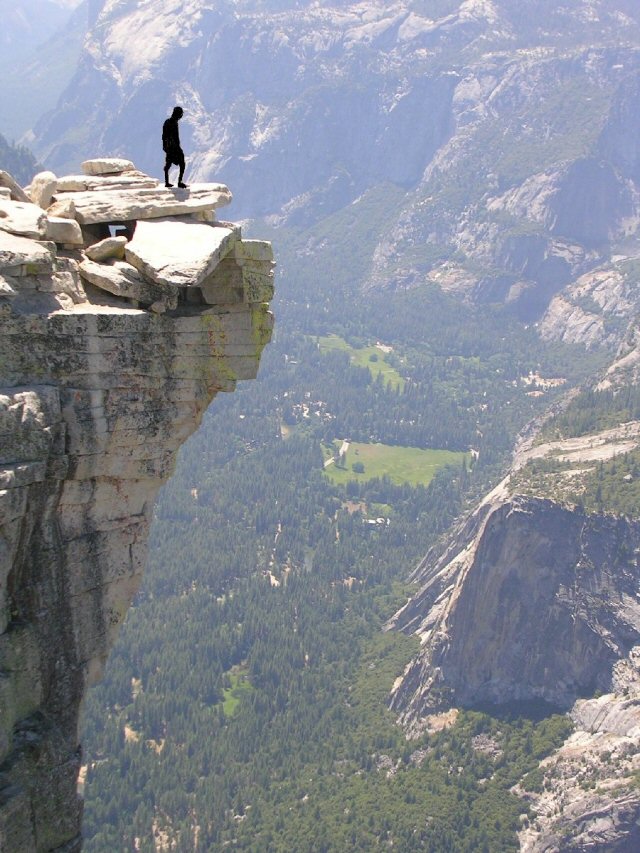
This is California’s Sierra Nevada, facing north. To the west is the San Joaquin Valley (not shown), to the right is a portion of the great southwestern desert. There are many mountains and hills in the desert that rarely, if ever, get any precipitation. Below are ravines and dry river beds. Only geologically suitable mountaintops would be used.

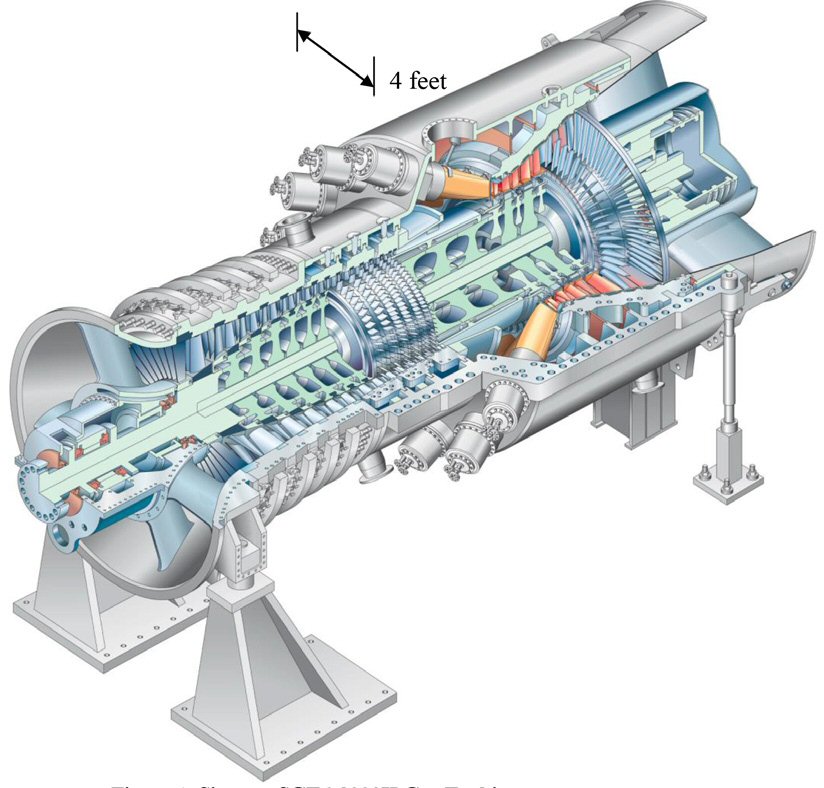
with new 1000 megawatt hydrogen power plants. Store a 24 hour supply of compressed hydrogen in man-made caverns and run the plants day and night. Fuel cells are not required.
New hydrogen power plants. Store a 24 hour supply of compressed hydrogen in man-made caverns and run the plants day and night. Fuel cells are not required.
Advanced Hydrogen Turbine

Clusters of five or more 1000-megawatt power plants would be built on top of selected mountains and use an advanced  hydrogen turbine, currently under development, to burn hydrogen directly without fuel cells.
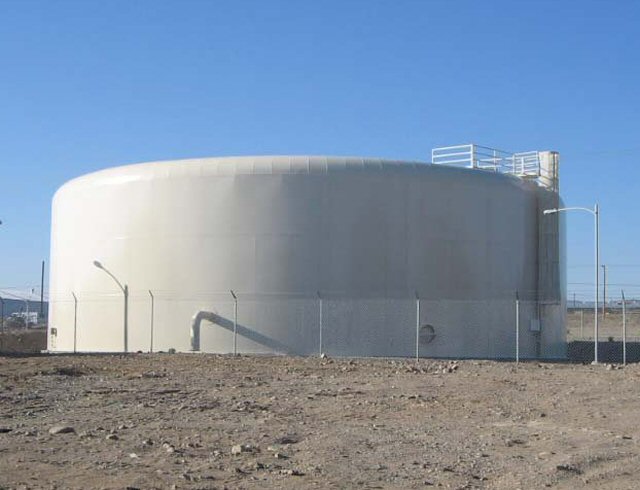
Condense and store the water vapor that the plants will produce.
Condense and store the water vapor the plants would produce.

When hydrogen is burned, water vapor is produced. Instead of allowing it to dissipate into the atmosphere, the latter would be collected, condensed and stored
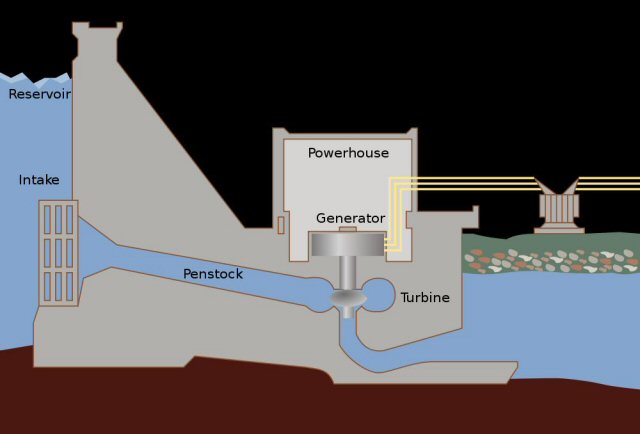
Use the same aquafactured water and gravity to turn turbines in a series of cascading plants located below the hydrogen plant. Their combined output should greatly exceed the energy used to produce, compress and pump the hydrogen. Dams are not required, only pipelines.

Below the hydrogen plant, a cascading series of water-driven turbines would be built. Costly dams would not be required, only pipes to feed the water to each successive turbine. The angle of descent and the pressure of the water would be designed to maximize efficiency. The jobs created by this system would be permanent and expandable. They would rely on free, inexhaustible raw materials (solar energy, seawater and gravity), not finite and unhealthful fossil fuels or nuclear fission.
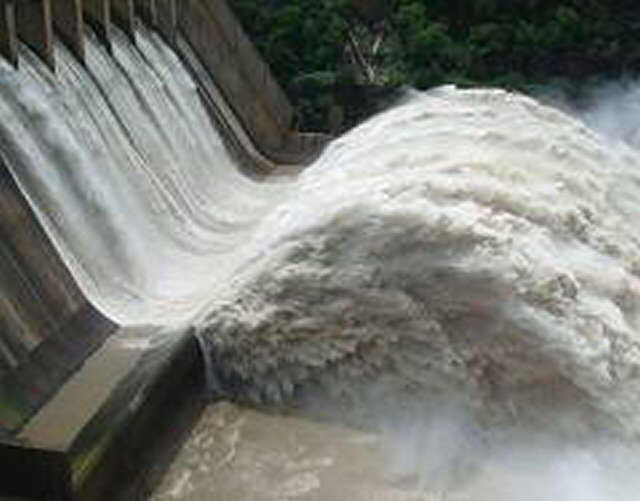
Use the new drought-proof source of water (and the stored chlorine, to treat it as needed) to create an economic frontier in the desert and elsewhere, recharge depleted aquifers, and save crops.

This is aquafacture: the manufacture of drought-proof, pure water anywhere, even in distant inland deserts. Unlike desalination, which consumes vast amounts of energy and requires a nearby natural sea shore, aquafacture actually generates a surplus of energy, makes water, requires no exploration and mining in dangerous locations, precludes the possibility of polluting spills and radioactive accidents, ends the dumping of carbon into the atmosphere, and ushers in the possibility of making the deserts green to recycle the carbon dioxide already in the atmosphere. Farmers and cities would get a constant, predictable amount of energy and water the year round without the possibility of floods or droughts. The system depends exclusively on sunlight, seawater and gravity, all practically inexhaustible and free.
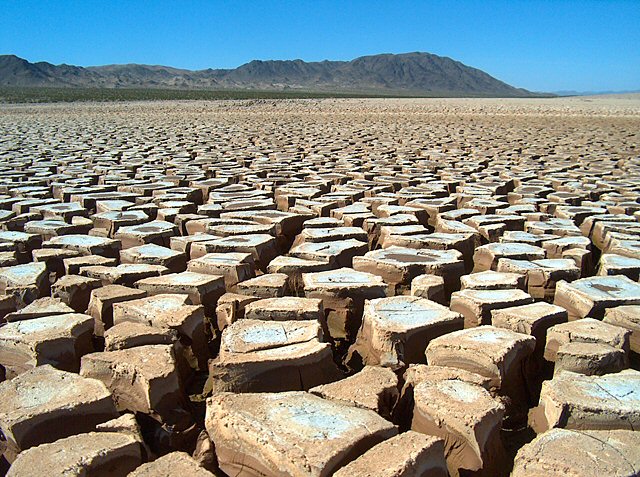
Using the new energy, pump seawater from Death Valley Lake to dry lakebeds throughout the Southwest.

The system is expandable. There are innumerable dry lake beds throughout the southwestern states.
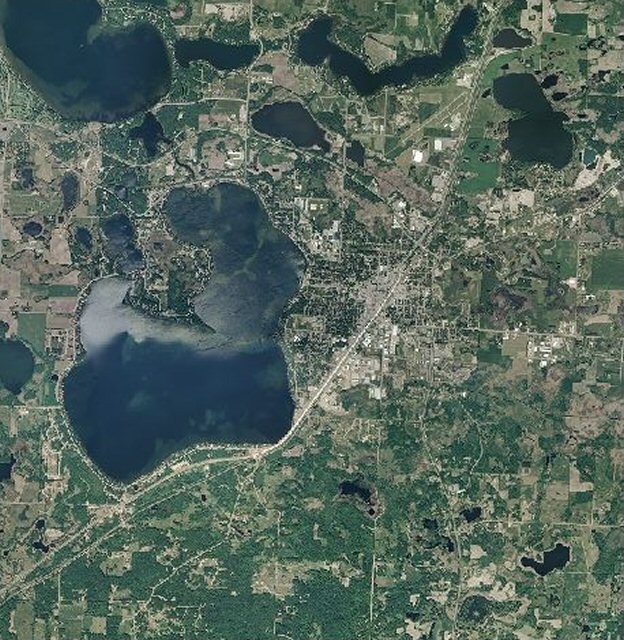
Create a vast interconnected network of shallow, warm, saltwater lakes with waterfront and view real estate; perfect for tourism, retirement, water sports, and fish farms of high value endangered species. Clone the hydrogen system as desired.

Once interconnected, the resulting ecosystem would be supported and improved by life-giving water. Since so many mountains and hills surround the proposed lakes, the real estate in and around the area would have stunning views not seen in millions of years. In effect, the inland sea of prehistoric times would be restored to user-defined specifications.
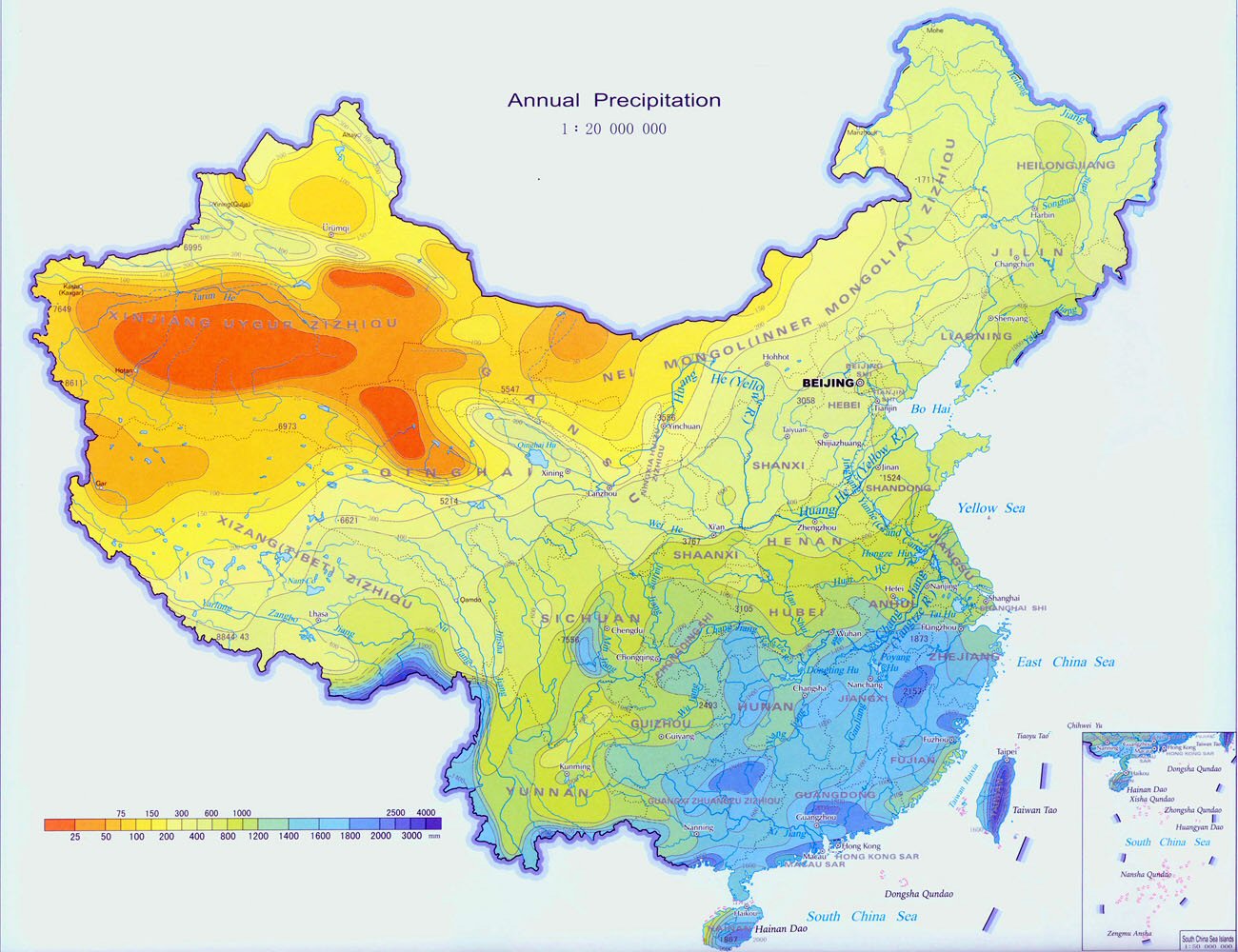
Export any excess water concentrate (hydrogen) and accompanying chlorine (to treat the pure water their hydrogen plants will aquafactured) to China, a vast, insatiable and receptive marked due to its
Export any excess water concentrate (hydrogen) and accompanying chlorine (to treat the pure water their hydrogen plants will aquafacture) to China, likely a vast, insatiable and receptive market due to its…

If we are to halt the emissions of carbon dioxide and methane, the chief culprits of global warming, enough hydrogen will have to be made available to China, India and Japan. They all consume enormous amounts of fossil fuels to generate electricity and will be forced to consume even more to meet future demand. China alone accounts for 50% of global coal use, and more than half of the country’s landmass has little or no water. Theoretically, even the Gobi Desert could be developed with aquafacture!
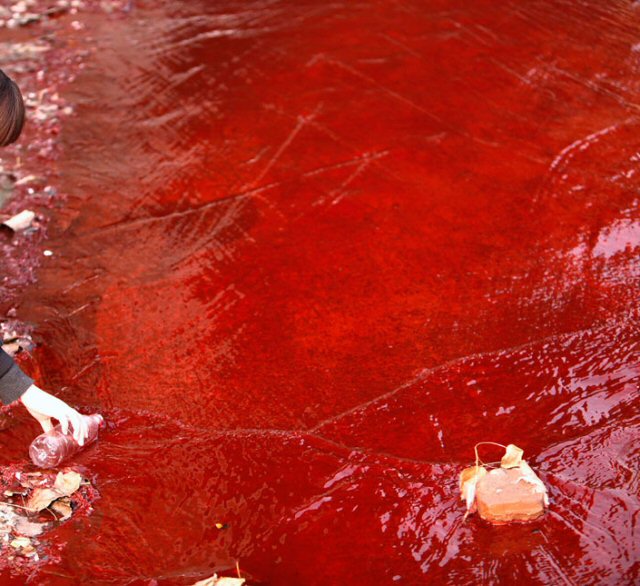
widespread, extreme pollution.
widespread, extreme pollution,

Extreme as it is, air pollution is not China’s most pressing environmental problem. The massive, continuing proliferation of factories has polluted most of its lakes and rivers.
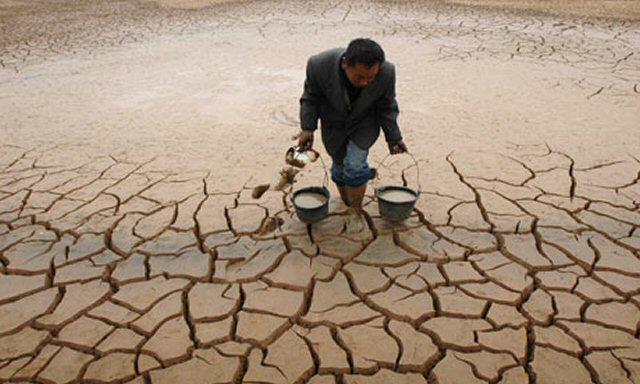
persistent drought,
persistent drought,

It’s not only that over half of China is extremely dry. Even areas that are supposed to have abundant rainfall have been hit with severe drought, a consequence of global warming.
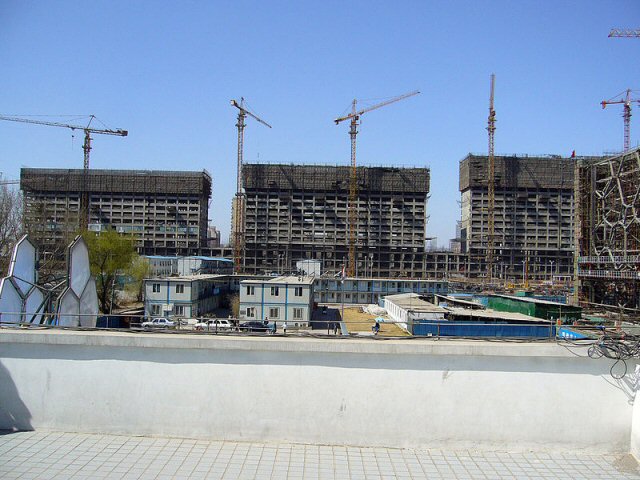
and unquenchable thirst for energy to support its high growth rate.

China’s economy must grow to lift its people out of poverty. If and when its per capita income reaches parity with the U.S., its demand for energy and water will increase to levels never seen. Without aquafacture, how will they and the rest of the world meet future demand?

A win-win solution. Millions of new, well paying middle class jobs for the two largest economies powered by renewable energy. The result: clean air and water, balanced trade, and possible cooperation rather than confrontation.

Nuclear-armed mankind is at a crossroads. Either we cooperate to reverse the damage we’ve already caused to the environment, which is accelerating, or we’ll have to face consequences no one can foresee or control.

Major Problems

Though by no means all-inclusive, the following are among today’s most intractable problems:

The truth

Introduction

Library

Welcome to Wikisolver, a free cooperative effort dedicated to finding feasible, practical solutions to the thorniest issues of our time, including, but not limited to, global warming, drought, and the yawning, growing gap in the distribution of income and wealth.

How It’s Organized

The site consists of one horizontal menu (in yellow letters at the top of the page), categories of posts on the left, and useful, informative external links at the bottom, sorted by topic. Plan A is a specific, feasible blueprint to simultaneously:

  • Halt -and eventually reverse- the accumulation of carbon emissions in the atmosphere.
  • Prevent flooding of low-lying cities.
  • Conquer drought, including deserts far from any body of water where desalination is impractical or impossible.
  • Substantially reduce the abysmal gap in the distribution of wealth and income without necessarily resorting to onerous, egregious taxes on the rich.

The top menu includes a detailed description of how the plan works, examples of how it could be replicated in various areas with a variety of geographic, geological, topographic and cultural characteristics, and warnings of what will happen if these problems are not promptly addressed and solved.

The left menu consists of Posts related to these and other pressing issues, sorted by topic, and a Search Box. Below it is a section of useful external links, by subject. To the right of them is our Featured Post, and to the right of that is the RSS section that allows users to subscribe to any or all of the categories on the list.

Homes Too Expensive

They say all real estate is local, but the West has more recently been an indicator of what is to come for the rest of the nation. It was the first region to crash in the mid-2000’s and the first to show signs of recovery toward the end of the last decade. Now the tides have turned again.

Sales of existing home sales nationally fell 3.2 percent in October 2013 from the previous month, but in the West they were down 7 percent. The West was also the only region to see a year-over-year decline in home sales.

“In the West region there is a significant shortage of inventory, so you have buyers who are looking for the right home unable to find it and unwilling to commit,” said Lawrence Yun, chief economist for the National Association of Realtors. “But because of the inventory shortage, one is still seeing strong price increases in the West.”

California is a glaring example. The median price paid for a California home in October was $357,000, up over 25 percent from a year ago, according to San Diego-based DataQuick. This was the 20th-consecutive month of annual price gains and the 11th month where those gains exceeded 20 percent.

As distress, in the form of foreclosures and short sales, move out of the West, there are far fewer low-end homes to buy. Just 6.6 percent of California homes sold in October were foreclosures, the lowest level since 2007. Supplies are down 26 percent in San Francisco, according to the California Association of Realtors, and that is pushing many buyers to condos instead of single family homes.

Condominium sales nationwide were actually up over 3 percent in October month-to-month, according to the NAR, while sales of single-family homes fell over 4 percent.

“Many buyers are considering more affordable options, such as condos and town-homes, especially in the San Francisco Bay Area, where there is a greater abundance of these property types,” CAR’s Leslie Appleton-Young said in a release.

While home prices in California, and across the nation, are still well below their peaks of the housing boom, there is a major difference for home buyers today: credit. Mortgage rates may be lower on the 30 year fixed, but that wasn’t the product used during the boom. Adjustable rate loans with no down payment requirement and 1 percent “teaser” rates were popular. Those are gone today. Now, most loans are fixed rate products that require larger down payments and higher credit scores.

“Bottom line, on a monthly payment basis and relative to income needed to qualify for a loan, a house in California is far more ‘expensive’ than from 2004 to 2008, even though house prices are not back to peak levels,” said Mark Hanson, a California-based housing analyst. “Put another way, it costs a lot more today to pay for a house using a mortgage than it did from 2004 to 2008. Thus, if 2004 to 2008 was a “bubble,” then this must be, too.”

On the flip side, home price gains are slowing in Phoenix, which like California saw prices jump over 25 percent recently. Now they are up just 16 percent annually, according to CoreLogic. Sales fell 8 percent in September, despite a 32 percent jump in inventory, according to the Cromford Report.

Investors may be putting some properties back on the market again in Phoenix, eager to take advantage of higher prices, but those same higher prices are crimping demand. If this is an indicator of what is to come in California, that is a clear red flag.

The rest of the nation did not see the same dramatic swings as most Western markets, but the supply, demand and pricing dynamics are similar. Prices are up over 12 percent nationally and inventories are down across the nation. For those predicting the national housing market over the next six months, watching the West is a good idea.

Original article in CNBC, 11/20/2013

Inside Countrywide

WorkingRE Magazine

Interview: Appraiser Who Brought Down Countrywide

By Isaac Peck, Associate Editor

The U.S. housing bubble and the corresponding real estate market crash of 2007-2008 brought about one of the most severe economic downturns in America since the Great Depression. The fallout was extensive: banks failed, established companies declared bankruptcy, the net worth of American households plunged, and millions of Americans lost their homes and jobs in a great recession that quickly spread globally, submerging the economies of Europe, Asia, and the developing world.

Among the many firms and individuals who acted irresponsibly, and maybe criminally, perhaps none did so with such flair and recklessness as Countrywide Financial.  Before its rescue-sale to Bank of America (BOA), Countrywide was the largest mortgage lender in the United States.

Countrywide became a “leader” of sorts in the lending industry, according to numerous lawsuits filed by the Department of Justice, by adopting reckless lending practices, encouraging fudged loan applications, and violating appraiser independence in order to gain market share. A move that, some say, led to other lenders lowering their standards to compete.

A little-known fact is that the original whistleblower at Countrywide Financial, the man whose suit sparked an investigation that culminated in a one billion dollar settlement between BOA and the Department of Justice, is a real estate appraiser named Kyle Lagow.

Kyle Lagow

Lagow was an appraisal manager and assistant vice president at Landsafe, Inc., the appraisal subsidiary of Countrywide, a position which gave him an inside look at the practices which caused the downfall of the largest mortgage lender in America. For his part, Lagow sees Countrywide as being at the heart of both the housing bubble and the real estate crash. In his words, Countrywide, “Started a train and laid the tracks that ran the industry off the edge of a cliff.”

This is his story.

How It Began

Kyle Lagow of Plano, Texas says he was an appraiser running his own firm for 14 years when he was contacted in 2004 by Landsafe and offered a position as an appraisal manager, responsible for building an appraisal division to span several states.

“The third time they called they made the opportunity attractive enough and told me that I would be able to build a staff of quality appraisers. So I told them that as long as we do it right, I’ll run it,” Lagow says.

At Landsafe, Lagow was tasked with hiring and training a division of staff appraisers spanning multiple states whose primary purpose was to appraise a growing volume of Countrywide loans. Ultimately, Lagow helped open new markets for the company, expanding Landsafe’s appraiser panel into Utah, Colorado, Arizona, Louisiana, Texas and Oklahoma.

Fraudulent Appraisals

Lagow says it didn’t take long for him to realize that Landsafe’s executives weren’t interested in quality appraisals.  The original suit filed by the DOJ alleges that in early 2005, a Landsafe executive called a meeting of appraisal managers and made it clear that (1) they needed to quit thinking of an appraisal as a separate unit, (2) that Landsafe appraisers were there only to “help facilitate closing,” and (3) that they needed to change their “thought process.”  (You can find the suit at WorkingRE.com; Sidebar Information (left column); Lagow vs. Countrywide Original Complaint.)

“An appraiser would turn in his or her appraisal. If it was low or didn’t meet value, it went to a reviewer. If the appraiser didn’t meet value, the reviewers were instructed to go and look at the market to see if they used the best comps and to try to discredit the appraiser. The kicker is that I have an appraiser who I trusted, hired and put on my fee panel because I believed they would do a good job. But at Landsafe, the entire review process was designed to ensure the appraisal came in at value. If one of my appraisers didn’t meet value, they were blacklisted. Our own company would turn them in to the state and call them a bad appraiser,” says Lagow.

Unfortunately, extreme internal pressure to meet value and the blacklisting of quality appraisers was just the tip of the iceberg.  In 2005, Lagow learned of a joint venture between KB Home and Countrywide, wherein Countrywide would provide the loans for new construction developments of KB Home. Lagow was tasked with hiring appraisers to complete that appraisal work.  However, Lagow says that when his staff appraisers showed up at KB’s developments to appraise properties, they were turned away and told that KB had an agreement with Countrywide where it alone would decide who did the appraisals.

Lagow soon learned that a separate appraisal manager at Landsafe was handling all of KB appraisal assignments; the work went to a small number of hand-picked appraisers. The DOJ suit alleges that in Houston, the appraiser chosen by KB Home completed over 400 appraisals in a single month by himself, all at a price of $450 per appraisal.

Shortly after Lagow realized what was happening, he began sending notifications to upper management, even though he had been warned against putting his concerns in writing. On September 7, 2005, Lagow wrote the following:

“In summary: We have a clear attempt to control the market- utilization of one appraiser, a refusal to supply data with outside appraisers, and the appraiser of choice is being paid a fee abnormally higher than what we pay everyone else for the same work. Add in the fact that recent appraisals from outside appraisals have come in low, and I could make a fairly strong case for market manipulation and appraisal fraud. Even if it is not intentional, it looks bad.”

At the end of his email, Lagow warned that the problem would spread if nothing was done to fix it: “I also want to caution anyone who cares to listen, that if we allow this in Houston it will spread through the KB Home markets.”

Lagow says that he personally inspected many of the appraisal reports completed by the Houston appraiser. “I looked at appraisal orders. I could tell you when the inspection appointments were scheduled. One day, one was set for noon and the next one at 12:01 P.M. It was a total fraud,” says Lagow.

See No Evil

Lagow’s words of warning fell on deaf ears as Landsafe executives proceeded to institute a “production-based” pay system where staff appraisers were forced to radically increase their appraisal volume in order to earn the same income, according to the complaint filed by the DOJ. Lagow also says that Landsafe also facilitated a channel whereby Countrywide’s own loan officers could request target “audits” of Landsafe appraisers who were not meeting value.

The original suit filed against Countrywide by the DOJ lists over half a dozen appraisers who were “audited” at the direction of loan officers who were upset that appraisers were not meeting value. According to the suit, one of the appraisers that Lagow hired to add integrity to the appraisal process was told point blank by a KB Home sales manager that KB would no longer require his services if his appraisals came in below contract price.  When he refused to go along with the fraud, the appraiser was blacklisted from completing appraisals on any Countrywide loans.

Frustrated at the apparent fraud he was witnessing, Lagow sent this chilling email to his supervisors at Countrywide Governance in February 2006:

“At the risk of losing my job I am forwarding this email to you and want to relay my deepest concern for the situation addressed. I report directly to you but I am also forwarding this to (a superior) because she and I have talked about general concerns in the past.

I have spent considerable time looking over the KB Home situation in Houston, Texas and took some time to drive a couple of subdivisions this weekend and look around.  As you are aware, one appraiser controls the orders and the values…I believe that (name redacted) and KB Home are engaged in a fraud to manipulate the local market.

In looking at the appraiser’s reports, when he needs to, for value, he goes outside the market to access superior sales to bump up the market and then uses the same sales in future sales, thus establishing and manipulating the market. The appraisal reports I have examined have a continual characteristic of selective manipulations of the market data in an effort to pump up the market.  It is my opinion that, based on very limited data, we could be making 115% loans in the markets and if you examine some KB Home subdivisions you see significant foreclosure rates.  I believe that by allowing the situation to continue we are condoning the activity and placing at risk the jobs of our employees at Landsafe and Countrywide. I am even more concerned, and I do not have any supporting data other than the logic that an order has to come from us, that the individuals who mandated that only one appraiser be utilized may be a Countrywide employee and could be implicated in a conspiracy to defraud both the homeowners and the stockholders.

We are charged with the responsibility of protecting our client’s assets. If I am correct on any of this, and if it blows up, the blame will rightly fall on us for failing in our task. This has the potential to be a lightning rod for the demise of Landsafe and we will need to act to make sure every effort has been made to safeguard against this…”

Nothing changed as a result of the letter, Lagow says. Finally, in 2008, Lagow says he sent an email directly to Angelo Mozilo, CEO of Countrywide, urging him to stop the fraudulent practices and warning him that his executives were not reporting the facts to him.

“I really wanted Mozilo to have not been aware of this. I wanted to believe that a guy who spent 40 years building this company wouldn’t want its legacy to be that we ran an industry off a cliff and that we gave our industry a bad name. I couldn’t believe that he could have known about it, I went to everyone else before I went to Mozilo,” says Lagow.

Lagow explains that Mozilo sent someone down to, in his words, “put on a show.”  He was even contacted by several of Countrywide’s top executives who seemed concerned, but the “conclusion” of management was that Lagow’s concerns were unfounded.

Fighting from the Corner

By late 2008, Lagow learned that he needed treatment to combat cancer and he was subsequently fired from Landsafe.  “I fought inside the company for a long time to stop what was going on. When I left I told them, look, I’m going to fight to fix this either inside the company or outside the company,” says Lagow.

Leaving Landsafe wasn’t easy for Lagow. “At the time, I was pretty defeated. I built their market for them. They took my model and applied it to the east and the west coast. They didn’t have a clue how to hire and manage a staff appraiser division,” says Lagow.

Lagow says he wasn’t even planning to file suit. “I had cancer when they fired me. I just wanted to make it through that fight.  I honestly didn’t want to go this route- I was on the list to do work for Bank of America.  But then I received a letter from a BOA’s attorney saying that they were not going to put me on their fee panel list,” says Lagow. At that point, Lagow said he had no choice. “I had to fight, there was nothing left.  I was broke.  I couldn’t do work for them, I didn’t have any money. After all that they put me through, I was ultimately deprived of this little bit of dignity of being able to do appraisal work. I got mad. I picked up the phone and called up some lawyers who were filing class action lawsuit. I said how can I help?”

The rest is history. In late 2009, Lagow filed a whistle-blower complaint under seal, charging that Countrywide had committed fraud and violated the U.S. False Claims Act.

But things got worse for Lagow before they got better. “Once the lawsuit was filed I couldn’t talk to anybody, not even my family. You go out there to try to help an industry, and no one even knows you’re fighting the fight. Your kids look at you like a failure, you can’t get any work. You’re fighting cancer. I lost everything, I had repo people knocking on my door,” Lagow says.

Lagow’s complaint was among at least five other whistle-blower complaints that were rolled into the $25 Billion settlement between regulators and the nation’s largest banks in 2012. Lagow’s complaint was also critical to a $1 billion settlement between the Federal Housing Administration (FHA) and Bank of America in 2012.

For Lagow, his eventual victory is bittersweet. “As far as being a whistleblower, I wouldn’t wish it on anyone. I got lucky. Without my lawyers, Tom Loeser, Shane Stevenson, and Stevie Berman, who were courageous enough to take the case, I’d be sitting in a house in default.”

For his share of the settlement, Lagow will receive $14.5 million for his role as whistleblower. Lagow is thankful but says that it isn’t as much as people might think.  “By the time the government takes its share, and the attorneys take theirs, it’s not as much of a windfall as everybody thinks.  If I were working for the rest of my life, I would earn more than that,” says Lagow.

Present and the Future

Appraisers may not be surprised to learn that Lagow doesn’t think much has changed in the industry, even after all he has struggled for. “I don’t think I made much of a difference. Everybody likes to say that there have been big changes. The only change right now is that there aren’t as many loans being done. If you had stolen $1 billion at gun-point, would you still be typing on your computer? I don’t think so. Yet the same people who were in charge when this fraud took place are still here. My supervisor at Landsafe, the area manager, is still there. The appraiser who was completing 400 appraisals a month in Texas still has his license. So you tell me, what’s changed?”

“You still have staff appraisers who know that if they don’t meet values, their name is going to show up on somebody’s do not use list,” Lagow continues.  “Volume corrupts because the biggest problem that we had back then was that loan officers who did the biggest volume would say, ‘If you don’t get rid of so and so, I’m going to go somewhere else.’  So loan officers had tremendous weight and influence and they still do. You have the same infrastructure in place so once loan officers start doing millions of dollars of loans again, the same thing will happen.”

“What these criminals did, committing fraud and inflating values, was a felony before and it is a felony now, yet we haven’t put any of the big players in jail- so nobody’s afraid,” Lagow says. “Go out there and look and see how many people have been indicted from small private mortgage companies.  Look and see how many have been indicted and tried and put in jail from the largest mortgage companies. You will find that there are numerous individuals in the private sector but when it comes to the big companies, the regulators don’t go after them. Let’s start putting some people in jail and see how quickly the rules start getting followed. Unless there is a profound movement in the industry as a whole, they’re going to do it again. And they’ll put the burden, and the blame, on the appraiser.”

Lagow’s message to other appraisers is simple: do good, honest work. “My message is to do the numbers, do the best appraisal reports you can.  If somebody doesn’t like your work, if your values aren’t there, walk away. Have the dignity and self-respect to walk away and go find another client, everything else will take care of itself.”

Disclaimers

WIKISOLVER DOES NOT GUARANTEE THE ACCURACY, CURRENCY, ADEQUACY OR COMPLETENESS OF ANY PORTION OF ITS CONTENT, INCLUDING, BUT NOT LIMITED TO, FACTS, VIEWS, OPINIONS, STATEMENTS OR RECOMMENDATIONS ON THE SITE.

No experts or specialists have reviewed or verified the content of any of the articles in WikiSolver. They are meant for reference only, therefore all its information is provided without any express or implied warranty of fitness for any purpose or use. Should you require expert advice, WikiSolver strongly urges you to seek a competent, reputable, licensed professional in the specific discipline or disciplines of interest.

The information in WikiSolver is provided free, without contract, express or implied, between the reader/user and the owner(s) of this site or the owner(s) of the servers upon which it is maintained, or anyone else connected with WikiSolver, directly or indirectly. Furthermore, no one at WikiSolver shall be held liable for any subsequent interpretations, changes, edits or modifications done by anyone else to any content whatsoever obtained from, or found at, WikiSolver.

WikiSolver is maintained in, and meant for, users in the United States of America under the protection of local and federal law. However, it is conceivable that some or all of its content may violate laws, precepts or beliefs in foreign countries. Should that be the case with yours, you use WikiSolver on your own initiative and at your risk and responsibility.

Fundamental Facts

Water Equation #2

Chemistry

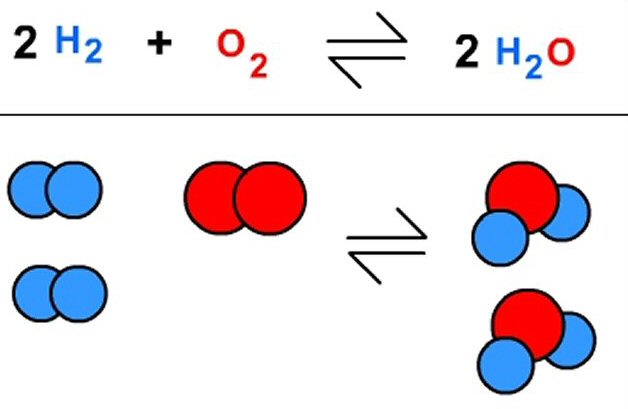
Assuming that hydrogen gas behaves as an ideal gas, that conservation of mass (nothing is lost) is achieved, and that sufficient oxygen is available for complete combustion, 2 moles of hydrogen gas, when combined with 1 mole of oxygen (O2)  will produce 2 moles of water.  A mole of hydrogen gas weighs 2 grams and occupies 22.4 liters (volume) at standard temperature and pressure (1 atmosphere and 0 degrees C, or 760 torr and 273 Kelvin). Therefore, assuming complete combustion, 22.4 L of hydrogen gas weighing 2 grams would yield, upon condensation, approximately 18 grams of rather cold, pure water (the exact amount would vary according to the atmospheric pressure and temperature). In simple terms, 1 mole of water (18 grams) is 9 times heavier than 1 mole of hydrogen (2 grams).

The importance of these facts cannot be overstated, for they may well be the key to simultaneously halt –and perhaps eventually reverse- global warming, conquer drought, and introduce a new economic platform geared specifically to reduce the yawning gap in the distribution of income and wealth, all of which have been identified as clear and present threats to the security of the world by legions of prominent scientists and economists, the United States government, and the World Bank. Here’s why.

Hydrogen and Gravity

Elemental hydrogen does not occur naturally on Earth. Long ago it combined with other elements to form many compounds, including fossil fuels and water. The law of conservation of energy states that it takes more energy to free the hydrogen in the ocean than would be released by oxidizing it. As a result, the process is considered inefficient and uneconomical. But that law does not consider the possibility of using solar in combination with gravity –both of which are constant and free- to take advantage of the weight differential between water and hydrogen to recover the energy loss or, depending on a number of variables, generate a large surplus of electricity. In fact, even though the three raw materials (gravity, solar and seawater) are free, fully renewable, abundant and readily accessible, no nation is known to be presently considering utilizing them exclusively to produce hydrogen by electrolysis of seawater on a scale sufficiently large to generate all their electricity, or alternatively, export hydrogen to others that are either unable or unwilling to produce it. One reason is the misplaced belief that it is far more efficient, and therefore less costly, to use solar to generate electricity directly; another is the disproportionate effect that special interests have on electoral processes, and by extension, on elected decision makers.

Water Cycle

The Water Cycle

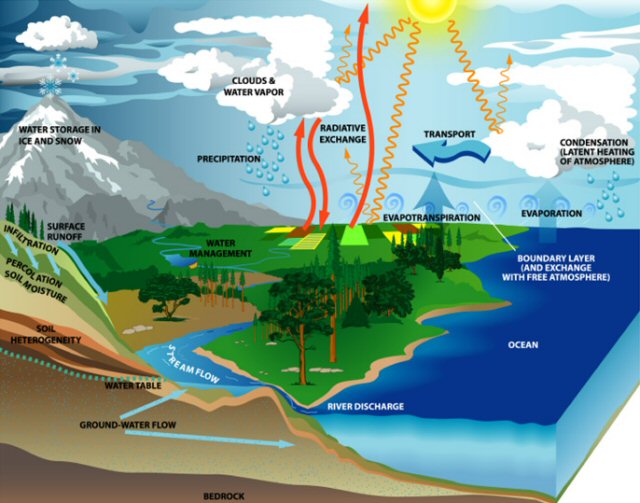
The world’s true source of fresh water is the ocean; without it our planet would look like Mars. But, as with fossil fuels, surface fresh water is not uniformly distributed throughout the world. Some areas, such as the Great Lakes in the United States and the Amazon Basin have it in great abundance; others, including the great deserts of the world, have little to none.

Impending Threat

Global warming is exacerbating this uneven distribution, threatening the production of food in many regions of the world, including California –which produces more than ½ of the nation’s fruits and vegetables- and the Great Plains, where the Ogallala Aquifer is drying up. If this is not decisively addressed, the U.S., currently a major exporter, may eventually be forced to import much, if not most, of its food. That would increase its dependence on foreign suppliers, the trade deficit, and unemployment; by extension, it would also reduce the tax base and increase the federal deficit. More importantly, since other food-exporting nations may also experience similar problems, who exactly would have the spare capacity to fill the shortfall, and for how long? But there’s more.  Natural population growth will create the need for new jobs and still more water. Clearly, humanity is at the edge of a precipice.

Terraced Waterfall

A Potential Game Changer

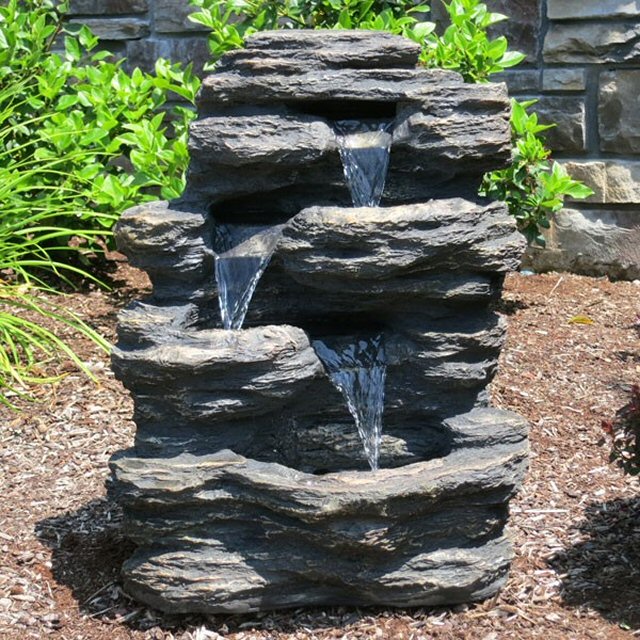
With the exception of desalination plants in some coastal areas, which consume enormous amounts of energy, humanity relies on the natural water cycle to quench its thirst and grow its food. The ancients did it thousands of years ago, and despite our technological advances, basically we’re still doing it the same way. The time has come to bypass the cycle, which no longer meets our needs. We must learn to manufacture our own fresh water far from coastal areas, where desalination is impossible or impractical, so we can irrigate the deserts, conquer drought, and spur economic growth regardless of climate change. Nuclear and fossil fuels cannot do that; hydrogen can. Plan A describes in broad detail a way to do so; therefore, given the glaring absence of other viable alternatives on a scale comparable to it, national governments and the United Nations should consider, at a minimum, assembling teams of prominent engineers, scientists and economists to confirm its feasibility. Time is of the essence.

Plan A: Detail

A comprehensive proposal to simultaneously:

1) Create an entirely new and permanent economic frontier, initially with thousands of well-paying middle class jobs that cannot be outsourced or relocated, followed by millions more when it becomes fully operational.

2) Transform the U.S. into the world’s largest green energy exporter, potentially capable of meeting the lion’s share of global current and future demand -without adding any greenhouse gases to the atmosphere.

3) Transform the trade deficit into a surplus.

4) Create a new drought-proof source of unpolluted water -unrelated to acquifers, rivers and lakes- to meet current and future demand.

5) Begin the process to reverse global warming without harming any economy.

BONUS: Public funds would not be required to build and operate it.

A Precedent

In 1998 Iceland announced its intention to eliminate its dependence on fossil fuels by creating a hydrogen energy economy. Endowed with abundant geothermal resources, the local price of electricity was lower than the price of the hydrocarbons that could be used to produce it. Accordingly, Iceland decided to export its surplus electricity by converting it into an exportable commodity, and in 2002 it produced 2,000 tons of hydrogen gas by electrolysis, primarily for the production of ammonia, at a local fertilizer plant. Due to reasons unrelated to the price of hydrogen, in 2004 the plant went out of business, and by 2006, deprived of its main customer, hydrogen production fell to negligible levels. However, these events proved that under certain conditions it is possible to produce hydrogen at prices below fossil fuels.

Purpose

The purpose of this plan is to use solar energy to produce hydrogen and oxygen from the electrolysis of seawater (brine) in the U.S. for domestic use and export it to China and elsewhere to: (a) replace coal as its primary fuel to generate electricity; (b) produce pure water, and (c) eliminate the main culprit of air pollution. The system would be efficient and profitable.

Hydrogen From Natural Gas

With present knowhow more energy is required to produce hydrogen from water than can be obtained by oxidizing it. As a result, a self-sustaining chain reaction is not possible and an external source of energy, usually natural gas, is required. Since it is more efficient and less costly to use gas directly to make electricity, global hydrogen production from water electrolysis, which requires electricity itself, is currently negligible, about 4%.

The Solar Exception

Fossil fuels and nuclear fission require extraordinarily costly and risky exploratory, mining, processing, and delivery operations. The incessant, ever-increasing burning of oil and coal has caused global warming and polluted the environment, and the need for a guaranteed supply of oil threatens to catalyze a cataclysmic war that will benefit no one and solve nothing. As for nuclear waste, its radioactive emissions last for hundreds of thousands of years, and current technology does not have a cost-effective way to stop them. In contrast, solar energy –the mainstay of most life on our planet- is delivered to us free, constantly, universally, and in great abundance.

Free elemental hydrogen gas occurs naturally on Earth, but it is not widely accessible. Instead, most of it has combined with oxygen to form the oceans, lakes and rivers that cover three fourths of the surface of our planet. The process of producing elemental hydrogen from water using electricity is known as electrolysis. Due to its salt content, which is a natural electrocatalyst, seawater (brine) is about one million times more conductive than pure water, therefore it is far more energy-efficient to use brine to produce elemental hydrogen. One of the main obstacles to do so is that seawater and uninterrupted sunlight do not naturally coexist in high-yield locations -defined as exceedingly long coastlines naturally sheltered from precipitation such as hurricanes, cyclones, typhoons, snow, rain, quasi-permanent cloud cover or fog or sandstorms- safe from the incessant threat of all-out war. Consequently, it behooves us to find a way to combine the sun’s energy, gravity and brine, which are free, abundant and virtually inexhaustible, to export hydrogen and freshwater at a lower cost overall to countries who would need to build enormously expensive irrigation projects and either fossil or nuclear plants to develop their arid regions. This article describes a way to do precisely that.

Why produce hydrogen when the same solar energy could be used to produce electricity directly? Electricity cannot currently be easily exported from one non-contiguous landmass to another, and no country is currently exporting its surplus solar energy. A perfect example is the State of Hawaii; the islands cannot connect their grids, and its surplus solar energy is not being exported. Since an efficient, low-cost medium has not yet been discovered to do so, hydrogen -nature’s battery- is the way to go. The first country that does it may well become the world’s largest and preferred energy supplier and the recipient of unimaginable wealth.

Why should other countries want to buy American-produced hydrogen? Because only the U.S. could potentially export hydrogen a price below what others would have to pay for the sum of coal, gas or nuclear fuel; the hydrogen would allow buyers to generate electricity from a clean source and simultaneously manufacture water. Should hydrogen replace coal as the principal fuel to generate electricity, one of the largest sources of carbon dioxide and other pollutants would be eliminated; eventually the hydrogen might also be used for mobile applications. In addition, for countries that rely on nuclear power or have announced plans to increase their reliance on it such as France, Japan, and China, the ever-present danger of contamination due to natural catastrophes, terrorism or war would disappear.

Storage And Transportation Of Hydrogen

Hydrogen is corrosive; therefore, pipelines and storage tanks require expensive internal coatings. However, underground caverns, salt domes and depleted oil and gas fields, which do not corrode, are currently used to store hydrogen. Similar facilities could be dug near electric power plants at a relatively low cost. While initially expensive, the additional cost of coating the pipelines used to distribute it –which would be borne by the users- would be offset by low-cost raw materials, reliable supplies, and a cleaner environment.

 Death Valley

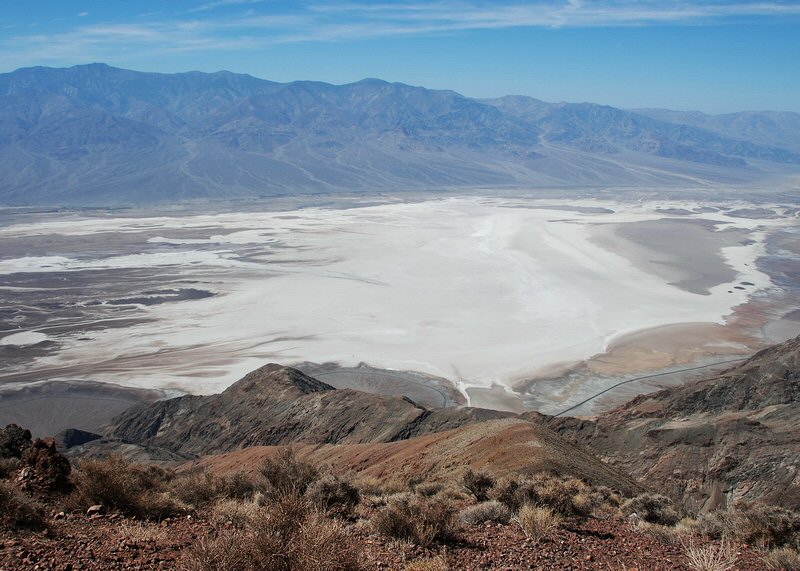
Formerly part of a Pleistocene-era inland sea, Death Valley’s physical characteristics are unique. Four consecutive mountain ranges shield it from precipitation and sandstorms, and at 282 ft below sea level, it is the lowest point in North America. As a result, solar exposure is virtually constant, the average daily wind speed is 10.4 to 12.5 miles per hour, the average annual precipitation varies between 1.58 and 2.2 inches per year, and the evaporation rate is an astonishingly high 143 inches per year. These statistics are important because they indicate that were it to be permanently filled with water, the high evaporation rate alone would promote and support an entirely new ecosystem.

Death Valley occupies approximately 3,000 square miles of sparsely-populated territory about 200 miles northeast of Los Angeles and 100 miles west of Las Vegas. A proposed high-speed train between Los Angeles and Sacramento, about 125 miles southwest, could be extended to Death Valley, Las Vegas and beyond. Because of its characteristics and location, it is the ideal hub of a potential interconnected network of shallow seawater lakes in portions of California, Nevada, Arizona and possibly even New Mexico and Texas that could be used to mass-produce hydrogen by electrolysis of seawater using solar energy exclusively.

Unlike fossil fuels, which require extensive labor costs, the price of this hydrogen would reflect the cost of three free, inexhaustible resources: gravity, seawater and solar energy. Furthermore, once fully operational, the resulting economy of scale could be expected to reduce its cost even more. The main challenge would be to meet the demand rather than amassing the required capital, engineering, or construction technology and equipment.

Requirements

1. Immediate government approval, non-financial assistance, and regulation.

2. Swift construction of a sea-level canal from the Pacific Ocean to Death Valley. Water would flow by gravity, and its cost would be amortized from the income derived from the hydrogen and other on-site secondary industries.

3. Adequate safeguards against catastrophic earthquakes, ecological consequences, invasive species, and terrorism.

4. An adequate supply of rare-earth minerals to make the solar panels.

5. Infrastructure for waste disposal and recycling back to the ocean

6. Hydrogen pipelines to the ocean, to export the hydrogen. This step would be unnecessary if the canal is deep enough to allow tankers into Death Valley.

7. An entirely new financial/ownership design to attract investors and distribute future wealth in an equitable fashion.

8. Top-notch personnel to organize and operate the enterprise.

9. Support from the Federal Reserve, as needed.

10. Investors to fund the project.

Specific Benefits

Ecology

  • Requires only seawater, sun and gravity; no greenhouse gasses are released.
  • Creates a new ecosystem to help reduce global warming.
  • Relies on natural topographic characteristics unavailable elsewhere to create a virtual monopoly on exportable renewable energy.

Employment

  • Creates a new low-cost energy source thus facilitating production and job creation in heavy users of electricity such as aluminum and rare earth minerals.
  • Creates secondary businesses such fish farming, tourism, salt harvesting, construction, agriculture, with all its supporting services.
  • Creates jobs that cannot be relocated or outsourced; low energy, and transportation costs would help to offset competing lower labor and medical costs in developing nations.

Energy

  • Energy independence. Natural gas from domestic and friendly sources currently used to generate electricity could be used to power automobiles.
  • Produces low-cost hydrogen commercially, the first step toward an eventual full hydrogen economy. Creates a massive hydrogen-producing industry to replace coal, gas and nuclear as the preferred fuel source.
  • Creates a reliable supply to support future widespread applications such as fuel cells.
  • Envisions that all new buildings in the new frontier, including homes, would generate a surplus of electricity. High-tension transmission lines would thus be reduced or eliminated, increasing efficiency and security in case of natural or man-made catastrophes.

Fiscal/Economic

  • Privately financed –no cost to any government.
  • Improves the credit rating of federal and state governments and reduces borrowing costs.
  • Reduces unemployment if the unemployed are hired.
  • Attracts domestic and foreign capital wishing to lock in future profits.
  • Stimulates the stock market because the size and scope of the new economic frontier would stimulate and expand the economy.
  • Expands the tax base, increases revenue, and decreases unemployment expenditures.
  • Extends the dollar’s role as the world’s reserve currency.

Legal

  • Currently, riparian laws may not specifically regulate the creation of large bodies of inland seawater because there are none. The Great Salt Lake is saltwater but not seawater, and it is not man-made.
  • The initial phase would begin in California, therefore immediate interstate agreements and/or congressional intervention might not be necessary.

Political

  • Promotes national unity, incorporates Republican & Democratic principles and ideology.
  • Showcases American resolve to unite for the common good using domestic resources.
  • Promotes peace by promoting global reliance on low-cost American-produced hydrogen while reducing the over-dependence on fossil fuels.

Real Estate

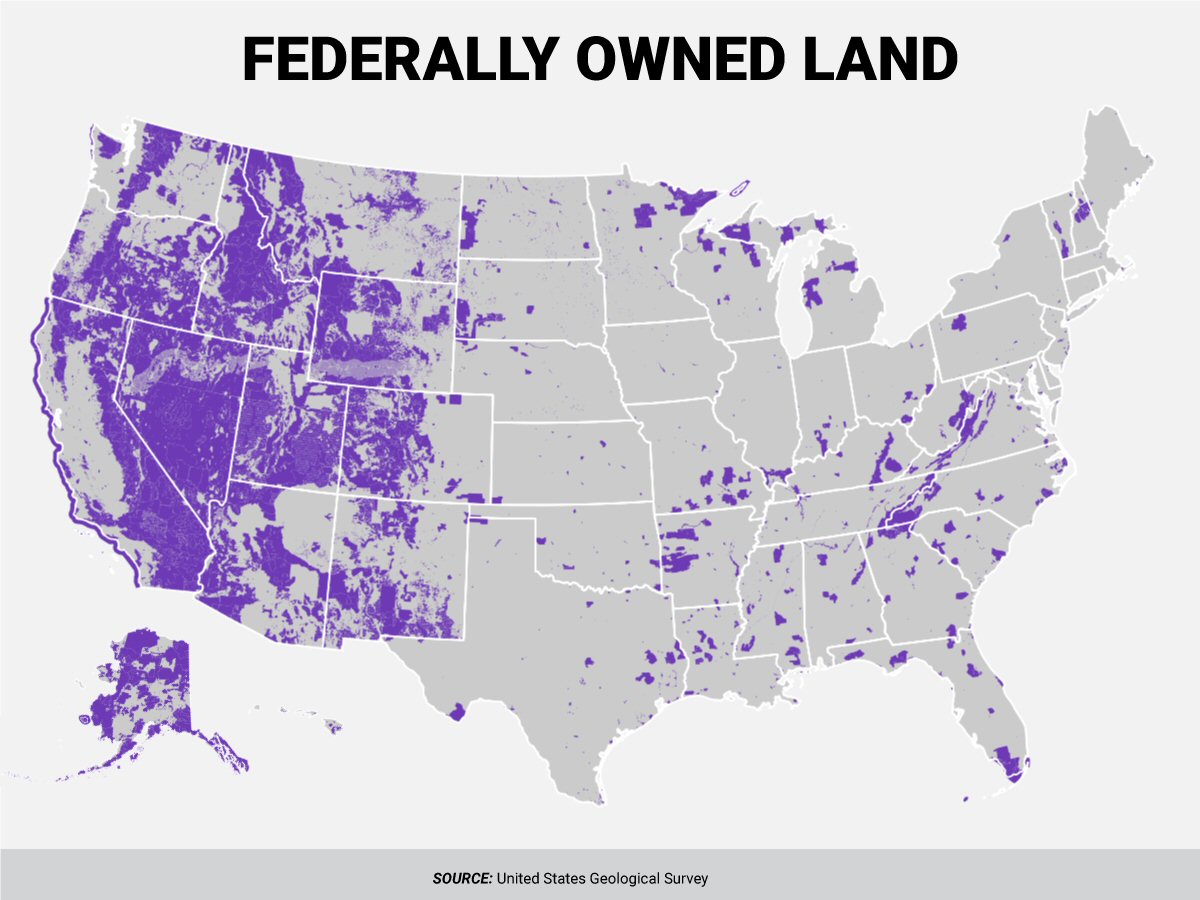
Federal Land Map
  • Income from the energy produced by each building –residential, commercial or industrial- might be appurtenant to the land to reduce risk to lenders.
  • Creates desirable waterfront properties with views, increases value.
  • Creates a construction and lending boom -in many cases on fallow federally-owned land- supported by permanent incomes, to accommodate the workers in the new economic zone.

Water

  • Creates cost-effective, reliable, permanent sources of water for the U.S. and China impervious to drought or global warming.

Trade

  • Creates a new income stream large enough to eventually transform the trade deficit into a surplus.

Cost

New York City’s Water Tunnel #3 is 60 miles long through solid rock, scheduled to be completed in 2020 at a cost of $6 billion, or approximately $100 million per mile. Assuming similar per mile costs, a comparable 200-mile waterway from the west coast to Death Valley with 5 times its volume, works out to about $100 billion, to be disbursed over the construction period. The rate of disbursement would be influenced by the number of assets doing simultaneous work. The additional cost of the plants would depend on their size and number.

Financing

Given the importance of a project of this nature and magnitude to countries that are net importers of energy, which are the majority, there should be no shortage of investors who would be willing to cash in on virtually guaranteed, long-term returns. Among these would be wealthy individuals, banks and sovereign funds who are constantly searching for a low-risk, high return investment. In addition, the Federal Reserve has stated that it would do whatever it can to support growth and reduce our compromising fiscal condition. Here is an opportunity to create an amalgam of these interests to ensure that future wealth is more equitably distributed. If made appurtenant to the land, the income from the sale of surplus energy would promote home ownership by assisting first-time buyers with their mortgage payments. Such variants might include tools such as bonds insured by the Federal Reserve and other novel financial instruments leading to the same result.

A Monopoly

No other sites, including the Dead Sea, the Qattara Depression in Egypt, Sebkha paki Tah, Morocco, Sabkhat Ghuzayyil, Libya, Chott Melrhir, Algeria, and Shatt Al Gharsah, Tunisia have all of Death Valley’s unique characteristics and advantages, described above, to achieve and maintain profitability. As a result, it is highly unlikely that any of these or any other potential sites could ever successfully compete.

What The Federal Government Could Do

As noted, the project need not be financed with public funds. However, the government still needs to approve, regulate and organize it. Finally, non-existent technologies are not required, only competent engineering, earth-moving equipment and a relatively small investment compared to its potential short and long-term benefits.

Death Valley

Death Valley is a desert valley located in Eastern California. Situated within the Mojave Desert, it features the lowest, driest, and hottest locations in North America. Badwater, a basin located in Death Valley, is the specific location (36° 15′ N 116° 49.5′ W) of the lowest elevation in North America at 282 feet (86.0 m) below sea level. This point is only 84.6 miles (136.2 km) ESE of Mount Whitney, the highest point in the contiguous United States with an elevation of 14,505 feet (4,421 m). Death Valley holds the record for the highest reliably reported temperature in the Western hemisphere, 134 °F (56.7 °C) at Furnace Creek on July 10, 1913—just short of the world record, 136 °F (57.8 °C) in Al ‘Aziziyah, Libya, on September 13, 1922.

Located near the border of California and Nevada, in the Great Basin, east of the Sierra Nevada mountains, Death Valley constitutes much of Death Valley National Park and is the principal feature of the Mojave and Colorado Deserts Biosphere Reserve. It is located mostly in Inyo County, California. It runs from north to south between the Amargosa Range on the east and the Panamint Range on the west; the Sylvania Mountains and the Owlshead Mountains form its northern and southern boundaries, respectively. It has an area of about 3,000 sq mi (7,800 km2). Death Valley shares many characteristics with other places below sea level.

Geology

Death Valley is one of the best geological examples of a basin and range configuration. It lies at the southern end of a geological trough known as Walker Lane, which runs north into Oregon. The valley is bisected by a right lateral strike slip fault system, represented by the Death Valley Fault and the Furnace Creek Fault. The eastern end of the left lateral Garlock Fault intersects the Death Valley Fault. Furnace Creek and the Amargosa River flow through the valley but eventually disappear into the sands of the valley floor.

Death Valley also contains salt pans. According to current geological consensus, during the middle of the Pleistocene era there was a succession of inland seas (collectively referred to as Lake Manly) located where Death Valley is today. As the area turned to desert the water evaporated, leaving behind the abundance of evaporitic salts such as common sodium salts and borax, which were subsequently exploited during the modern history of the region, primarily 1883 to 1907.

As a general rule, lower altitudes tend to have higher temperatures where the sun heats the ground and that heat is then radiated upward, but as the air begins to rise it is trapped by the surrounding elevation and the weight of the air (essentially the atmospheric pressure) above it. The atmospheric pressure is higher at very low altitudes than it is under the same conditions at sea level because there is more air (more distance) between the ground and the top of the atmosphere. This pressure traps the heat near the ground, and also creates wind currents that circulate very hot air, thereby distributing the heat to all areas, regardless of shade and other factors.

This process is especially important in Death Valley as it provides its specific climate and geography. The valley is surrounded by mountains, while its surface is mostly flat and devoid of plants, and of which a high percentage of the sun’s heat is able to reach the ground, absorbed by soil and rock. When air at ground level is heated, it begins to rise, moving up past steep high mountain ranges, which then cools slightly, sinking back down towards the valley more compressed. This air is then reheated by the sun to a higher temperature, moving up the mountain again, whereby the air moves up and down in a circular motion in cycles, similar to how a convection oven works, albeit a natural one. This superheated air increases ground temperature markedly, forming the hot wind currents that are trapped by atmospheric pressure and mountains, thus stays mostly within the valley. Such hot wind currents contribute to perpetual drought-like conditions in Death Valley and prevent much cloud formation to pass through the confines of the valley, where precipitation is often in the form of a virga (rain that evaporates in mid-air before hitting the ground). Death Valley holds temperature records because it has an unusually high number of factors that lead to high atmospheric temperatures.

Climate

The depth and shape of Death Valley influence its summer temperatures. The valley is a long, narrow basin 282 feet (86 m) below sea level, yet is walled by high, steep mountain ranges. The clear, dry air and sparse plant cover allow sunlight to heat the desert surface. Summer nights provide little relief as overnight lows may only dip into the 86 to 95 °F (30 to 35 °C) range. Moving masses of super-heated air blow through the valley creating extremely high temperatures.

The hottest air temperature ever recorded in Death Valley (Furnace Creek) was 134 °F (57 °C) on July 10, 1913, at Furnace Creek. During the heat wave that peaked with that record, five consecutive days reached 129 °F (54 °C) or above. The greatest number of consecutive days with a maximum temperature of 100 °F (38 °C) or above was 154 days in the summer of 2001. The summer of 1996 had 40 days over 120 °F (49 °C), and 105 days over 110 °F (43 °C). The summer of 1917 had 52 days where temperatures reached 120 °F (49 °C) or above with 43 of them consecutive. Four major mountain ranges lie between Death Valley and the ocean, each one adding to an increasingly drier rainshadow effect, and in 1929 and 1953 no rain was recorded for the whole year. The period from 1931 to 1934 was the driest stretch on record with only 0.64 inches (16 mm) of rain over a 40-month period.

From 1961-2008 the weather station at Death Valley (Furnace Creek) recorded an average yearly temperature of 76.7 °F (24.8 °C) with an average high in January of around 66 °F (19 °C) and 116 °F (47 °C) in July. From 1934-1961 the weather station at Cow Creek recorded a Mean Annual Temperature of 77.2 °F (25.1 °C)°F.

The period from July 17–19, 1959 was the longest string of consecutive days where nighttime low temperatures did not drop below 100 °F (38 °C). The highest ever night time low temperature in Death Valley was 103 °F (39 °C) recorded on July 5, 1970 and July 24, 2003.

The longest stretch of consecutive days where temperatures reached 90 °F (32 °C) or more was 205 during Apr-Oct 1992. On average there are 192 days per year in Death Valley where temperatures reach 90°F (32°C) or more.

The lowest temperature recorded at Greenland Ranch was 15 °F (−9 °C) in January 1913.

The average annual precipitation in Death Valley (Greenland Ranch Station) is 1.58 inches (40 mm). The wettest month on record is January 1995 when 2.59 inches (66 mm) fell on Death Valley.[18] The wettest period on record was mid 2004 to mid 2005, in which nearly 6 inches (150 mm) of rain fell in total, leading to ephemeral lakes in the valley and the region and tremendous wildflower blooms. Snow with accumulation has only been recorded in January 1922, while scattered flakes have been recorded in other occasions.

In 2005, Death Valley received four times its average annual rainfall of 1.5 inches (38 mm). As it has done before for hundreds of years, the lowest spot in the valley filled with a wide, shallow lake, but the extreme heat and aridity immediately began sucking the ephemeral lake dry.

In 2005, a big pool of greenish water stretched most of the way across the valley floor. By May 2005 the valley floor had resumed its more familiar role as Badwater Basin, a salt-coated salt flats. In time, this freshly dissolved and recrystallized salt will darken.

The western margin of Death Valley is traced by alluvial fans. During flash floods, rainfall from the steep mountains to the west pours through narrow canyons, picking up everything from fine clay to large rocks. When these torrents reach the mouths of the canyons, they widen and slow, branching out into braided streams. The paler the fans, the younger they are.

During the Pleistocene ice age, which ended roughly 10,000–12,000 years ago, the Sierra Nevada ranges were much wetter. During that time, Death Valley was filled with a huge lake, called Glacial Lake Manly, that was nearly 100 miles long and 600 feet deep.[23] Remnants of this wetter period can still be seen in the region today, including the presence of several isolated populations of pupfish that still call the region home.

As one would imagine, the humidity levels in Death Valley are generally low, and during the summer, the relative humidity can remain below 30% for weeks at a time. This coupled with the high air and surface temperatures and windy conditions rapidly evaporates any standing fresh water. From standard evaporation pans, the typical summer daily evaporation is determined to be 0.75 inches/day (1.9 cm/day) from May through August with maximum rates at 1.50 inches/day (3.8 cm/day) during the summer. Over the long term (1961-2002), the annual total potential evaporation is 143 inches per year (363 cm/yr). This rate of moisture loss greatly exceeds the average annual precipitation of 1.9–2.2 inches (4.8–5.6 cm) per annum, making the region arid. Standing water and damp mud, however, can exist on the surface on the salt flats in Death Valley because evaporation is hindered by high salt content of the water.

Wind also plays a significant role in the dryness of Death Valley since it is a major component in evaporation. While there have been no long-term direct measurements of wind speed, the climate record does include daily wind movement data. This measure determines the wind movement per day by counting the total distance of wind moving past the anemometer during the measurement period. (Each rotation of the anemometer corresponds to a given “distance” of wind movement, and the meter’s counter clicks off the distance of “wind travel” in much the same way our car odometer counts miles travelled.) Average daily wind movement at Death Valley is lowest during the winter and peaks in early spring. From March to May the average daily wind movement is 250 to 300 miles (200-480 km) per day. Dividing that number by 24 hours gives a rough estimate of average daily wind speed: 10-4 to 12.5 mph.

Solar heating of dark, sparsely vegetated surfaces by radiation through clear, dry air. Since the vegetation cover is sparse, little solar radiation is used for evapotranspiration and instead heats the ground and surface air.

Meteorologists know that the hottest days usually occur in Death Valley when a high pressure ridge centers over western Nevada. The ridge thus blocks cooler maritime air from pushing east while a thermal low located in southern California directs hot air from the deserts of southern Arizona and Mexico into the valley.

The highest ground temperature ever recorded was 201oF (93.9oC) on 15 July 1972. The air temperature at standard thermometer height that day peaked at 128oF (53.3 oC). The hottest month ever was July 1917 averaging 107.2oF (41.8oC); the second hottest, and the hottest of modern record, was July 2005 averaging 106.5oF (41.4 oC).

The coldest month on record was December 1990 at 44.9oF (7.2 oC). The coldest recorded daily temperature was 15oF (-9.4oC) on 18 January 1913 (the same year as the record high). During the winter 1928/29, 72 consecutive days recorded temperatures at or below freezing. The lowest summer temperature since 1961 is 54oF (12.2oC) on 6 June 1996.

The wettest calendar year in Death Valley climate history was 1941 which saw 4.63 inches (118 mm) accumulate. The most precipitation over a 12-month period fell between 1 October 1977 and 30 September 1978: 6.40 inches (162 mm). Second was the period July 1977 to June 1978: 5.09 inches (129 mm). The wettest month was January 1995 when 2.59 inches (66 mm) accumulated. The wettest day was 15 April 1988 when 1.47 inches of rain fell. The only other day on record to exceed an inch of rain was 26 September 1997.

Death Valley precipitation records include calendar years with no precipitation: 1929 and 1953. A string of 40 months from 1 March 1931 to 30 June 1934, recorded a total of only 0.64 inches (16 mm).

From Wikipedia, the free encyclopedia

Contact Us

Writer

If you would like to participate in our effort to compile and disseminate solutions, here are a couple of things you could do:

1) Let others know about our website. They may have suggestions to improve it.

2) If you would like to contribute an essay or have suggestions to make our effort better and more efficient, just fill out the form below.

WordPress theme: Kippis 1.15