High Risk of Severe Water Stress in Asia

March 30, 2016

A study published in the peer-reviewed online journal PLOS (Public Library of Science) finds that in the absence of autonomous adaptation or societal response, there is a high risk of severe water stress in some densely populated Asian watersheds by 2050.

Abstract

The sustainability of future water resources is of paramount importance and is affected by many factors, including population, wealth and climate. Inherent in current methods to estimate these factors in the future is the uncertainty of their prediction. In this study, we integrate a large ensemble of scenarios—internally consistent across economics, emissions, climate, and population—to develop a risk portfolio of water stress over a large portion of Asia that includes China, India, and Mainland Southeast Asia in a future with unconstrained emissions. We isolate the effects of socioeconomic growth from the effects of climate change in order to identify the primary drivers of stress on water resources. We find that water needs related to socioeconomic changes, which are currently small, are likely to increase considerably in the future, often overshadowing the effect of climate change on levels of water stress. As a result, there is a high risk of severe water stress in densely populated watersheds by 2050, compared to recent history. There is strong evidence to suggest that, in the absence of autonomous adaptation or societal response, a much larger portion of the region’s population will live in water-stressed regions in the near future. Tools and studies such as these can effectively investigate large-scale system sensitivities and can be useful in engaging and informing decision makers.

Carbon Emissions 10 Times Faster Than Ever

March 28, 2016

A study in Nature Geoscience compared the ongoing anthropogenic increase in carbon emissions with previous similar episodes. The only known analogous event –the Palaeocene-Eocene Thermal Maximum, or PETM- happened 56 million years ago during the Cenozoic era, when the Earth’s average temperature shot up by about 5 degrees Celsius. While the precise cause of that ancient spike is not yet known, geologic evidence shows that it took place gradually, over a period of 4,000 years. Subsequently the greenhouse effect acidified the oceans and unleashed a major die-off of some marine organisms.

Deep ocean core sediments off the coast of New Jersey revealed that the rate of accumulation during the PETM was about 1 billion tons of carbon per year. In contrast, today’s rate is 10 times higher, too fast for organisms to adapt. Since the current rate of carbon release is unprecedented, there is no time-tested way to determine if our species, at the top of the food chain, will survive the onslaught.

Highly Efficient Solar Cells

March 27, 2016

A new study published on March 24, 2016 in the journal Science demonstrates that hybrid lead halide provskites, solar cells that can be produced cheaply with easily synthesized materials, have an astonishing ability: not only do they absorb energy from the sun to generate electricity as all solar cells do, they actually produce additional light energy.

Today’s photo cell efficiency record is close to 21%, well below the 33% absolute theoretical ceiling that William Shockley and Hans Queisser predicted in their widely accepted 1961 paper. It may now be possible to reach that limit at a much lower cost.

The Categoric Report

The Mayan Lesson
 

Human nature does not change; it only repeats itself. The ancient Maya, a singularly gifted civilization that rose, peaked, declined and collapsed almost simultaneously with the Roman Empire, left a vast historical record: a tale of an unholy alliance of kings, priests, and military leaders who usurped and corrupted their religion to legitimize and perpetuate their rule. To subdue their people, they created a society afflicted with abysmal inequality and used their immense wealth to wage perennial wars of aggression, practice institutionalized genocide, and ruin their environment.

Collectively the Maya once occupied and controlled the deltas of most Caribbean rivers in Mesoamerica, from the Pánuco River on the north, where the Teenek (the Aztecs still call them Huastecs) live, to the Gulf of Honduras. Whether they achieved this astonishing feat under the leadership of a long-forgotten military genius, when they all spoke Proto-Mayan over four thousand years ago, is anybody’s guess. The fact is, in a world without beasts of burden, pirogues reigned as the only means of mass transit along the great rivers. And, by reason of the strategic location of their homeland, they effectively controlled all fluvial and coastal trade between the Mexican and Guatemalan highlands -with their vast deposits of obsidian, jade, cinnabar and many other minerals- and the Caribbean Sea, as well as between what we now call North and South America. Over time, their immense wealth supported the great progress they made in the arts and sciences, among them amazingly accurate calendars, linguistics (their scripture, though not the first in Mesoamerica, could be read and understood by speakers of all the Mayan languages), mathematics, astronomy, hydrology, architecture, medicine (which made it possible for  them to thrive in a jungle teeming with hundreds if not thousands of tropical diseases) and agriculture. However, eventually the original central authority splintered into a multitude of independent and competing city-states. As with the ancient Greeks, who suffered a desperate struggle between Athens and Sparta, Mayan city-states eventually coalesced into the orbits of two rival alliances led by Calakmul and Tikal, the two dominant southern lowland cities of the Classical Period (300-900 A.D.). Over time, their intentional mutual isolation fractured Proto-Mayan into thirty-two related but mostly mutually unintelligible languages, complete with different names for the deities of their common religion, and caused centuries of fratricidal wars that culminated in the slow demise of their civilization. By 900 A.D., six-hundred years before the Spanish invasion, the formerly great cities of the southern lowlands, now in ruins, had been abandoned to the relentless jungle.

Humble cinnabar -underestimated and now all but forgotten- was the premier source of wealth of the time. Since time immemorial it had been used to make red for textiles, buildings, writing, pottery, murals and burials, and the work was done mostly in poorly ventilated huts or small rooms. One byproduct was pure elemental mercury, a highly toxic liquid metal that is not naturally found in its pure state. As jars full of it have been found in ancient burial chambers, two things are certain: humans distilled it, and over time -hundreds or even thousands of years- it necessarily must have found its way to the food chain via aquifers, streams, rivers and the sea -a long-term environmental catastrophe of incalculable magnitude.

The Maya commonly used cinnabar powder or paste to coat cadavers with it, a necessity -or so they believed- since someone had long ago determined that only cinnabar could and would keep the dead from rising from their graves at night to steal the souls of the living. And the demand was incessant and permanent. The constant “flowery deaths” –cutting the beating hearts out of hapless captives- guaranteed a steady supply of corpses. For the elite, it was a stupendously lucrative business. In cahoots with the priests and the generals, the kings had monopolies on war making, which caused deaths, and on cinnabar, which they imported from the highlands and for which there was an enormous, permanent demand. That forced ordinary people to work tirelessly for meager amounts of it, be it by growing food, serving in the army whenever the fields did not require their labor, or collecting exotic feathers, jaguar skins, seashells, jade, or whatever the kings fancied at exchange rates the kings, not the people, determined.

The ruse lasted for centuries, possibly longer, until the day someone mustered the courage to verify it. And so, as it always does, the truth finally emerged. Ironically, their genial writing system -the Internet of the day, which had long since been usurped by the elite to perpetuate their wealth and power- may have played a pivotal role in the rebellion that followed.

Scores of barricaded palaces and other structures have been unearthed where rulers, generals and priests took refuge as the vengeful, enraged masses came for them. The defenses did not hold; the elite were massacred, the scribes disappeared, and the Classical Period came to an end. By A.D. 900 the great Cholan-speaking cities in the Petén jungle -along with the cult of intolerable inequality which had brought ordinary people so much misery and grief- had been abandoned. In their wake, egalitarian villages re-emerged led by elders who doubled as custodians of a vestigial kernel of knowledge.

Nine hundred years later (letter to Colonel Charles Yancey, January 6, 1816) Thomas Jefferson aptly postulated what may be the underlying principle that destroyed the Mayan civilization -and now threatens our own: “If a nation expects to be ignorant and free, in a state of civilization, it expects what never was and never will be.”

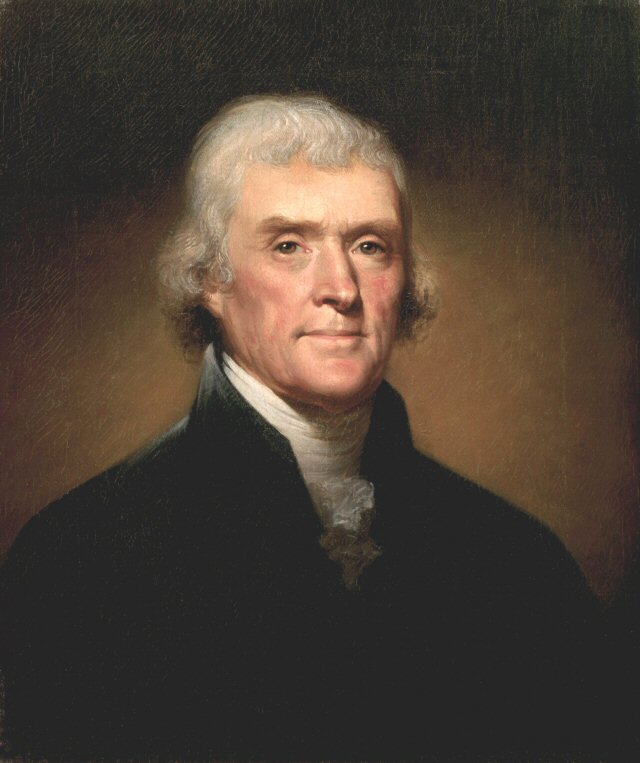
Jefferson’s Warning: Perpetual Debt, Trade Deficit, Bubbles, Derivatives

Two hundred years have passed since  president Jefferson wrote this (excerpted) letter. Not only have we not acted to reduce the risk of total collapse of our financial system, it’s far worse than he could have possibly imagined -and there’s no relief in sight. Today our largest private employer is a retailer, not a manufacturer as in 1950. Among other things, that means that well-paying middle class jobs for men no longer exist to generate the tax revenue the government should and could have. As a result, the combination of accumulated liabilities and risks far exceed the combined resources of the Federal Government and the Federal Reserve, a private bank, which cannot continue to create money from thin air indefinitely. Heed! Do whatever must be done to save this last remnant of our democracy from the jaws of the plutocratic monster. The day of reckoning is fast approaching and we’re running out of time.


Excerpt, Letter to Colonel Charles Yancey

Monticello, January 6, 1816

Thomas Jefferson
Thomas Jefferson

Like a dropsical man calling out for water, water, our deluded citizens are clamoring for more banks, more banks. The American mind is now in that state of fever which the world has so often seen in the history of other nations. We are under the bank bubble, as England was under the South Sea bubble, France under the Mississippi bubble, and as every nation is liable to be, under whatever bubble, design, or delusion may puff up in moments when off their guard. We are now taught to believe that legerdemain tricks upon paper can produce as solid wealth as hard labor in the earth. It is vain for common sense to urge that nothing can produce nothing; that it is an idle dream to believe in a philosopher’s stone which is to turn everything into gold, and to redeem man from the original sentence of his Maker, “in the sweat of his brow shall he eat his bread.” Not Quixot enough, however, to attempt to reason Bedlam to rights, my anxieties are turned to the most practicable means of withdrawing us from the ruin into which we have run. Two hundred millions of paper in the hands of the people, (and less cannot be from the employment of a banking capital known to exceed one hundred millions,) is a fearful tax to fall at haphazard on their heads. The debt which purchased our independence was but of eighty millions, of which twenty years of taxation had in 1809 paid but the one half. And what have we purchased with this tax of two hundred millions which we are to pay by wholesale but usury, swindling, and new forms of demoralization. Revolutionary history has warned us of the probable moment when this baseless trash is to receive its fiat. Whenever so much of the precious metals shall have returned into the circulation as that everyone can get some in exchange for his produce, paper, as in the revolutionary war, it will experience at once an universal rejection. When public opinion changes, it is with the rapidity of thought. Confidence is already on the totter, and every one now handles this paper as if playing at Robin’s alive. That in the present state of the circulation the bank should resume payments in specie, would require their vaults to be like the widow’s cruse. The thing to be aimed at is, that the excesses of their emissions should be withdrawn as gradually, but as speedily, too, as is practicable, without so much alarm as to bring on the crisis dreaded. Some banks are said to be calling in their paper. But ought we to let this depend on their discretion? Is it not the duty of the legislature to avert from their constituents such a catastrophe as the extinguishment of two hundred millions of paper in their hands? The difficulty is indeed great: and the greater, because the patient revolts against all medicine. I am far from presuming to say that any plan can be relied on with certainty, because the bubble may burst from one moment to another; but if it fails, we shall be but where we should have been without any effort to save ourselves. Different persons, doubtless, will devise different schemes of relief. One would be to suppress instantly the currency of all paper not issued under the authority of our State or of the General Government; to interdict after a few months the circulation of all bills of five dollars and under: after a few months more, all of ten dollars and under; after other terms, those of twenty, fifty, and so on to one hundred dollars, which last, if any must be left in circulation, should be the lowest denomination. These might be a convenience in mercantile transactions and transmissions, and would be excluded by their size from ordinary circulation. But the disease may be too pressing to await such a remedy. With the legislature I cheerfully leave it to apply this medicine, or no medicine at all. I am sure their intentions are faithful; and embarked in the same bottom, I am willing to swim or sink with my fellow citizens. If the latter is their choice, I will go down with them without a murmur. But my exhortation would rather be “not to give up the ship.”

Australia’s Great Barrier Reef At Greater Risk Than Previously Believed

February 23, 2016

According to an article published in Nature Communications, the prognosis for Australia’s Great Barrier Reef is in much worse than previously thought.

Excerpt

“The Great Barrier Reef (GBR) is founded on reef-building corals. Corals build their exoskeleton with aragonite, but ocean acidification is lowering the aragonite saturation state of seawater (Ωa). The downscaling of ocean acidification projections from global to GBR scales requires the set of regional drivers controlling Ωa to be resolved. Here we use a regional coupled circulation–biogeochemical model and observations to estimate the Ωa experienced by the 3,581 reefs of the GBR, and to apportion the contributions of the hydrological cycle, regional hydrodynamics and metabolism on Ωa variability. We find more detail, and a greater range (1.43), than previously compiled coarse maps of Ωa of the region (0.4), or in observations (1.0). Most of the variability in Ωa is due to processes upstream of the reef in question. As a result, future decline in Ωa is likely to be steeper on the GBR than currently projected by the IPCC assessment report.”

Water Crisis

06/05/2021

Lake Powell, half full 2014
Drought at Lake Powell

A comprehensive research article published in Science Advances found that water scarcity is actually worse than first thought. The authors found that fully two-thirds of the global population suffer severe water scarcity at least 1 month per year, and nearly half of them live in India and China. In addition, five hundred million people in the world face severe shortages the year round. Their recommendations: cap water consumption by river basin, increase water-use efficiency, and better share the limited freshwater resources.

However well-intended, their suggestions are just a palliative. What is really needed is a vast new source of freshwater. Barring cataclysmic events such as nuclear war, which cannot be discarded, our species needs to have 2.3 children per woman just to survive. Since it’s not possible to have one third of a child, they’ll have to have a minimum of three, and the population will grow. And that growth will spur a higher demand for mates of both sexes and even more water to satisfy their many needs. It’s not that there’s not enough water on our planet; it’s just that despite our otherwise awesome technological achievements in other aspects of human living (and killing) we still basically collect water the same way ancient civilizations did thousands of years ago. Perhaps one reason for this anomaly is the fact that with a few exceptions, most centers of wealth and power have abundant supplies of water at their disposal. For example, it is difficult to imagine how an occupant of the White House, facing the Potomac and periodic ice storms, would include among his/her most pressing priorities finding ways to improve the city’s water supply. It would be contrary to human nature. Conversely, if they lived in Los Angeles, Phoenix or Las Vegas, undoubtedly their attitude toward water would be vastly different.

Make no mistake, the water crisis is as real as, and will be exacerbated by, global warming. And it is the responsibility of leaders worldwide, regardless of how much water there may be in their immediate vicinity, to solve the problem before it spills over into the realm of war and famine. For example, look no further than Syria, where a devastating drought is said to have sparked the ongoing civil war and its consequences.

We need to manufacture our own water far from any shore to make deserts green with oxygen-producing crops to recycle the carbon dioxide already in the atmosphere, and the only way to do so is to produce hydrogen in vast amounts from electrolysis of seawater using solar as the primary source of energy. The technology exists; the principle was vividly illustrated in the movie The Martian, and it is further explained here. The missing ingredient is an enlightened, charismatic leader with the ability to rally even the most ardent skeptics before it’s too late.

Resetting U.S.-Russian Relations

February 4, 2016

Henry Kissinger’s speech (original link to https://gorbachovfund.ru is broken) at the Gorbachev Fund in Moscow

From 2007 into 2009, Evgeny Primakov and I chaired a group composed of retired senior ministers, high officials, and military leaders from Russia and the United States, including some of you present here today. Its purpose was to ease the adversarial aspects of the U.S.-Russian relationship and to consider opportunities for cooperative approaches. In America, it was described as a Track II group, which meant it was bipartisan and encouraged by the White House to explore but not negotiate on its behalf. We alternated meetings in each other’s country. President Putin received the group in Moscow in 2007, and President Medvedev in 2009. In 2008, President George W. Bush assembled most of his National Security team in the Cabinet Room for a dialogue with our guests.

All the participants had held responsible positions during the Cold War. During periods of tension, they had asserted the national interest of their country as they understood it. But they had also learned through experience the perils of a technology threatening civilized life and evolving in a direction which, in crisis, might disrupt any organized human activity. Upheavals were looming around the globe, magnified in part by different cultural identities and clashing ideologies. The goal of the Track II effort was to overcome crises and explore common principles of world order.

Evgeny Primakov was an indispensable partner in this effort. His sharp analytical mind combined with a wide grasp of global trends acquired in years close to and ultimately at the center of power, and his great devotion to his country refined our thinking and helped in the quest for a common vision. We did not always agree, but we always respected each other. He is missed by all of us and by me personally as a colleague and a friend.

I do not need to tell you that our relations today are much worse than they were a decade ago. Indeed, they are probably the worst they have been since before the end of the Cold War. Mutual trust has been dissipated on both sides. Confrontation has replaced cooperation. I know that in his last months, Evgeny Primakov looked for ways to overcome this disturbing state of affairs. We would honor his memory by making that effort our own.

At the end of the Cold War, both Russians and Americans had a vision of strategic partnership shaped by their recent experiences. Americans were expecting that a period of reduced tensions would lead to productive cooperation on global issues. Russian pride in their role in modernizing their society was tempered by discomfort at the transformation of their borders and recognition of the monumental tasks ahead in reconstruction and redefinition. Many on both sides understood that the fates of Russia and the U.S. remained tightly intertwined. Maintaining strategic stability and preventing the spread of weapons of mass destruction became a growing necessity, as did the building of a security system for Eurasia, especially along Russia’s long periphery. New vistas opened up in trade and investment; cooperation in the field of energy topped the list.

Regrettably, the momentum of global upheaval has outstripped the capacities of statesmanship. Evgeny Primakov’s decision as Prime Minister, on a flight over the Atlantic to Washington, to order his plane to turn around and return to Moscow to protest the start of NATO military operations in Yugoslavia was symbolic. The initial hopes that the close cooperation in the early phases of the campaign against al-Qaida and the Taliban in Afghanistan might lead to partnership on a broader range of issues weakened in the vortex of disputes over Middle East policy, and then collapsed with the Russian military moves in the Caucasus in 2008 and Ukraine in 2014. The more recent efforts to find common ground in the Syria conflict and to defuse the tension over Ukraine have done little to change the mounting sense of estrangement.

The prevailing narrative in each country places full blame on the other side, and in each country there is a tendency to demonize, if not the other country, then its leaders. As national security issues dominate the dialogue, some of the mistrust and suspicions from the bitter Cold-War struggle have reemerged. These feelings have been exacerbated in Russia by the memory of the first post-Soviet decade when Russia suffered a staggering socio-economic and political crisis, while the United States enjoyed its longest period of uninterrupted economic expansion. All this caused policy differences over the Balkans, the former Soviet territory, the Middle East, NATO expansion, missile defense, and arms sales to overwhelm prospects for cooperation.

Perhaps most important has been a fundamental gap in historical conception. For the United States, the end of the Cold War seemed like a vindication of its traditional faith in inevitable democratic revolution. It visualized the expansion of an international system governed by essentially legal rules. But Russia’s historical experience is more complicated. To a country across which foreign armies have marched for centuries from both East and West, security will always need to have a geopolitical, as well as a legal, foundation. When its security border moves from the Elbe 1,000 miles east towards Moscow, Russia’s perception of world order will contain an inevitable strategic component. The challenge of our period is to merge the two perspectives—the legal and the geopolitical—in a coherent concept.

In this way, paradoxically, we find ourselves confronting anew an essentially philosophical problem. How does the United States work together with Russia, a country which does not share all its values but is an indispensable component of the international order? How does Russia exercise its security interests without raising alarms around its periphery and accumulating adversaries? Can Russia gain a respected place in global affairs with which the United States is comfortable? Can the United States pursue its values without being perceived as threatening to impose them? I will not attempt to propose answers to all these questions. My purpose is to encourage an effort to explore them.

Many commentators, both Russian and American, have rejected the possibility of the U.S. and Russia working cooperatively on a new international order. In their view, the United States and Russia have entered a new Cold War.

The danger today is less a return to military confrontation than the consolidation of a self-fulfilling prophecy in both countries. The long-term interests of both countries call for a world that transforms the contemporary turbulence and flux into a new equilibrium which is increasingly multipolar and globalized.

The nature of the turmoil is in itself unprecedented. Until quite recently, global international threats were identified with the accumulation of power by a dominating state. Today threats more frequently arise from the disintegration of state power and the growing number of ungoverned territories. This spreading power vacuum cannot be dealt with by any state, no matter how powerful on an exclusively national basis. It requires sustained cooperation between the United States and Russia, and other major powers. Therefore the elements of competition, in dealing with the traditional conflicts in the interstate system, must be constrained so that the competition remains within bounds and creates conditions which prevent a recurrence.

There are, as we know, a number of divisive issues before us, Ukraine or Syria as the most immediate. For the past few years, our countries have engaged in episodic discussions of such matters without much notable progress. This is not surprising, because the discussions have taken place outside an agreed strategic framework. Each of the specific issues is an expression of a larger strategic one. Ukraine needs to be embedded in the structure of European and international security architecture in such a way that it serves as a bridge between Russia and the West, rather than as an outpost of either side. Regarding Syria, it is clear that the local and regional factions cannot find a solution on their own. Compatible U.S.-Russian efforts coordinated with other major powers could create a pattern for peaceful solutions in the Middle East and perhaps elsewhere.

Any effort to improve relations must include a dialogue about the emerging world order. What are the trends that are eroding the old order and shaping the new one? What challenges do the changes pose to both Russian and American national interests? What role does each country want to play in shaping that order, and what position can it reasonably and ultimately hope to occupy in that new order? How do we reconcile the very different concepts of world order that have evolved in Russia and the United States—and in other major powers—on the basis of historical experience? The goal should be to develop a strategic concept for U.S.-Russian relations within which the points of contention may be managed.

In the 1960’s and 1970’s, I perceived international relations as an essentially adversarial relationship between the United States and the Soviet Union. With the evolution of technology, a conception of strategic stability developed that the two countries could implement, even as their rivalry continued in other areas. The world has changed dramatically since then. In particular, in the emerging multipolar order, Russia should be perceived as an essential element of any new global equilibrium, not primarily as a threat to the United States.

I have spent the greater part of the past seventy years engaged in one way or another in U.S.-Russian relations. I have been at decision centers when alert levels have been raised, and at joint celebrations of diplomatic achievement. Our countries and the peoples of the world need a more durable prospect.

I am here to argue for the possibility of a dialogue that seeks to merge our futures rather than elaborate our conflicts. This requires respect by both sides of the vital values and interest of the other. These goals cannot be completed in what remains of the current administration. But neither should their pursuits be postponed for American domestic politics. It will only come with a willingness in both Washington and Moscow, in the White House and the Kremlin, to move beyond the grievances and sense of victimization to confront the larger challenges that face both of our countries in the years ahead.

Job Losses in January 2016

February 4, 2016

The U.S. Bureau of Labor Statistic, released its job report for January. Layoffs increased by 218%, the highest since last summer, mostly due to a loss of 16,000 jobs at Wal-Mart, America’s biggest non-government employer, and 4,800 at Macy’s. The low-wage retail sector suffered cuts of 22,246, the highest total since 2009. The energy sector shed 20,103 jobs, mostly from Halliburton, Baker Hughes, and Schlumberger, the nation’s largest oilfield services firms.

Fiscal Year 2017 Defense Department’s Budget Request

February 2, 2016

Secretary of Defense Ashton B. Carter revealed the 2017 fiscal year budget request. Essentially it is a continuation of former Secretary Chuck Hagel’s view that the path forward for the U.S. is an open-ended arms race to safeguard the nation’s interests, even if they perpetuate our addiction to fossil fuels, particularly oil. It is a path of confrontation with Russia and China and the eventual annihilation of the human race.

Left unsaid is how much the budget will add to the national debt; it also assumes that the American economy will be able to afford such expenditures given the wholesale destruction of the middle class and the 47 million poor people who, through no fault of their own, do not have the income to contribute to the Treasury as much as they once did.

These are Secretary Hagel’s thoughts on the strength of the Department of Defense.

Five Challenges

The department must and will address all five challenges and across all domains, Carter said.

“Not just the usual air, land and sea, but also particularly in the areas of cyber, space and electronic warfare, where our reliance on technology has given us great strengths but also led to vulnerabilities that adversaries are eager to exploit,” he added.

Highlighting new investments in the budget to deal with the accelerated military campaign against ISIL, Carter said the department is requesting $7.5 billion, 50 percent more than in 2016.

Of that, he said $1.8 billion will go to buy more than 45,000 GPS-guided smart bombs and laser-guided rockets. The budget request also defers the A-10 final retirement until 2022, replacing it with F-35 Joint Strike Fighters squadron by squadron.

Strategic Capabilities
To support the European Reassurance Initiative, the Pentagon is requesting $3.4 billion in 2017, quadrupling the fiscal 2016 amount, the secretary said, to fund more rotational U.S. forces in Europe, more training and exercising with allies, and more prepositioned fighting gear and supporting infrastructure.

Investments in new technologies include projects being developed by the DoD Strategic Capabilities Office, which Carter created in 2012 when he was deputy defense secretary, “to reimagine existing DoD, intelligence community and commercial systems by giving them new roles and game-changing capabilities,” he said.

To drive such innovation forward, the 2017 budget request for research and development accounts is $71.4 billion.

Carter said SCO efforts include projects involving advanced navigation, swarming autonomous vehicles for use in different ways and domains, self-driving networked boats, gun-based missile defense, and an arsenal plane that turns one of the department’s older planes into a flying launch pad for a range of conventional payloads.”

WordPress theme: Kippis 1.15
Translate »