[google-translator]
Decoupled catalytic hydrogen evolution from a molecular metal oxide redox mediator in water splitting
Benjamin Rausch, Mark D. Symes, Greig Chisholm, Leroy Cronin*
WestCHEM, School of Chemistry, University of Glasgow,
University Avenue, Glasgow G12 8QQ, UK.
The electrolysis of water using renewable energy inputs is being actively pursued as a route to sustainable hydrogen production. Here we introduce a recyclable redox mediator (silicotungstic acid) that enables the coupling of low-pressure production of oxygen via water oxidation to a separate catalytic hydrogen production step outside the electrolyzer that requires no post-electrolysis energy input. This approach sidesteps the production of high-pressure gases inside the electrolytic cell (a major cause of membrane degradation) and essentially eliminates the hazardous issue of product gas crossover at the low current densities that characterize renewables-driven water-splitting devices. We demonstrated that a platinum-catalyzed system can produce pure hydrogen over 30 times faster than state-of-the-art proton exchange membrane electrolyzers at equivalent platinum loading.
Hydrogen is vital for the production of commodity chemicals such as ammonia and has great potential as a clean-burning fuel (1, 2). However, currently around 95% (~15 trillion mol year−1) of the world’s supply of H2 is obtained by reforming fossil fuels (3), a process that is both unsustainable and leads to a net increase in atmospheric CO2 levels. Of the alternative methods for H2 production that are not linked to fossil resources, the electrolysis of water stands out as a mature, scalable technology for which the only required inputs are water and energy (in the form of electricity) (4). Hence, if the energy source is renewable, H2 can be produced sustainably from water using electrolysis (5, 6).
Renewable energy inputs tend to be sporadic and fluctuating, and thus the systems that are developed to harness this energy and convert it to H2 [such as proton exchange membrane electrolyzers (PEMEs) (7), solar-to-fuels systems (8), and artificial leaves (9)] must be able to deal with varying energy inputs effectively and have rapid startup times. At the low power loads that are characteristic of renewable power sources, the rate at which H2 and O2 are produced may in fact be slower than the rate at which these gases permeate the membrane (10). At the very least, this will severely affect the amount of hydrogen that can be harvested from such devices (11), and in extreme cases could give rise to hazardous O2/H2 mixtures. The PEME is the most mature technology cited for renewables-to-hydrogen conversion, but prevention of such gas crossover at low current densities remains a challenge. PEMEs use nontrivial amounts of precious metal catalysts and so tend to operate at high current densities (1 A cm−2 or above) and high pressure, where the cost of their components can be offset to some extent (7). However, these optimal conditions may be hard to maintain in all cases of renewable driven electrolysis (for example, in small-scale facilities), where less-expensive and lower-power devices would therefore be beneficial. Meanwhile, the high-pressure and high-current-density conditions under which PEMEs work most effectively are also not without drawbacks: These conditions can also lead to gas crossover through the membrane, and the coexistence of H2, O2 and catalyst particles produces reactive oxygen species (ROS) that degrade the membrane and shorten its lifetime (12, 13). There is thus a need to develop new electrolyzer systems that can prevent product gases from mixing over a range of current densities and that make more effective use of the precious metal catalysts they employ, in order to make renewables-to-hydrogen conversion both practically and economically more attractive.
Previously, we introduced the concept of the electron-coupled proton buffer (ECPB), which can act to decouple electrolytic H2 and O2 production, producing these gases at separate times (14, 15). Here we describe a redox mediator that can be reversibly reduced in an electrolytic cell (as water is oxidized at the anode) and then transferred to a separate chamber for spontaneous catalytic H2 evolution, without the need for additional energy input after reduction of the mediator (Fig. 1). This approach leads to a device architecture for electrolyzers that has several important advantages. First, it allows the electrochemical step to be performed at atmospheric pressure, while potentially permitting H2 to be evolved at elevated pressure in a distinct compartment. Second, virtually no H2 is produced in the electrolytic cell itself, which (taken with the feature above) obviates the need to purge H2 from the anode side of the cell and could significantly reduce ROS-mediated membrane degradation and the possibility of explosive gas mixtures forming at low current densities or upon membrane failure. Third, H2 evolution from such a system is no longer directly coupled to the rate of water oxidation, and thus the decoupled H2 production step can be performed a rate per milligram of catalyst that is over 30 times faster than that for state-of-the-art PEMEs (movie S1). Finally, the hydrogen produced has the potential to have an inherently low O2 content, both on account of its production in a separate chamber from water oxidation and by virtue of the fact that the reduced mediator reacts rapidly with O2 in solution. This final point could render the H2 produced suitable for applications requiring high-purity H2 such as fuel cells (16) or the Haber-Bosch process (17), without the need for post-electrolysis purification or built-in recombination catalysts.
The redox mediator investigated in this work was silicotungstic acid (H4[SiW12O40]), the cyclic voltammogram (CV) of which on a glassy carbon electrode in aqueous solution is shown in Fig. 2A (black line). H4[SiW12O40] was chosen for investigation on account of its high solubility in water (up to 0.5M), in which solvent it is a strong acid (18). H4[SiW12O40] has reversible one-electron redox waves centered at +0.01 V (wave I) and –0.22 V [wave II; all potentials are versus the normal hydrogen electrode (NHE)], the positions of which are critical to the following discussion (18). Also shown in Fig. 2A are reductive scans taken at a similar pH in the absence of H4[SiW12O40] on carbon and Pt electrodes (red and green lines, respectively). Given that the onset of H2 evolution on Pt occurs at essentially the same potential as the first reduction of H4[SiW12O40], but that H2 evolution on carbon is not appreciable above –0.6 V, we hypothesized that the reduction of H4[SiW12O40] at a carbon electrode at potentials slightly more positive than –0.6 V would give the two-electron reduced form (H6[SiW12O40]) without any competing H2 evolution. If H6[SiW12O40] were then exposed to Pt, it should spontaneously evolve H2 until equilibrium between H2 and the reduced mediator was reached, which Fig. 2A suggests will correspond to a mixture of H4[SiW12O40] and the one-electron reduced form, H5[SiW12O40].
To test this hypothesis, an airtight electrolysis cell was constructed with a Pt mesh or carbon felt anode (for water oxidation) and a carbon felt cathode (for H4[SiW12O40] reduction), as shown in fig. S1. Reduction of the mediator and concomitant water oxidation were performed, and the composition of the gases in the separated headspaces was monitored by gas chromatographic headspace analysis (GCHA). Full faradaic efficiency for O2 evolution could be observed (using Pt anodes), whereas complete two-electron reduction of the mediator could be achieved with only trace H2 being evolved [see supplementary materials (SM) section SI-4 and figs. S2 and S3].
This two-electron reduced H6[SiW12O40] could then be stored without significant spontaneous H2 evolution (<0.002% loss of H2 per hour; fig. S3). Taken together, these data suggest that O2 evolution and H2 evolution can be effectively decoupled from each other using H4[SiW12O40], potentially allowing the O2 produced during electrolysis to be vented to the atmosphere without the need for additional H2 removal processes (19).
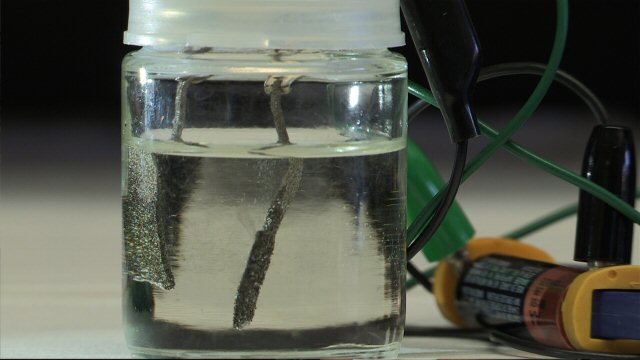
The two-electron reduced mediator could then be removed from the electrolysis cell and introduced into sealed reaction flasks under an atmosphere of Ar. The addition of various metal foils to this solution catalyzed H2 evolution, with Pt exhibiting the best performance (SM section SI-5 and fig. S4A). Powdered samples of MoS2 (20, 21) and Ni2P (22) were also found to be effective catalysts for H2 evolution from H6[SiW12O40] (fig. S4B). However, by far the greatest rate of H2 evolution was found when using precious metal catalysts supported on carbon. Figure 2B shows that per milligram of Pt used, the rate of H2 production from H6[SiW12O40] exceeds the rate of H2 evolution possible using a state-of-the-art PEME by a factor of 30 (red data). This more effective use of the precious metal H2 evolution catalyst could be a result of the better dispersion of catalyst that is possible when it is not confined to an electrode.
The kinetics of H2 evolution from solutions of H6[SiW12O40] as a function of time and catalyst are examined in Fig. 3A. Based on the volume of mediator solution used in these experiments, full conversion of two-electron reduced H6[SiW12O40] to one-electron reduced H5[SiW12O40] would be expected to liberate 122.4 ml of H2, whereas complete reversion to H4[SiW12O40] would release 244.7 ml of H2 (SM section SI-6). In practice, somewhat more than 122.4 ml of H2 were liberated in under 30 min with all the catalysts examined in Fig. 3A, suggesting complete and rapid transformation of H6[SiW12O40] to H5[SiW12O40], followed by limited further conversion (10 to 36%) of H5[SiW12O40] toH4[SiW12O40] under these conditions.
Initial rates were then extrapolated to rates of H2 produced per milligram of precious metal per hour (Table 1 and table S2), giving a maximum rate of 2861 mmol of H2 mg–1 hour–1 when using low loadings of Pt/C. The rate of H2 evolution decays from the initial value in Fig. 3B on account of the process H6[SiW12O40]→H5[SiW12O40] being 80% complete within 30 s for all the Pt/C loadings shown. Hence, in a continuous flow system, it should be possible to achieve rates very similar to the initial rate measured here for as long as the flow of H6[SiW12O40] is maintained (the mediator could then be recycled to the cathode for recharging). Table 1 compares the rate of H2 production by the mediator-based system with that achieved by a selection of state-of-the-art PEMEs from the recent literature (a more extensive supplementary materials (SM sections SI-3 and SI-7).
Next, we examined the purity of the H2 that was produced by this silicotungstic acid–mediated method. GCHA indicated that the level of electrolysis-derived O2 in this H2 was below detectable limits (T0.08%; SM sections SI-4 and SI-6). Moreover, if 10% O2 were deliberately introduced into the headspace of the vessel containing H6[SiW12O40], this extraneous O2 was completely removed by reaction with H6[SiW12O40] (% O2 in the headspace was only 0.04% after 30 min), ultimately producing water and reoxidized mediator (23) and further guaranteeing that the H2 evolved is O2-free (SM section SI-9 and fig. S9). This has obvious implications for electrolyzer safety, because gaseous mixtures of H2 and O2 on the cathode side are now precluded by the reduced mediator’s rapid reaction with O2. This reaction is spontaneous and does not require any precious metal–based recombination catalysts such as those often employed in PEMEs.
As noted earlier, a primary mode of degradation of the perfluorinated membranes used in PEMEs is attack by ROS (12). These ROS form in the presence of O2, H2, and precious metals (including the catalytic recombination layers that are designed to prevent mixtures ofO2 andH2 forming in electrolysis product streams). Moreover, recombination of H2 and O2 is an exothermic process that causes local heating, damaging the membrane through mechanicalmeans; this route is especially prevalent at Pt sites on the cathode (24, 25). The use of a mediator can help to mitigate against membrane degradation in three ways. First, the amount of H2 produced in the electrolyzer itself is vastly diminished, removing the need to purify the O2 product stream and preventing ROS formation on the anode side of the cell. Second, on the cathode side, the reduced mediator reacts rapidly with any O2 present to produce water, and any peroxy species that do form will do so in bulk solution far from the membrane and will themselves rapidly react with reduced mediator to form water (23). Finally, the catalyst is now isolated in a second chamber and is not in contact with the membrane, lessening local heating effects. Hence, using a mediator could potentially allow increased lifetimes for the membranes used in such electrolyzers relative to the life span of similar membranes in PEMEs.
The efficiency of the electrochemical process to produce O2 from water and H6[SiW12O40] from H4[SiW12O40] was calculated and compared to equivalent systems that would produce H2 and O2 directly by electrolysis (SM section SI-7 and fig. S6). In comparison to a system that uses a carbon cathode to reduce protons and a Pt anode to oxidize water, the mediated system was 16% more efficient, with an overall energy efficiency of 63%. A standard electrolysis system for direct O2 and H2 production from water, in which both electrodes are Pt, was found to have an efficiency of 67% [which agrees well with the efficiency of room temperature PEMEs reported in the literature (26)]. Hence, given the potential for lower loadings of precious metal and high initial purity of the product gases when using mediated electrolysis (and other possible techno-economic advantages; SM section SI-12), we believe that such systems will be competitive with PEMEs in terms of cost-efficiency metrics.
The redox reactions of silicotungstic acid are summarized in fig. S10A. Starting from fully reduced H6[SiW12O40], H2 evolution in the presence of a catalyst such as Pt/C is rapid, leading to the one-electron reduced species H5[SiW12O40]. This process can be reversed by electro-reducing H5[SiW12O40] at a carbon cathode. Alternatively, starting from the fully oxidized species H4[SiW12O40], the one-electron reduced species can be accessed either by electrochemical reduction or by reaction with H2 in the presence of a suitable catalyst such as Pt/C (SM section SI-8 and fig. S8). Likewise, if one-electron reduced H5[SiW12O40] is placed in a sealed reaction vessel under Ar in the presence of Pt/C, H2 evolves slowly into the headspace, as gauged by GCHA (fig. S7). This behavior implies that there exists an equilibrium betweenH2 andH4[SiW12O40] on one hand and the one electron reduced mediator (H5[SiW12O40]) on the other in the presence of catalysts such as Pt/C.
Overall faradaic efficiencies for the roundtrip process were gauged by fully reducing a sample of H4[SiW12O40] toH6[SiW12O40] with coulometry. Pt/C was then added to this H6[SiW12O40], and H2 was evolved. At the cessation of spontaneous H2 evolution, an amount of H2 corresponding to 68% of the charge passed in reducing H4[SiW12O40] to H6[SiW12O40] was obtained. In a cyclic system, any one-electron reduced H5[SiW12O40] could simply be returned to the electrolyzer for re-reduction to H6[SiW12O40]. However in this case, once H2 evolution had ceased, the Pt/C catalyst was removed by filtration under Ar, and the resulting Pt-free mediator solution was titrated with an Fe(III) source in order to oxidize all remaining H5[SiW12O40] to colorless H4[SiW12O40] and thus ascertain the amount of H5[SiW12O40] still present at the cessation of H2 evolution (SM section SI-10). This value, when combined with the electrons already accounted for by the amount of H2 evolved, gave a faradaic yield in excess of 98% for the roundtrip H4[SiW12O40] →H6[SiW12O40] → H4[SiW12O40].
The stability of the mediator to several cycles of oxidation and reduction was probed both electrochemically (by comparing the charges passed in oxidizing the reducing the mediator over a series of cycles, SM section SI-13) and by comparing ultraviolet-visible spectra of fresh and cycled samples and of reduced samples that were reoxidized by exposure to air (SM section SI-14). Figure S11A shows that 98% of the charge passed in fully reducing the mediator by one electron could be retrieved by reoxidation over nine full one-electron reduction-oxidation cycles, with no apparent degradation of the mediator. Figure S11B shows the stability of the mediator to four consecutive cycles of reduction to 80% of the maximum for full two-electron reduction, followed by reoxidation to 20% of this maximum. This experiment was designed to mimic the conditions under which the mediator would have to operate in a continuous-flow system. The data in fig. S11B suggest that there is no decay in the amount of charge that can be stored in the mediator (which would signal irreversible decomposition) within these bounds over the number of cycles probed. Similarly, fig. S12, A and B, show that a sample of silicotungstic acid subjected to 20 consecutive two-electron reduction and reoxidation cycles has an ultraviolet-visible spectrum indistinguishable from that of a fresh sample of silicotungstic acid. Taken together, these data suggest that the mediator is stable to redox cycling under these conditions and that H4[SiW12O40] might thus be suitable as a mediator in a continuous-flow system.
Because of the high molecular weight of H4[SiW12O40], it does not constitute an especially effective static storage medium for H2 (or H2 equivalents). Clearly, lower–molecular-weight mediators, or systems capable of storing more electrons, would therefore be at a practical advantage (15), allowing greater buffering capacity to be built into the system and providing more flexibility with regard to the temporal separation of water oxidation and H2 generation. We are currently pursuing the identification of such mediators, and we see great potential for optimized mediator systems to be combined with other recent breakthroughs in catalysis (27, 28) and device design (9, 29), facilitating the use of low-power inputs (or those subject to large fluctuations) in renewables-to-hydrogen conversion.
REFERENCES AND NOTES
1. A. Le Goff et al., Science 326, 1384–1387 (2009).
2. N. Armaroli, V. Balzani, ChemSusChem 4, 21–36 (2011).
3. U.S. Department of Energy Hydrogen Analysis Resource Center, Hydrogen Production, Worldwide Refinery Hydrogen Production Capacities (2012), http://hydrogen.pnl.gov/ cocoon/morf/hydrogen/article/706.
4. J. D. Holladay, J. Hu, D. L. King, Y. Wang, Catal. Today 139, 244–260 (2009).
5. F. M. Toma et al., Nat. Chem. 2, 826–831 (2010).
6. D. Gust, T. A. Moore, A. L. Moore, Acc. Chem. Res. 42, 1890–1898 (2009).
7. M. Carmo, D. L. Fritz, J. Mergel, D. Stolten, Int. J. Hydrogen Energy 38, 4901–4934 (2013).
8. Y. Tachibana, L. Vayssieres, J. R. Durrant, Nat. Photonics 6, 511–518 (2012).
9. S. Y. Reece et al., Science 334, 645–648 (2011).
10. F. Barbir, Sol. Energy 78, 661–669 (2005).
11. A. Berger, R. A. Segalman, J. Newman, Environ. Sci. 7, 1468–1476 (2014).
12. L. Ghassemzadeh, K.-D. Kreuer, J. Maier, K. Müller, J. Phys. Chem. C 114, 14635–14645 (2010).
13. V. Prabhakaran, C. G. Arges, V. Ramani, Proc. Natl. Acad. Sci.U.S.A. 109, 1029–1034 (2012).
14. M. D. Symes, L. Cronin, Nat. Chem. 5, 403–409 (2013).
15. B. Rausch, M. D. Symes, L. Cronin, J. Am. Chem. Soc. 135, 13656–13659 (2013).
16. International Organization for Standardization, ISO 14687-2:2012, Hydrogen fuel – Product specification – Part 2: Proton exchange membrane (PEM) fuel cell applications for road vehicles, www.iso.org/iso/home/store/catalogue_ics/ catalogue_detail_ics.htm?csnumber=55083 (2012).
17. N. Wiberg, E. Wiberg, A. F. Holleman, in Inorganic Chemistry (Academic Press, San Diego, CA, 2001), vol. 1.
18. B. Keita, L. Nadjo, J. Electroanal. Chem. 217, 287–304 (1987).
19. S. A. Grigoriev et al., Int. J. Hydrogen Energy 34, 5986–5991 (2009).
20. H. I. Karunadasa et al., Science 335, 698–702 (2012).
21. D. Merki, S. Fierro, H. Vrubel, X. Hu, Chem. Sci. 2, 1262–1267 (2011).
22. E. J. Popczun et al., J. Am. Chem. Soc. 135, 9267–9270 (2013).
23. A. Hiskia, E. Papaconstantinou, Inorg. Chem. 31, 163–167 (1992).
24. A. B. LaConti, H. Liu, C. Mittelsteadt, R. C. McDonald, ECS Trans. 1, 199–219 (2006).
25. A. S. Aricò et al., J. Appl. Electrochem. 43, 107–118 (2013).
26. N. Mamaca et al., Appl. Catal. B 111–112, 376–380 (2012).
27. T. W. Kim, K.-S. Choi, Science 343, 990–994 (2014).
28. Z. Han, F. Qiu, R. Eisenberg, P. L. Holland, T. D. Krauss, Science 338, 1321–1324 (2012).
29. K. S. Joya, Y. F. Joya, K. Ocakoglu, R. van de Krol, Angew. Chem. Int. Ed. 52, 10426–10437 (2013).
30. J. Xu, G. Liu, J. Li, X. Wang, Electrochim. Acta 59, 105–112 (2012).
31. P. Millet et al., Int. J. Hydrogen Energy 35, 5043–5052 (2010).
32. C. Xu, L. Ma, J. Li, W. Zhao, Z. Gan, Int. J. Hydrogen Energy 37, 2985–2992 (2012).
33. S. Siracusano et al., Int. J. Hydrogen Energy 37, 1939–1946 (2012).
ACKNOWLEDGMENTS
This work was supported by the Engineeering and Physical Sciences Research Council (UK). L.C. thanks the Royal Society/Wolfson Foundation for a Merit Award. M.D.S. thanks the University of Glasgow for a Lord Kelvin Adam Smith Research Fellowship. We are grateful to J. Liddell (University of Glasgow) for production of the H cells used in this work. Supplementary materials are available, which include full experimental details for electrochemical procedures, GCHA, and catalytic H2 evolution, as well as a movie showing the H2 evolution step (movie S1). The advances presented in the work form part of a patent filing.
SUPPLEMENTARY MATERIALS
www.sciencemag.org/content/345/6202/1326/suppl/DC1
Supplementary Text Sections SI-1 to SI-14 Figs. S1 to S12
Tables S1 and S2
References (34–42)
Movie S1
16 June 2014; accepted 6 August 2014
10.1126/science.1257443