Gridlock


Capitol Hill

Gridlock is a philosophical and emotional reaction to internal demographic, economic and social changes of unprecedented magnitude and scope. Simply stated, it is the quintessential conflict between the irresistible force -change- and the immovable object -status quo. While gridlock is not the cause of the aforementioned problems, it does deprive the government of the support it needs to address them. Ominously, history is replete with nations and empires that succumbed to procrastination and political necrosis.

Drawbacks

October 15, 2014

Lockheed Martin announced that it has made a fusion-related technological breakthrough. It would use deuterium, an isotope of hydrogen found in the ocean, to generate nearly 10 million times more energy that the same amount of fossil fuels. There would be no radioactive waste.

At first glance this would appear to be the answer to the world’s energy needs. However, given the disastrous state of the environment due to mankind’s amazing technological progress, extreme caution is in order.

Drawbacks To Fusion Of Hydrogen

1) It reduces the amount of hydrogen on our planet by converting it into helium. Less hydrogen means a corresponding irreversible reduction in the amount of water, something the Earth does not naturally do. Over time, it would give a whole new meaning to the definition of drought.

2) In fusion, a percentage of matter is actually destroyed and converted into energy. The Earth does not have a natural mechanism to reduce its mass, therefore fusion is unnatural.

3) Fusion would make fossil fuels and fission obsolete for generating electricity. Energy-producing countries and multinationals would lose their source of revenue; that would wreak havoc with the stock and bond markets and unleash a global depression of cataclysmic proportions.  To prevent this, a captive market would have to be created to give energy investors the means to preserve their wealth. This implies that someone or something would have to have the power to perpetually prevent energy consumers worldwide from using fusion without paying current energy producers. Most countries have sovereign access to the sea, which happens to be the largest source of hydrogen on the planet; they should be expected to argue that the hydrogen in the ocean is free and to fiercely resist any attempts to force them to pay third parties for its use.

4) If the recent Russia-China 30-year energy agreement is an indication of what fuels they expect to be used over that period of time, large-scale civilian use of fusion is at least 30 years away. That means there’s time for non-fusion natural alternatives to be introduced and implemented.

5) There must be a reason why fusion does not naturally occur on earth.

War On Coal?

What ‘war on coal’?

The carbon fuel is doing fine
Javier E. David    | @TeflonGeek
CNBC.com 06/03/2014

If there’s a war on coal, someone may have forgotten to tell the primary target.

As the Environmental Protection Agency unveils new standards on cutting carbon emissions at U.S. power plants, a confluence of factors underscore how coal still remains a vital source of generating electricity.

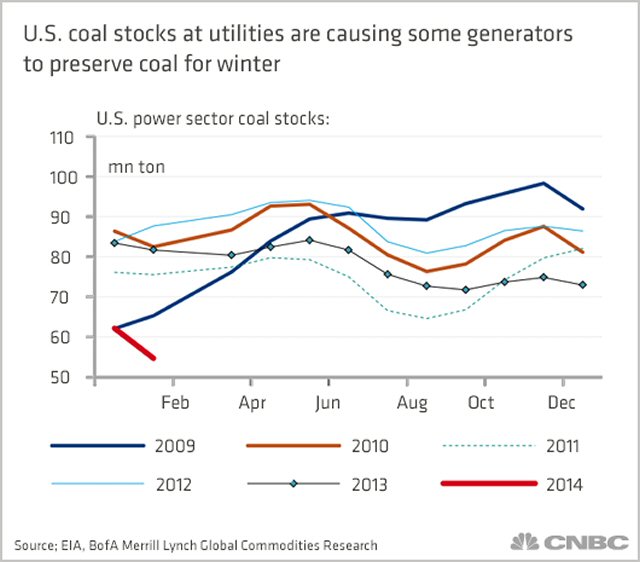
To be sure, regulations such as the Mercury and Air Toxic Standards, plus a shift toward natural gas by utilities, has put the fuel source under pressure. Yet nearly 40 percent of U.S. electricity is currently generated by coal, with both domestic and international use on the rise—fueled in part by a winter surge in natural gas prices. In recent research, Bank of America-Merrill Lynch noted that low U.S. coal supplies coincided with volatility in natural gas, triggered by “demand rationing” in the power sector.

The rise in coal use—especially in Europe, where natural gas prices are far higher than in the U.S.—”is driven by market economics, especially with the rebound in gas prices,” said Bordoff, who noted that it’s cheaper for utilities to scale back on nat gas and use coal. Despite that, the EPA is likely to “change the economics of coal” by stiffening emissions targets for carbon intensive fuel, he added.

If there’s a war on coal, someone may have forgotten to tell the primary target.

As the Environmental Protection Agency prepares to unveil new standards on cutting carbon emissions at U.S. power plants, a confluence of factors underscore how coal still remains a vital source of generating electricity.

To be sure, regulations such as the Mercury and Air Toxic Standards, plus a shift toward natural gas by utilities, has put the fuel source under pressure. Yet nearly 40 percent of U.S. electricity is currently generated by coal, with both domestic and international use on the rise—fueled in part by a winter surge in natural gas prices. In recent research, Bank of America-Merrill Lynch noted that low U.S. coal supplies coincided with volatility in natural gas, triggered by “demand rationing” in the power sector.

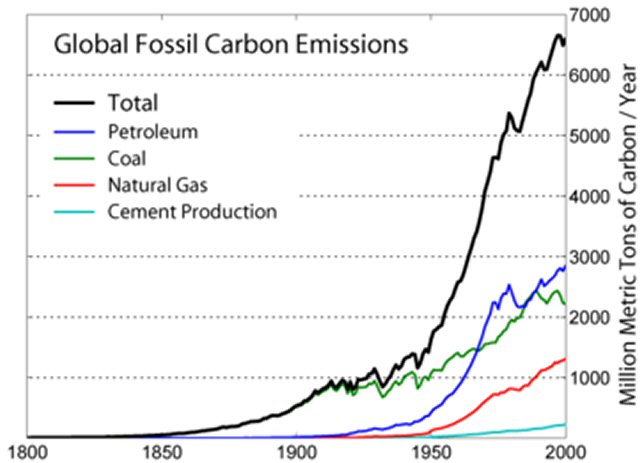
Coal is a leading cause of global carbon emissions. However, in spite of predictions about its demise, demand for the fuel source is expected to rise by more than 4 percent this year, according to the Energy Information Administration.

“It’s not surprising there’s strong demand, because coal is a relatively cheap source of generating electricity when you don’t account for social costs,” said Jason Bordoff, director of Columbia University’s Center on Global Energy Policy.

The rise in coal use—especially in Europe, where natural gas prices are far higher than in the U.S.—”is driven by market economics, especially with the rebound in gas prices,” said Bordoff, who noted that it’s cheaper for utilities to scale back on nat gas and use coal. Despite that, the EPA is likely to “change the economics of coal” by stiffening emissions targets for carbon intensive fuel, he added.

The new rules come as the Obama administration is under scrutiny from conservationists. With a climate change bill stalled by foes in Congress, the carbon reduction initiative looms as a major test of President Obama’s climate bonafides.

The Union of Concerned Scientists cites coal plants as “the nation’s top source of carbon dioxide,” adding that the typical plant generates more than 3.5 million tons of greenhouse gasses per year. But the fuel is economically important for producing states like Kentucky, West Virginia and Ohio, which have fought to preserve its use.

Even before the EPA’s changes are made public, the battle over its substance has already been joined.

In a study, the U.S. Chamber of Commerce said that curbing carbon emissions could cost the economy more than $50 billion a year, and result in the elimination of 224,000 jobs. Yet the Natural Resources Defense Council did a study of its own, saying new EPA rules could actually save the country more than $37 billion on electricity bills in 2020, and create more than 274,000 jobs.

Battle between coal, natural gas

 Battle Between Coal and Gas


The dynamic between natural gas and coal is important as well, because gas is a linchpin of the U.S. government’s efforts to make coal obsolete. The White House hopes to push natural gas usage as a percentage of electricity generation up to 46 percent by 2030, up from its current levels near 30 percent.

Environmental regulations, the availability of coal and the price of natural gas are all determinants that utilities must weigh when deciding how to fire up plants.

“The EPA decision is part of a long-term analysis” made by the power sector, said Sue Kelly, CEO of the American Public Power Association. In an interview, she said utilities would do best “not to put too many eggs in the baskets of either coal or gas,” adding that renewable energy should also be part of power companies’ portfolio.

Coal’s continued popularity in the face of mounting challenges can be attributed to some of the baggage carried by nat gas, often cited as one of the cleanest power sources. Kelly says a dearth of pipelines in the U.S. was a big factor behind the surge that sent gas prices up more than 40 percent over the winter.

“If I were handicapping natural gas vs coal, I would put my money on nat gas in the long run,” she said. However, “with nat gas you are dependent on a pipeline delivery system, and there can be issues there.”

30 Million Americans in Denial

Paul B. Farrell Archives
May 26, 2014
Climate science is a hoax: Big Oil, GOP, God say so
Commentary: 30 million Americans dismiss all warnings of deadly disaster

SAN LUIS OBISPO, Calif. — Yes, climate science is a hoax. Why? No solution. The problem is obvious. But talk’s cheap. No solution? No consensus? No political will? Too much science. No action. Nothing. America’s lost its soul. Lost the can-do spirit that made it a great nation. Inspired me as a U.S. Marine. And the clock keeps ticking ….

Thirty million Americans just don’t trust scientists warning of a “95% certainty” humans cause global warming. But they do trust Big Oil, the GOP, God. They honestly believe climate science is a dangerous fear-mongering liberal conspiracy. Listen, we’ll explain:
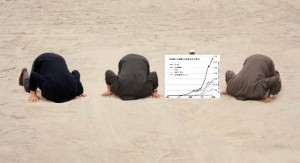
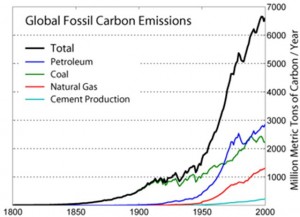
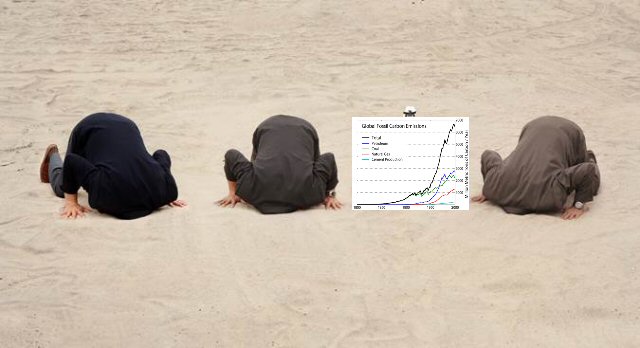
Heads in the SandGlobal Fossil Carbon Emissions

Recently Florida Sen. Marco Rubio joined the deniers: “I think all science deserves skepticism.” And in a recent debate all four candidates in the GOP primary for North Carolina governor denied climate change was man-made, agreeing with the current governor, a former long-term Duke Power executive.

Yes, their party position is clear, mapped out by Oklahoma Sen. James Inhofe in “The Greatest Hoax: How the Global Warming Conspiracy Threatens Your Future.” But in an effort to question Inhofe’s motivation, his ClimateProgress.org reviewer noted that over the years Inhofe has received “$1,352,523 in campaign contributions from the oil and gas industry, including $90,950 from Koch Industries.”

Also challenged, Inhofe’s reliance on divine guidance. Inhofe said “God’s still up there. The arrogance of people to think that we, human beings, would be able to change what He is doing in the climate is to me outrageous.” But before you dismiss Inhofe, or any other science deniers for their strong religious convictions, remember the great Christian King Canute of Denmark who sat on his throne at water’s edge, to prove the futility of commanding the tide to stop.
The clock’s ticking. Who can you trust? Big Oil? Or Lloyds of London?

Environmental economist Bill McKibben wrote in Foreign Policy, it may “already be too late” to stop the impact of our climate change. New evidence keeps piling up … a new Lloyds of London report urging Munich Re and other insurers to factor climate risks in their pricing models … Pentagon generals are warning climate change is now a threat to national security … plus a new report by S&P Rating Services warns of sovereign nation credit rating downgrades spreading globally as the rising costs of climate disasters put pressures on economic growth.

Nobel physicist Robert Laughlin hammered home a similar point in his American Scholar cover story, “The Earth Doesn’t Care If You Drive a Hybrid,” warning that humans are not only causing today’s climate change disasters, but are fueling Earth’s “Sixth Great Species Extinction,” which may result in our civilization disappearing like dinosaurs. Drive a hybrid? Recycle? Eat organic? Solar energy? Band-Aid solutions. Science, technology isn’t the problem.

Inhofe is not alone in believing God’s in charge, humans can’t turn back the tide. The fact is, climate science really is a big “hoax” to millions of Americans. The Stanford Social Innovation Review diagnosed this trend in “Climate Science as a Culture War” a few years ago. Their research is clear: “The public debate around climate science is no longer about science, it’s about values, culture and ideology.” And still we keep trying to convince them with more science. They don’t care.
Multiple personality disorder: We’re fighting a war for America’s soul.

In its research, Stanford Review build on the Yale University’s “Six Americas” opinion research study, updated annually, which concludes that big “majorities believe global warming will harm future generations of people and plant and animal species.” But “four in ten say they feel helpless, disgusted or sad when thinking about global warming.”

Yes, scientists may be certain, but the American soul is deeply divided, at war with itself … psychologists would diagnosis this a multiple personality disorder … trapped in multiple mental conflicts between the “Six Americas” … six separate personalities that don’t get along … wars accelerating with each new climate disaster… while distrust of science gets darker … while the political, ideological, cultural gap between these “Six Americas” widens … while the hoax metastasizes into an even bigger hoax further dividing Americans … the clock keeps ticking.

No solution. Just more research: Endless warnings from scientists at UN-IPCC, US-NCA, insurers, generals, rating agencies. Just louder warnings of a “95% certainty” the danger is bigger. But no solution, no consensus, no political will. Why? The super-rich, powerful, conservative 11% segment of “Six Americas” fights hardest, spends more, is more aggressive, nearly doubling from six percent five years ago. Believe passionately. Yes, 11%; 30 million Americans, science-deniers who are fighting a hoax.

This “Dismissive America” is one of Yale’s “Six Americas:” They are certain “climate change is not happening … does not warrant a national response.” Many are “high-income, well-educated white men … very conservative Republicans … civically active and hold strong religious beliefs … likely to be evangelical Christian … strongly endorse individualistic values and oppose most forms of government intervention.” Who are they? Yale doesn’t name names, but the profile may well fit Inhofe’s political donors.

What’s next if the “Culture War” continues? New surveys show 76% of Americans at least passively agree with Inhofe, say climate change is not a top national priority. And that, unfortunately, suggests predictions made by Australian Public Ethics Professor Clive Hamilton in his “Requiem for a Species: Why We Resist the Truth about Climate Change,” may prove all too accurate: Soon Earth will “enter a chaotic era lasting thousands of years. Whether human beings would still be a force on the planet, or even survive … one thing seems certain: there will be far fewer of us.” Science is no solution to our culture war.
Wrong questions. Yes, it exists. But we’re paralyzed, won’t act in time?

Folks, we’re asking the wrong questions. We have no solutions. No will to act. Yes, Stanford, Yale, McKibben, and millions of others are among the other five “Six Americas” who believe they have a solution. More science. They’re wrong. Just Band-Aids. Silicon Valley capitalists love searching for the next scientific solution, next Big Thing, next profitable IPO.

But nobody has any real solutions to the real problems: A deeply dividing “Culture War,” as climate disasters accelerate … lost in magical thinking … six multiple personalities locked in a costly, deadly battle for the Soul of America … like lost characters in Beckett’s classic, “Waiting for Godot,” endlessly searching for answers in the wrong places, trapped in Sartre’s existential “No Exit” hell.

Yes, so many wealthy and well-intentioned great minds sure keep trying: The UN-IPCC team of 2,000 scientists now on their fifth assessment since 1988, the 500 scientists at the U.S. National Climate Assessment, NASA’s Jim Hansen, Bill McKibben and his 350.org global network of climate activists, arrested at the White House protesting the Keystone XL pipeline, plus the new “Risky Business” team of former New York Mayor Michael Bloomberg, Hank Paulson and tech billionaire Tom Steyner … all perfectly rational Americans … the list goes on.

But they’re asking the wrong questions: Yes, the problem exists, it’s so painfully obvious … But do we need more research? … No, we need consensus, political will, action … We need to stop avoiding the taboo issues … Ask the right questions … How do we get a consensus with “Six Americas” so divided? … Can anyone stop the inevitable? The world’s estimated 50% increase in carbon emissions by 2050? … How in a world of 190 nations with little trust, who don’t like America telling them to cut emissions that will slow their economic growth … And where’s the new technology for all nations, not just Silicon Valley’s next profitable Next Big Thing IPO? … And can we ever stop in time?

Time to refocus America, unite all “Six Americas.” Face the real problems. Admit throwing more science at science-deniers isn’t working. Admit climate science really is a hoax to millions of politicians, energy billionaires, evangelicals.

The “Dismissive” just aren’t buying the science. In fact, more science, more technology just toughens, intensifies, accelerates the resolve and resistance of America’s 30 million “Dismissives.” Makes them stronger. Widens the cultural gap. Time to refocus, downplay science. Clock’s ticking. Emissions won’t stop.

America needs a new consensus, new political will. Or we may indeed follow the dinosaurs into extinction. Remember Ben Franklin’s warning at the signing of the Declaration of Independence on July 4, 1776: “We must, indeed, all hang together, or assuredly we shall all hang separately.”

Paul B. Farrell is a columnist based in San Luis Obispo, Calif. Follow him on Twitter @MKTWFarrell
Climate Change Evidence & Causes

February 26, 2014

The U.S. National Academy of Sciences and its British counterpart, the Royal Society, issued a report (.pdf link, may take a few seconds to load) addressing twenty issues in question/answer format, among them the recent slowing in the increase of world temperatures, the connection between greenhouse gases and extreme weather, melting glaciers, the acidity of the oceans, and rising seas. The report warns of dire consequences, including an impending threat to food production, freshwater supplies, coastal infrastructure, and the lives of millions of people currently living in low-lying areas.

While comprehensive, blunt and realistic, the report stops short of recommending a specific blueprint mankind can agree on to simultaneously stop burning fossil fuels to generate electricity.

Our proposed solution does that and more. It is designed to manufacture drought-proof water anywhere, even in inland deserts, generate a surplus of green energy as part of the process, and create millions of non-temporary, well-paid middle class jobs that cannot be outsourced or relocated.

The report concludes that ordinary citizens and governments will have to choose from an unpleasant palette of alternatives to counteract this developing calamity, among them “unproven geoengineering solutions.” That is of course correct, not because any or all of these choices are necessarily unsound but because humans have never been in a  predicament -man-made or natural- of this magnitude and scope. The same line of reasoning could have been used when the beautiful English countryside was first darkened by ugly soot at the dawn of the Industrial Revolution, itself uncharted territory at the time. Instead, everyone welcomed the wealth and power it created, and now its time to face the music.

It is our ability to reason that sets us apart from other animals; therefore every new invention or course of action we take may have unforeseen consequences -favorable or detrimental- far into the future. Clearly there’s no turning back. Whatever we do or don’t do as a species in the context of climate change will determine whether we tame this problem or become extinct as our other Homo cousins did.

To paraphrase president Johnson: we can and should do our best; that is all we can do.

Poverty and Wealth

“The first man who, having fenced in a piece of land, said “This is mine,” and found people naïve enough to believe him, that man was the true founder of civil society. From how many crimes, wars, and murders, from how many horrors and misfortunes might not any one have saved mankind, by pulling up the stakes, or filling up the ditch, and crying to his fellows: Beware of listening to this impostor; you are undone if you once forget that the fruits of the earth belong to us all, and the earth itself to nobody.”

—    Jean-Jacques Rousseau, Discourse on Inequality, 1754

Background

Noah Cursin Canaan

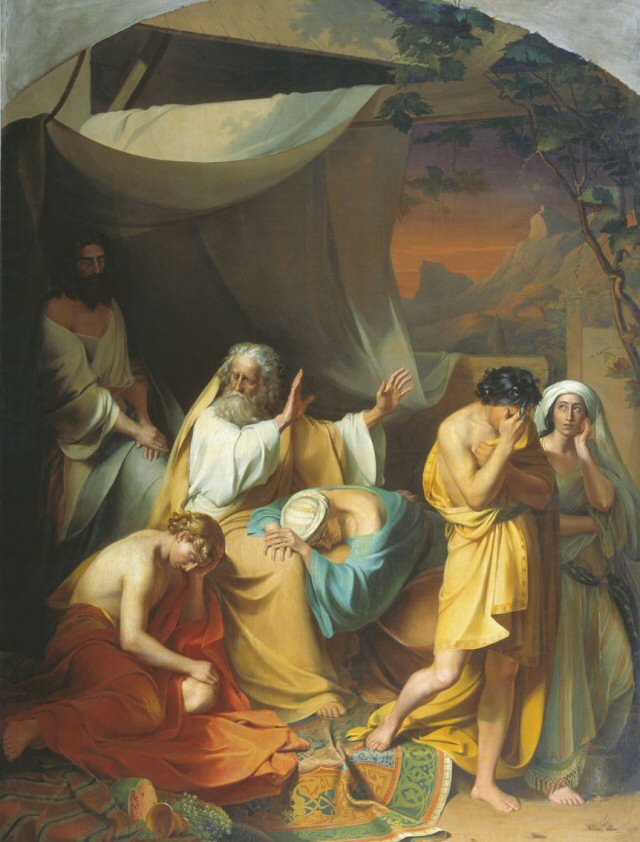
The Bible recounts how, after the Great Flood, Noah reintroduced slavery –the ultimate degree of poverty- with his son, no less.  It also states that the source of poverty is God, not man. Thus, being of divine origin, poverty is necessarily ancient, widespread and pervasive. However, in deference to free will, rulers and judges have the authority –and bear the responsibility- for protecting the meek and the powerless. It is up to them to codify the rights of the poor and define the boundaries and degrees of poverty.  But the degree to which it afflicts a society is determined by the ideology and policies of its rulers. Measured by that yardstick, all societies without exception have failed miserably, for even in peacetime deaths directly attributable to poverty dwarf all other catastrophes and wars combined. For millions in that predicament, death is literally a step up, a ticket to paradise. And always, poverty is a menace to peace.

The Poverty Line

In 1969 the U.S. government adopted the “poverty line” as the official poverty determinant. Mollie Orshansky, an economist at the Social Security Administration, developed tiers for different sizes of families based on an economy food plan developed by the Department of Agriculture for low-income families. Using 1963 as the base year, she concluded that a family of two adults and two children spent about $1,033 for food. On the basis the 1955 USDA survey, Orshansky determined that “typical” families spent one-third of their after-tax income on food. She then multiplied that figure by 3 to arrive at $3,100 as the minimum yearly income that family needed to survive, which became the poverty line for a family of 4. Any family with an income of less than that was poor.

The line is readjusted annually to factor inflation. For 2014 it is $11,670 for one person; for four it is $23,850. There are of course many things wrong with this arbitrary concept. For example, a man making say, $11,900, is he not poor? If he is, at what point in the income ladder does he cease to be? And if he is poor even though his income exceeds the poverty line’s maximum, by what rationale should he be excluded from the safety net?

Poverty is in fact not rigid, with some in one zone and the rest in another. It is a condition of gradual, imperceptible change, like the colors of a rainbow, and it should be measured accordingly. A fixed line is used because it is convenient for decision makers for administrative and political reasons, not because it truthfully measures the quality of life people can afford to have. Quality of life, after all, is what counts. A more realistic definition of poverty might be to include in it all debtors who do not have enough liquid assets to retire their debt. Within that group, the debt they owe relative to their income and number of dependents would define the rung of poverty they belong to. Of course, that would be bad news for our elected representatives, for well over 70% of us are net debtors.

The System

In modern capitalism the distribution of wealth, income and earnings is of no consequence. There is no concept of fairness other than that those who produce are compensated by the market, and those who do not are not because they have not earned the right. The reasons for lack of productivity are irrelevant, and it lacks a built-in mechanism to analyze or even consider any related social and/or political consequences.  This dark characteristic conveniently rejects by omission the postulate that life’s basic needs are a human right regardless of occupation, ability or desire to pursue the accumulation of unlimited wealth as life’s goal. Instead, it rewards those who do have that ability or inclination with disproportionate power to chart a society’s course by denying the same opportunity to all others.

Beverly Hills Street
South Central Blue Street


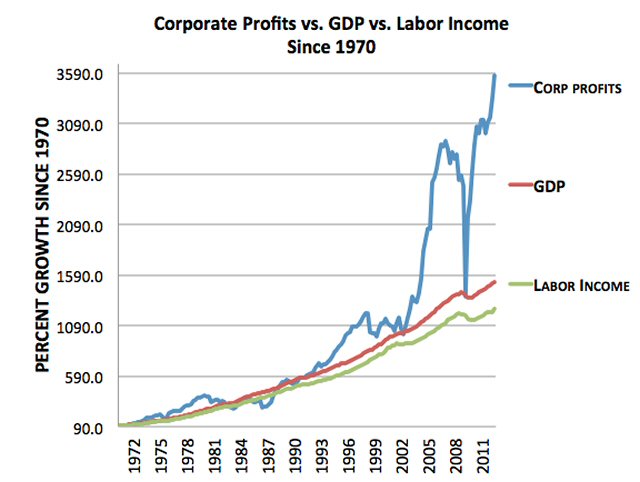
Today the gap in the distribution of income and wealth in the United States has reverted to what it was just before the Great Depression.


Beachfront Home
Dilapidated House

Data from the United States Federal Reserve Survey of Consumer Finances show that the top 1 percent of households has more wealth than the entire bottom 95 percent.  They have nearly half of all financial wealth (net worth minus net equity in owner-occupied housing). The top 1/2 percent of households has 42 percent of the financial wealth.  The higher one goes up the income scale, the greater the rate of capital accumulation.  Not only has the top 20 percent grown more affluent compared with everyone below, the top 5 percent has grown richer compared with the next 15 percent. The top one percent has become richer compared with the next 4 percent. And the top 0.25 percent has grown richer than the next 0.75 percent. That top 0.25 owns more wealth than the other 99 percent combined.

Beverly Hills Residential Street
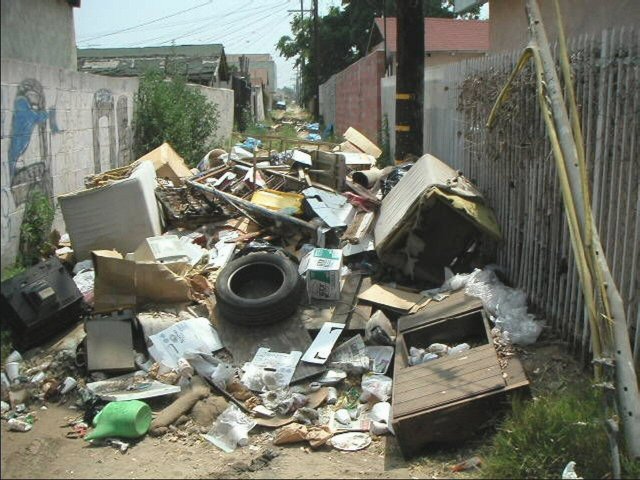
Garbage Alley

This is unacceptable, and not just on moral grounds. In the past, a theoretically egalitarian democracy has been coupled with a functionally non-egalitarian capitalism on the assumption that government would do three things.

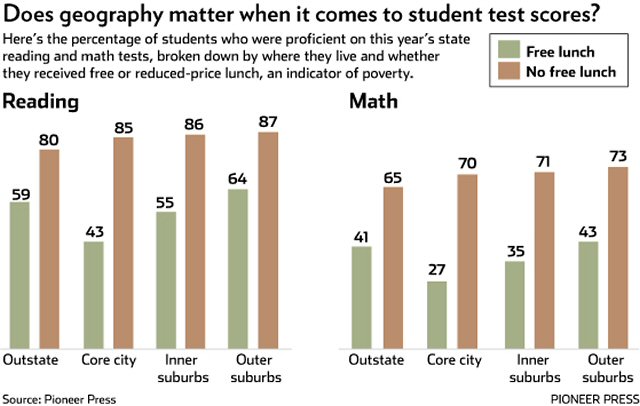
Inner vs Suburb Schools

Firstly, a guarantee that first-class education and skills would be available to children of parents who did not have first-class income and wealth; the next generation would be better skilled and able to earn more than the previous. Secondly, government would insure that those who cannot compete for whatever reason do not perish economically. Thirdly, it would use the tax system to make after-tax distributions of income and wealth more equal than before-tax distributions of income and wealth. But the system is contradictory and has failed with respect to purpose and result. How does one put together a democracy based on the concept of equality while running an economy with ever greater degrees of economic inequality? At some point, those who are losing economically must use their potential to usher in a government that reverses the trend.  Perhaps a society could move much farther along the path of inequality, perhaps not.  No one knows where the breaking point is or the consequences that would follow if it is reached.

Ethnic/Racial Facts

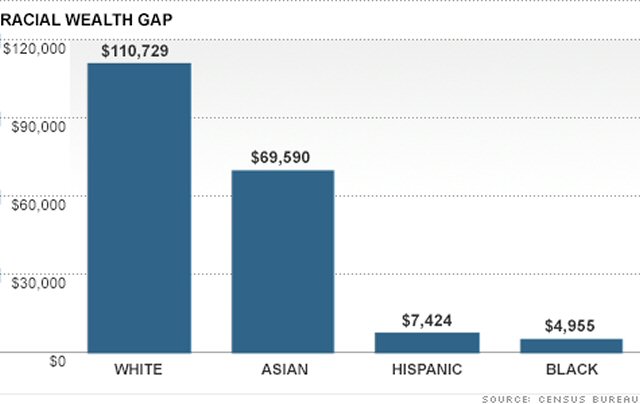
The wealth gap between white families, and blacks and Hispanics, is enormous and increasing.

Racial Wealth Gap

Although the income gap between blacks and whites is getting smaller, there is a dime of wealth in the average black household for every dollar of wealth in every white household. Special observations  about Hispanics are in order. They can be of any race; that tends to distort totals that, for reasons of convenience, government and private statisticians have traditionally merged. It is far easier for non-Hispanics to lump all “Latinos” together on the basis of region of origin or language rather than on the basis of the ethnicity of each individual. But according to a study by the Pew Hispanic Center, Latinos who call themselves white and those who say they are “some other race” have distinctly different characteristics. Among those identified as ethnically Hispanic on the 2000 census, 48 percent were counted as white, two percent black and a small fraction American Indian, Asian and Pacific Islander.  Only 6 percent described themselves as being of two or more races.  The rest marked “some other race.” Hispanics who identified themselves as white have higher levels of education and income and greater degrees of civic enfranchisement than those who picked the “some other race” category.  More foreign-born Latinos and fewer U.S. citizens say they are of “some other race.” This pattern reflects traditional conditions in their native countries, where the descendants of Europeans, although fewer in number, own a far greater share of wealth and enjoy greater social and business recognition and acceptability than persons of Amerindian, black, Asian, or mixed ancestry. This is true even in countries where Amerindians or mixed blood are the majority.

A Clear and Present Danger

Just hours after Yale professor Robert Shiller had won the Nobel prize for economics he said: “The most important problem that we are facing today…is rising inequality in the United States and elsewhere in the world.” Indeed, of all the advanced economies, the U.S. is the most unequal, and where it is growing at the fastest rate. The annual income of the typical American household has fallen 9% since 1999, according to a recent report from the Census Bureau. Much of the decline was due to the Great Recession; since the recession ended in 2009 incomes for all Americans except the top 1% have hardly changed. Incomes grew by only 4% for the bottom 99% but surged by more than 31% for the top 1%. And last year the top 1% accounted for 22% of the nation’s income; the top 0.1% took home half of that.

700 Appraisers’ Decisions

You Only have to Make 700 +/- Decisions in the Next Six Hours

by Diana Jacobs

It’s a curious time in which the appraiser finds themselves practicing.

There is greater oversight with demands for shorter turnaround time. There are appraisal management companies (AMCs) that shop the appraiser’s turnaround time and price.

There are software companies that download data the appraiser enters with graphs, market conditions analysis, regression analysis and a wide variety of maps and pictures, which makes it appear as though the appraiser has chartered a plane, shot an aerial view, contacted governmental agencies and obtained tax information, flood information, environmental information, a soils survey, zoning and of course, provided a complete breakdown of the current Multiple Listing Data.

All of this information is at the very finger tips appraisers, who are being encouraged to consider, in the future, having someone else do their inspection while they work with the data from their desktop.  The trend among users and providers is to have the appraiser focus on their “critical thinking” time.  So just how much time is involved in an appraisal and how many decisions does an appraiser have to make?

Using the form 1004 residential form (most widely used form for a large majority of lending practice) the appraiser has numerous decisions to make in roughly six to eight hours.

It breaks down like this:

Page 1              206 decisions (134 without the condition and individual blocks of choice)
Page 2              205 decisions (potential blanks to be completed)
Page 3                41 decisions (narrative blanks for the possible additional comments)
1004MC              71 decisions/blanks to complete
Total                 523 possible decisions (451 without condition of materials and blocks of choice)

All of these decisions are without directions on what the appraiser must do when inspecting the neighborhood and the subject and the comparative transactions or the Limiting Conditions or the 25 Ethical Obligations of the Signed Certification Page, which at a minimum, has to have an additional item #26 for the history of service disclosure.

Keep in mind, you have to plan your inspection and never leave a neighborhood the same way you came in.  Why?  Because you stated you inspected the neighborhood: how did you do that if you didn’t drive all of the streets or charter a plane to fly over to ensure everything is the same or similar in terms of maintenance, condition, and general conditions that create and affect the value?

What’s the running total? 523 Decisions on the form. Twenty-six (26)  Ethical Obligations to promise and be held legally accountable for by up to 30 years in prison and a fine of up to $1 million, according to Title 18 U.S. Code Section 1001 or similar state laws.

Whew! Now it’s time, of course, to consider the remaining decisions;

•         3 Directives of USPAP SR 2-1
•         12 Directives of the Written Report in SR 2-2 (a) of the 2014-2015 USPAP Appraisal Report
•         10 Directives of SR 2-3 but we aren’t going to count those 10 as they are part of the 26 on the Supplemented Form.

There are four USPAP Rules and each has very specific decisions and directives which appraisers are required to prove they have taken into consideration and/or performed.  The Ethics Rule has three subsections; the Record Keeping Rule includes nine items of musts. The Competency Rule has three directives on being competent; three directives on acquiring competency and three directives on what to do if you discover you’re not competent.  The Scope of Work and Jurisdictional Exception rules both have multiple directives of exhortations and prohibitions (do’s and must not do’s).

We’re not through yet.  Mortgage lending comes with a host of additional decisions which result in approximately 130 pages of assignment conditions of which about 40 pages relate to the residential appraisal report form and each page adds its own specific directive on the additional requirement of performing and reporting an appraisal in the secondary market.  There are easily 100-200 additional considerations that must be made under those assignment conditions.

Oh, lest we forget, 67 of those fields of the 1004 form must be UAD compliant.

784 Decisions to Make, 784 Decisions
My count, and it doesn’t break down the multiple directives of the assignment conditions or specifics of the Statements of USPAP or the Scope of Work Rule, etc., is 784 decisions for the appraiser in every residential assignment.

Don’t get me wrong, I’m all for maintaining quality management and quality control over this most serious issue of performing an appraisal assignment. When an appraiser makes a mistake they should be grateful for the opportunity to correct the error.  In the event the error was discovered after the fact, the appraiser needs to accept accountability.

Often the appraiser, in an effort to get the job done in time, will fail to keep the appropriate documentation in their workfile.  It’s not always about the intentional act of trying to withhold or mislead.  It’s simply a time issue for the appraiser.  In the appraiser’s mind if it’s available through Internet research why does it have to be printed out when it can be retrieved if needed?  Of course, that has proven to be the Achilles Heel of many state-disciplined appraisers as the workfile is the evidence needed to prove compliance with all of the regulations in those many decisions that have to be made during an assignment.

Now, may I ask you this question?  Is the appraiser really getting the respect, support and monetary remuneration for the service they provide?  Isn’t it time for the users of the appraisal services to recognize the work that goes into the appraisal product?  Shouldn’t the users of appraisal services and the regulators of appraisers recognize the obvious potential for errors when so many decisions have to be made in such a short amount of time?  Isn’t that what our forefathers thought when they stated in the development rule of SR 1-1 (c) “Perfection is impossible to attain, and competence does not require perfection”?

About the Author
Diana Jacob currently lives outside Hillsboro, Texas on a small ranch and has been involved in real property appraisal since the latter part of the 1980s.  She holds the Certified General Certification from the states of North Carolina, Georgia and Texas and a Residential Certification from the state of Louisiana.  She is a certified USPAP instructor and represents the Texas Association of Appraisers at The Appraisal Foundation Advisory Council (TAFAC).

Article originally in workingre.com, reprinted by permission.

Looser Underwriting Standards

News reports indicate that major banks in the U.S., including J.P. Morgan Chase and Wells Fargo, have begun lowering their underwriting standards for one-to-four family homes. The reason: continued decline in new mortgages in January, a Mortgage Bankers Association projection that total originations will decline to $1.116 trillion from approximately $1.755 trillion during 2013, and a preliminary estimate from Inside Mortgage Finance showing that single-family-mortgage-backed securities by Fannie Mae, Freddie Mac and Ginnie Mae were 10% down from December 2013, the lowest since January 2009.

This is an ominous indicator that needed to be nipped in the bud. Here’s why. Moderate, stable demand from “able” first-time buyers is the lifeblood or real estate, particularly when refinancing activity is practically non-existent. When demand declines, sellers are forced to either drop their asking prices or pull their properties off the market until it picks up again. But for everyone except the top 1%, current incomes do not support higher prices. Furthermore, going forward there is no reason to believe this situation will improve since most jobs being created are in the service sector and pay way below what’s required to buy a home at today’s prices. Banks lend because, with few exceptions, they have historically made money when they have done so. Simply stated, if they don’t lend, their profits drop, and if that happens their shareholders are unhappy, especially when their stock begins to decline. And then there’s the awful possibility that if the demand is allowed to continue to decline unabated it may result in another wave of foreclosures, one which, given the government’s many commitments and accumulated debt, would test its ability to neutralize.

Until recently, banks had focused on lending to low-risk wealthy individuals. But they account for only a small percentage of the population, and confining lending activity to that group necessarily results in a correspondingly low volume of originations. Since banks nominally compete with each other for market share, the only way for them to grow beyond that safe sector is to dramatically expand their activity to the less affluent.

Enter Wells Fargo, the largest originator. It is now originating FHA-insured loans to non-super prime borrowers, another way of saying not-so-affluent. These loans are attractive to the extent that most of the risk of default is transferred to the government and the banks can easily sell them in the secondary market, collect substantial fees, and quickly recover their capital to do the same all over again.

In the end, whatever compensatory action the Federal Reserve and its member banks take, whether to keep interest rates low indefinitely or lower originating standards, will prove insufficient unless the economic fundamental that caused the need for this action improves: the steep decline in the purchasing power of the middle class, formerly the largest demographic group. It is irrational to expect these good people to pay high prices for homes without the required supporting income and job security for a 30-year (or longer) commitment. In other words, going forward the only true fix is to create an entirely new mechanism for a far more equitable distribution of future income and wealth. We can have either low wages or high real estate prices, but we can’t have both.

Scientists’ Warnings 12/04/2013

On December 3, 2013, a group of world renowned scientists in a wide array of disciplines issued a comprehensive report detailing the frightening consequences that will follow if global warming is not halted and reversed.  Meeting in Columbia University’s Low Library, they discussed their study and their –so far- unsuccessful effort to create a universally acceptable global plan to reduce emissions of carbon dioxide and other greenhouse gases. They also pointed out that the internationally agreed upon target to limit global warming to 2 degrees Celsius is in fact a “prescription for long-term disaster.”

The study makes it crystal clear what the costs of the current trajectory are, and that to combat the trend, a level of global cooperation entirely different from our current approach will be required.

Advanced Hydrogen Turbine

Background

Siemens Energy, along with numerous partners, has an ongoing U.S. Department of Energy (DOE) program to develop hydrogen turbines for coal-based integrated gasification combined cycle (IGCC) power generation that will improve efficiency, reduce emissions, lower costs, and allow for carbon capture and storage (CCS). Siemens Energy is expanding this program for industrial applications such as cement, chemical, steel, and aluminum plants, refineries, manufacturing facilities, etc., under the American Recovery and Reinvestment Act (ARRA). ARRA funding will be utilized to facilitate a set of gas turbine technology advancements that will improve the efficiency, emissions, and cost performance of turbines for industrial CCS. ARRA industrial technology acceleration, application, and adaptation will also benefit advanced hydrogen turbine development and existing machines in typical utility applications.

This project is managed by the DOE’s National Energy Technology Laboratory (NETL). NETL is researching advanced turbine technology with the goal of producing reliable, affordable, and environmentally friendly electric power in response to the nation’s increasing energy challenges. With the Hydrogen Turbine Program, NETL is leading the research, development, and demonstration of these technologies to achieve power production from high hydrogen content fuels derived from coal that is clean, efficient, and cost-effective, minimizes carbon dioxide (CO2) emissions, and will help maintain the nation’s leadership in the export of gas turbine equipment.

Project Description

Siemens Turbine
Click to enlarge

Under the ARRA funded program, Siemens Energy will focus on advancing state-of-the art large natural gas fired turbine technology to produce turbines specifically designed for operation on hydrogen and syngas fuels derived from industrial processes that capture a large percentage of CO2. Advanced technologies and concepts will be evaluated, down selected, and validated. The advanced technologies, component designs, and manufacturing processes will be developed and verified in sub-scale and full-scale tests and process verifications to demonstrate that the program goals can be achieved. Some of the key enabling technologies needed are as follows:

• Fuel-flexible, ultra low NOX, long-life combustion system operating at the increased firing temperatures needed to achieve high efficiency. Siemens will work to develop a premixed combustion system capable of operating on hydrogen fuel at high temperatures with minimal dilution flow. As part of this development, modeling tools for thermal acoustics and computational fluid dynamics will be adapted for hydrogen fuels and validated with test data. The primary path for the hydrogen combustor is a modification of the current Siemens premixed natural gas burner to operate on hydrogen. In addition, as risk mitigation, several alternative combustion technologies will be evaluated to determine if they can provide an improvement for high-temperature hydrogen operation.

• Development and optimization of higher temperature material system (base alloy, bond coat, and thermal barrier coatings [TBCs]) capabilities that allow operation in challenging environments, thus ensuring that the turbine components achieve high reliability and long life.

• Advanced manufacturing processes and techniques essential to producing the novel turbine cooling schemes that are being pursued in this program. Siemens will be producing full-sized engine parts using advanced core making technology, performing investment casting trials, conducting destructive and non-destructive evaluations, machining prototype parts using a proposed production process and conducting full-scale engine testing on final products.

• New sensors and diagnostics to allow more efficient, fuel-flexible, and safe gas turbine operation. Customer interviews determined key sensing needs and sensor specifications for these needs. Based on these results, Siemens will work with sensor vendors to design, develop, and validate sensor designs for engine validation or use in on-line control.

Goals/Objectives

The objective of the ARRA activity is to identify a set of gas turbine technology advancements that will improve the efficiency, emissions, and cost performance of gas turbines for industrial applications with CCS. This extension will accelerate the key technologies needed to significantly improve the efficiency of gas turbines in industrial applications, apply these technologies to the advanced hydrogen turbine, and adapt to existing turbine frames as applicable.

Government funding for this project is provided in whole or in part through the American Recovery and Reinvestment Act.

AWARD NUMBER: DE-FC26-05NT42644

WordPress theme: Kippis 1.15
Translate »